Quick Take
- Narration: Ralph Cosham’s reading is elegant and unhurried, with a quality of learned pleasure that suits Irving’s nineteenth-century prose; the Spanish guitar accompaniment throughout is an inspired production choice.
- Themes: Memory and place, Moorish civilization as a lost world, the romance of ruin
- Mood: Dreamlike and nostalgic, with moments of genuine enchantment
- Verdict: One of the most atmospheric travel writing audiobooks available, enhanced by Cosham’s performance and the musical accompaniment; indispensable for anyone visiting Granada.
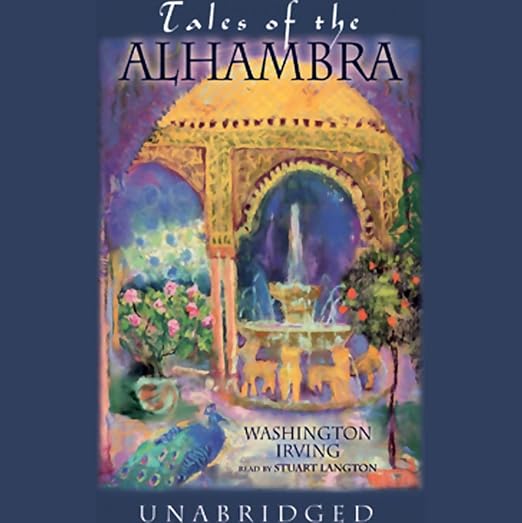
I have a habit, when I know I’m going somewhere meaningful, of finding the book that was written from inside that place. Not guidebooks in the conventional sense but books that carry the sensory memory of a specific location the way great travel writing does: you read them and the place becomes available to you in a different register. I would have given almost anything to have listened to Tales of the Alhambra before visiting Granada for the first time. I came to it afterward instead, in my apartment on a winter Sunday, and found that even in retrospect it was doing the work it promises: restoring the palace in a form that physical memory alone cannot sustain.
Washington Irving arrived at the Alhambra in 1829 and, in an arrangement that would be inconceivable today, was given permission to live within its walls. The sketches and stories he wrote during that residency, collected and published in 1831, became not only a literary success but something stranger and more durable: an act of imaginative reconstruction that helped rescue a neglected monument from further decay. The romantic attention of an American writer living among the palace’s ruins contributed to the eventual recognition of what had been left to crumble. Tales of the Alhambra is one of those rare books that literally changed what it described.
The Spanish Guitar and What It Does to Irving’s Prose
The production choice that distinguishes this audiobook immediately is the Spanish guitar accompaniment woven throughout Ralph Cosham’s reading. This could easily be gimmicky, and in lesser hands it would be. Instead, the music functions the way it does in the best film scores: it amplifies without competing, setting the sensory context that Irving’s prose is already reaching for. The Alhambra is a building saturated with acoustic history, built by a civilization that understood music as architecture, and hearing it described to actual guitar adds something that silent reading cannot provide.
Cosham’s narration is ideal for Irving’s nineteenth-century register. He reads with what I can only describe as informed leisure, the pace of someone who understands that this prose was designed for a reader with time. Irving’s sentences are long and carefully balanced, his descriptions precise and his digressions deliberate, and Cosham honors the rhythm without slowing to the point of stiffness. One reviewer described the prose as reminding them of Salman Rushdie in places, which is a generous comparison but not entirely off: both writers share an interest in the mythological as a layer of lived reality.
History, Legend, and the Space Between Them
One of the pleasures of Tales of the Alhambra that the synopsis captures well is its unapologetic mixing of modes. Irving moves between historical fact, medieval legend, his own observations about the palace’s current condition in 1829, and stories told to him by local inhabitants without clearly marking where one category ends and another begins. This is either a feature or a problem depending on what you want from the book. As a historical record, it’s frustrating. As an evocation of how a place carries its own mythology, it’s precisely right.
The stories themselves, imprisoned princesses, palace ghosts, buried treasure, encounters with the last Moorish inhabitants of a conquered city, are written with the narrative energy of someone who understood that the legend was more generative than the fact. Irving is an enthusiastic narrator in the best sense: he found this place enchanting and he wants you to find it enchanting. Whether one finds his occasional condescension toward the Spanish peasants he encounters uncomfortable or simply of-its-time is a judgment individual listeners will make; one reviewer called him “occasionally bigoted” and also “remarkably complementary of the Moors,” which captures the nineteenth-century American liberal position with some precision.
The Ideal Companion for Andalucia
The most consistent note in reviews is that this audiobook transforms the experience of visiting the Alhambra. One reviewer read the physical book while standing in the palace and described it as a “wonderful complement.” Several others listened before or after their visits and described the stories giving depth to visual memory that guidebooks alone couldn’t provide. One reviewer wished they had listened to it before their visit rather than after, which I share, having made the same sequencing error.
At eight and a half hours, this is an ideal length for the material: complete without exhausting. The Spanish guitar accompaniment sustains the atmospheric register across the full runtime, and Cosham’s pacing ensures that Irving’s more languorous descriptive passages don’t test patience. The uneven quality of the collection itself, which one reviewer described as “marvelous if uneven,” is genuine: some tales are more fully realized than others, and the sketch form means the book has variable momentum. But the best sections, Irving’s description of the palace at dawn, the story of the three beautiful daughters of the Moorish king, the account of the court of the lions in its ruined state, are among the finest travel writing I’ve encountered in audio form.
Who Gets the Most from This Audiobook
If you are planning a visit to Granada and the Alhambra, this is the single most useful audiobook you can listen to before you go. Not because it will give you the history in any reliable sense, but because it will give you the emotional grammar of the place: the specific quality of melancholy and beauty that a civilization’s end leaves in architecture.
Listeners who come primarily for historical accuracy will be better served by a scholarly history of Moorish Spain. Irving is not that. He is a romantic writer who happened to live in one of the world’s great monuments and wrote from inside its atmosphere. If that is what you want, this eight-and-a-half-hour audiobook with Spanish guitar woven through Ralph Cosham’s unhurried reading is something close to a perfect artifact.
Frequently Asked Questions
Is the Spanish guitar accompaniment throughout the audiobook distracting, or does it enhance the listening experience?
For the overwhelming majority of listeners, it enhances rather than distracts. The production uses the music as atmospheric context rather than constant interruption; it threads through the narration in a way that recalls the musical tradition of the civilization Irving is describing. Listeners who find any musical accompaniment in audiobooks intrusive should know it is present throughout.
Is this a reliable historical source about the Alhambra and Moorish Spain, or more of a literary impression?
Primarily a literary impression, and Irving himself is honest about this in the text. He mixes observed detail with legend, personal anecdote, and stories told to him by locals without clearly distinguishing factual from invented. As an evocation of how the place felt to a sensitive observer in 1829, it’s irreplaceable. As historical documentation, it requires a skeptical eye.
Should I listen to this before or after visiting the Alhambra?
Either works, and multiple reviewers attest to both. Before a visit, it provides the emotional and mythological context that transforms a building into a world. After a visit, it restores and deepens sensory memories that photographs alone cannot sustain. The reviewer who read it standing inside the palace suggests an even more integrated approach if you’re willing to listen while exploring.
Ralph Cosham recorded this in 2004. Does the narration feel dated in any way?
Not at all. The production, Cosham’s narration plus the Spanish guitar accompaniment, suits a text written in 1831 and benefits from a reading style that is unhurried and classical rather than contemporary. If anything, a more modern narration style would feel incongruous with Irving’s register. Cosham’s approach is one of the most appropriate narrator-to-text matches in the travel writing audiobook catalog.