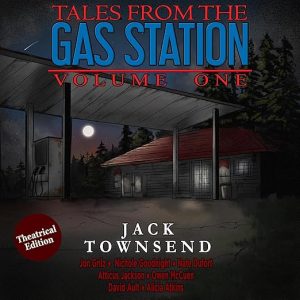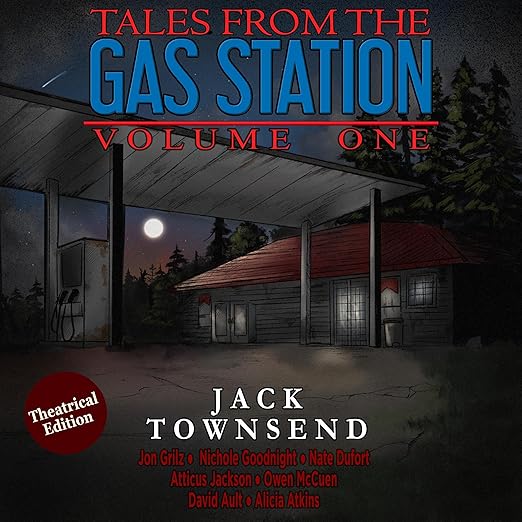
Jack, the night-shift clerk at a 24-hour gas station at the edge of town, has a problem. Actually, he has several. The audiobook of Jack Townsend's Tales from the Gas Station: Volume One, narrated by Jon Grilz, opens with the particular comedic register of a person who has accepted that his job will involve drunk customers and shoplifting raccoons, and who has not yet fully accepted that it will also involve body-in-the-trunk revelations, monster hunters, and garden gnomes with apparent supernatural agency. The joke is that Jack keeps trying to apply the same level of exhausted pragmatism to the second list that he applies to the first.
This audiobook runs nearly nine hours, which is about right for the kind of accumulating weirdness Townsend is constructing. The gas station isn't just a setting; it's a nexus point, the kind of place where the ordinary world and whatever lies beneath it are in constant low-grade contact. The opening chapters establish the routine before they start dismantling it, and that patience pays off. By the time the body appears in the trunk and the chain of supernatural events begins, the listener has enough grounding in Jack's personality and his relationship to the station that the escalating absurdity lands rather than just accumulates.
The book's main structural achievement is sustaining the comedic register while the stakes genuinely increase. Most horror-comedy either lets the horror collapse under the weight of the jokes or lets the jokes go flat once the horror becomes real. Townsend manages the balance through Jack's narration, which remains dry and slightly dissociated regardless of what's happening around him. He's not an idiot who doesn't understand the danger; he understands it perfectly and just doesn't have the resources to do anything about it except keep showing up for his shift. That characterization creates a tension between the register of the voice and the reality of the situation that carries the book through its more uneven passages.
Jon Grilz is a crucial part of why this works in audio. His interpretation of Jack is relentlessly flat in the best possible way. When something genuinely horrifying happens, Grilz doesn't modulate upward into alarm; he reads the narration at exactly the same pace and pitch as the raccoon shoplifting incident, and that tonal consistency is funnier than any amount of comic emphasis would be. The doomsday cultists, the monster hunters, the sociopathic characters whose agendas remain opaque, all of them pass through Jack's narration and come out slightly reduced by contact with his resigned acceptance of the universe's fundamental strangeness.
Why It Works in Audio
The horror elements are real enough to satisfy readers who come from that genre. Townsend isn't just using supernatural trappings for jokes; the dark, ancient force infecting the dreams of people around the gas station has a genuinely unsettling quality, and the moments where the comedy steps aside to let the dread in are handled with enough skill that the tonal shift doesn't feel like a mistake. The apocalyptic potential of the main conspiracy is taken seriously even as Jack's response to it remains fundamentally comedic.
The audiobook format suits this material particularly well because so much of what makes it funny is timing. Grilz understands that Townsend's comedy operates through accumulation and then release, through the buildup of completely deadpan setup followed by a single sentence that reframes everything that came before. That rhythm is easier to feel in audio than on the page, where the reader sets the pace. Listeners who have encountered the popular online version of this story will find the audio production a satisfying way to experience the material; those coming to it fresh will find it a complete experience without needing any prior context.
Before You Commit to Tales from the Gas Station: Volume One
One reviewer described the ending as falling apart somewhat, and that's a fair if slightly harsh assessment. The book is better at building its conspiracy than it is at resolving it, and the final chapters move faster than the careful setup in the middle might lead a listener to expect. This is partly a structural choice, the story is designed to continue across additional volumes, and partly a function of the genre Townsend is working in, where cosmic horror doesn't resolve cleanly almost by definition. If you need a narrative that ties its threads together into a satisfying knot, the first volume will leave you with loose ends. If you're comfortable with a conclusion that feels more like a pause than a resolution, it works.
The book also has moments of intense tonal dissonance that some listeners will find bracing and others will find uncomfortable. The genre-mixing is deliberate, but Townsend occasionally pushes the comedy into territory that feels slightly off, a few scenes that strain the deadpan frame rather than inhabiting it. These are isolated and don't undermine the book as a whole, but they're worth noting for listeners who need their horror-comedy tonal consistency to be airtight.
Who Will Get the Most From It
Listeners who enjoy their horror served with a side of dry comic resignation will find the audiobook one of the better entries in that specific mode. The Night Vale comparison is obvious but apt in its register if not its form; this is first-person cosmic horror from the perspective of someone who just wants to get through the shift. Jon Grilz's narration is the main reason to choose the audio version over print, and it's a compelling reason. Skip it if you need your narrative arcs to close cleanly within a single installment, or if tonal instability in horror-comedy reads to you as a craft failure rather than a feature. Come back for the sequels if the first volume hooks you, because the online community for this series is enthusiastic and the story does continue.
Common Questions
How does Jon Grilz's narration style suit the horror-comedy tone of this audiobook?
Grilz's flat, understated delivery is central to the book's comedy. He reads genuinely alarming events with the same mild bewilderment as the mundane ones, which is precisely what Townsend's narrator-protagonist requires. Listeners who prefer more emotionally varied narration may find his approach monotonous; those who appreciate deadpan comedy will consider it a strength.
Does the audiobook work as a standalone, or does it end on a cliffhanger requiring the sequel?
The first volume tells a complete story but leaves threads open for continuation. It functions as a standalone in the sense that the immediate crisis is addressed, but the larger conspiracy involving the gas station's nature is not fully resolved. Think of it as the first season of a story rather than a closed narrative.