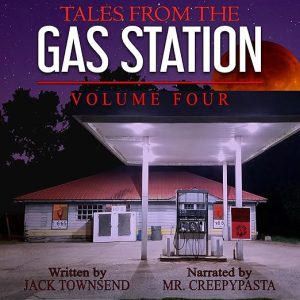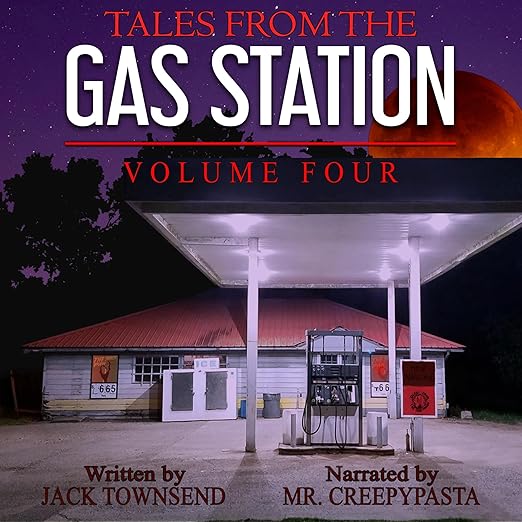
Four volumes in, the joke has hardened into an architecture. This audiobook runs fourteen hours and forty-one minutes with MrCreepyPasta reading, and it opens on Jack running what the description calls "the worst business in history" and shouldering the obligations that come attached to the job. He owes regular feeding to something living under the crawlspace. An entire town's memories have been rewritten in ways that make him look bad. His self-appointed biggest fan refuses to accept a no, the cultists are back and cultier, and his high school reunion has been scheduled to coincide with "the prophesied end of the world."
What makes the series work is the ratio between event and register. Every item above is delivered in the same flat administrative tone, as though a crawlspace tenant requiring meals were a scheduling issue rather than a cosmic one. The supporting cast runs on identical logic: Jerry, always willing to lend a hand "or a sword-bat, if the situation calls for it"; Rosa, who "secretly contains the incredible powers of a dark god"; and a new arrival introduced as "a deadly doppelgänger with terrible people skills." That final phrase is the whole comic method in miniature. The horror is entirely real, and the voice describing it declines to acknowledge that.
Volume four also carries a genuine plot underneath the absurdity, which the premise does not promise. A serial killer surfaces in town and leaves a trail of clues pointing at Jack. His most plausible ally, the new sheriff Amy O'Brien, has had every memory of their friendship erased, so he cannot call in a favor that no longer exists in her head. He spends the book pursued by the authorities, by an obsessed god, and by demons the description specifies as being of "both the metaphorical and literal variety," and finally by his own past. The 4.7 average rests on only two ratings, so read that figure as a placeholder rather than as a settled verdict.
Why It Works in Audio
MrCreepyPasta's involvement is not incidental casting. Comedy of this shape lives or dies on delivery, because the humor is purely a matter of register: read the cosmic material as cosmic and the joke dies on contact, play it as farce and the dread evaporates with it. The gap between how serious the events are and how unbothered the voice sounds is the entire mechanism the book runs on. Nearly fifteen hours is a long stretch to hold a deadpan without it flattening into monotony at one end or cracking into archness at the other, and that is the specific technical problem this recording sets for itself.
The reviews here are unusually considered for comic horror. Shayla Hearns builds an argument rather than a reaction, complaining that storytelling generally "has fallen victim to the addictive factor" of shock value, with the necessary parts of a good story traded away for a moment engineered to make people gasp, and crediting this book with refusing that trade. The reviewer known simply as c is blunter and just as useful: "it's just so fun. absolutely a joy to read even when it gets gross." Read side by side, the two point at one quality from opposite ends, which is that the grotesque material here serves a story instead of standing in for one.
Worth noting as well is how much of the comedy in this volume rests on Jack's social position rather than on the monsters. His town has been handed a version of events in which he comes off badly, a murder investigation is drifting steadily toward his door, and a reunion is about to put him in a room with everyone who knew him before any of it started. Strip out the dark god and the thing in the crawlspace and what remains is a recognizable anxiety dream about being publicly misremembered. That grounding is why the absurdity keeps its grip, and it is exactly what a fourth volume needed to find.
Things to Know Before Starting Tales from the Gas Station, Volume Four
Two of the three reviewers flag the same weakness in the final stretch, arriving at it from different directions. shari lynn calls the book "fun and insane" and then concedes, "To be honest, also a bit confusing." The same review allows that "The final chapters might make total sense to another person." c is happier with the resolution and still wishes "the ending had had some more development between the characters considering what they've been through together," which is a fair complaint after four volumes of shared catastrophe. The landing is the soft spot by rough consensus, and that matters here, because a book promising Armageddon owes you an ending.
Do not start with volume four. shari lynn's firmest recommendation is to get hold of the first book in audio before anything else, and the reasoning is structural rather than sentimental: a plot built on rewritten collective memory only pays off if you remember the version being painted over, and an erased friendship between Jack and the sheriff is only poignant if you watched it form. The second practical note is scale. This is a very long book, filled end to end with escalating absurdity, which is a great deal of tone to absorb, and the humor stays consistent rather than varied, so a listener who tires of the register by hour four will find no relief at hour nine.
Who Will Get the Most From It
Anyone already holding the first three volumes is the obvious audience, which accounts for most of the people who will pick this up, along with the wider group who like horror delivered with a straight face. If you enjoy fiction where an apocalyptic threat is treated as a logistical inconvenience, the tone will click inside the first chapter. shari lynn supplies the most useful comparison on offer, reporting flatly: "I actually enjoyed this series more than The Hitchhiker series." The pairing is instructive: the same appetite for absurd escalation, the same refusal to let any character react with appropriate alarm.
Skip it if gross-out material is a hard limit, since c's endorsement specifically covers the parts where it gets gross rather than apologizing for them. Skip it too if you need a clean resolution, given what two reviewers report about the closing chapters. My own read is that volume four attempts something genuinely difficult, closing an apocalyptic arc while leaving the door ajar, which c describes as wrapping up in a way that manages to "keep the universe of the story open" rather than sealing it. Whether that reads as generous or as hedging will depend entirely on how much more of this world you want.
Before You Press Play
- Performance: MrCreepyPasta carries nearly fifteen hours of deliberate deadpan, the register the comedy depends on, since playing cosmic horror as cosmic would kill the joke outright.
- What it covers: Cosmic horror played as bureaucracy, rewritten collective memory, cults and doppelgangers, small-town apocalypse.
- Feel: Deadpan and escalating, funny in the same breath as genuinely grim.
- Our call: A satisfying fourth volume for existing readers, undercut slightly by a confusing final act, and no place at all to begin.
Do I need the earlier volumes before this audiobook?
Yes. One reviewer's main recommendation is to get the first book in audio first, and the reasoning holds up. A plot built on rewritten town memories only works if you remember the original version, and the erased friendship with the sheriff depends on having watched it develop.
Why does this audiobook show such a high rating from so few ratings?
The 4.7 average rests on just two ratings, which is far too small a sample to mean much. The three written reviews attached are more informative, and they run from unqualified enthusiasm to a four-star verdict that finds the final chapters confusing.
How gruesome does Tales from the Gas Station, Volume Four get?
Gross enough that one reviewer's praise explicitly covers the parts where it gets gross rather than excusing them. Body horror and cosmic threat are treated as routine inconveniences throughout, which softens the impact tonally without removing any of the imagery. If squeamishness is a genuine constraint, take that warning at face value.
Does volume four end the series?
It closes an apocalyptic arc while leaving room to continue. One reviewer describes it as wrapping up in a way that keeps the universe of the story open, while also wishing for more character development in the ending. Another found the final chapters confusing outright.