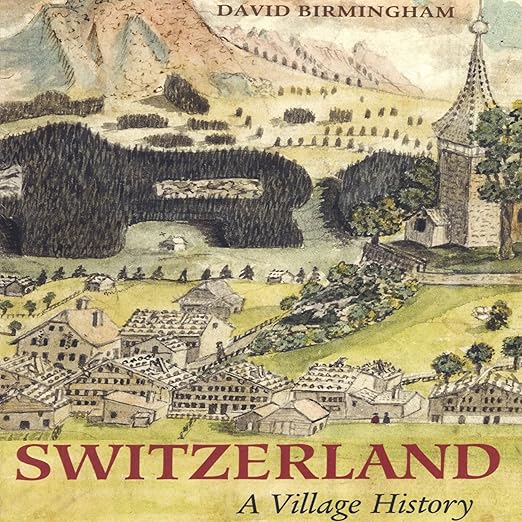
David Birmingham's Switzerland: Village History arrives as something unusual in the audiobook travel-and-history category: a genuine piece of micro-history, focused not on Switzerland as a whole but on the life and arc of a single alpine village over several centuries. Published by Ohio University Press and Swallow Press, academic imprints, not mass-market travel publishers, the book wears its scholarly lineage openly. The audiobook, narrated by Ayn Czubas at just over nine hours, is a serious historical listen rather than an ambient travel companion.
The village at the center of Birmingham's study sits in Switzerland's alpine territory, its economy built on cattle raising and cheese production over generations of modest, land-constrained prosperity. That specific grounding, cattle, cheese, the physical reality of alpine farming, gives the early chapters an economic concreteness that most Swiss history writing, which tends toward banking, neutrality, and confederation-level politics, does not attempt. Birmingham is interested in the people who built the country before it became a concept, and that interest produces a genuinely distinctive perspective on a country that most listeners will know primarily through its contemporary reputation.
Is Switzerland: Village History Worth Your Time?
Reviewer Digital Dave, who listened after a recent trip to Switzerland, describes the book as complementing travel well, particularly for the region around Gruyere. That pairing, the audiobook as travel companion or post-trip deepener, is probably the most productive framing for this content. Birmingham's village is embedded in the landscape in ways that become more legible if you have been to alpine Switzerland or are preparing to go.
Reviewer Andrew P. Cox notes that the book includes maps of Switzerland providing landmarks referenced in the text. That is a meaningful caveat for the audiobook listener: those maps are absent in audio format, and Birmingham's prose references specific geographical features (passes, valleys, neighboring villages) that readers of the print edition can locate visually. Listeners who want to follow the geographical references closely may want the print edition open alongside the audio, or at least a Swiss topographical map for reference. This is not a fatal limitation, the historical narrative does not require precise geographical tracking to follow, but it is a genuine gap.
Cox also identifies Birmingham's prose as having "a crisp writing style" and genuine subject knowledge. That assessment holds up in the audiobook format. Birmingham does not over-explain or pad. The coverage of the Napoleonic invasion, which brought revolution and poverty to the village after its period of modest cheese-industry prosperity, is treated with the right combination of political context and local consequence. The disruption was not just ideological; it was material and immediate. Birmingham keeps those two dimensions together, which is the mark of competent micro-history.
The Best Parts of Switzerland: Village History
Ayn Czubas reads the material with the measured cadence appropriate to scholarly nonfiction. The prose is not dramatically varied, Birmingham writes history, not narrative adventure, and Czubas does not impose emotional interpretation that the text does not support. The delivery is clean and consistent, suited to content that rewards attentive listening rather than passive enjoyment. For a nine-hour audiobook in an academic register, that clarity of narration is a genuine asset.
The historical arc Birmingham traces is genuinely educational. From the pre-Napoleonic period of subsistence alpine farming through the disruptions of the early 19th century, the gradual democratic consolidation of Switzerland through the 1848 Federal Constitution, the Edwardian discovery of the Alps as tourist destination (which transformed highland villages from economic backwaters into aspirational destinations), through the disruptions of two world wars and the postwar prosperity of highland farmers and guest house operators, the sweep covers nearly 300 years and keeps its local-village focus throughout.
That sustained local focus is the book's defining quality. Swiss confederation history, the role of the country in European neutrality, banking and finance, none of this is the subject. The subject is one village's relationship to cattle, cheese, land, political change, and economic precarity across three centuries. That specificity is what makes it valuable for listeners who want to understand how Switzerland's contemporary stability was actually built, at the ground level, rather than inherited through geography and good timing.
Before You Commit to Switzerland: Village History
The book's academic origins mean the prose prioritizes accuracy and completeness over accessibility or storytelling momentum. This is not narrative history in the Sebastian Faulks or Antony Beevor mode. Birmingham does not construct scenes or dramatize individual lives. The perspective is analytical and aggregate, this happened, then this happened, here is why, rather than biographical or novelistic. Listeners who respond best to history presented through individual human stories will find the register somewhat distant.
The audiobook also lacks the book's maps, as noted above. The geographical specificity of Birmingham's text, the Northern Spine, specific passes, the Gruyere region, the relationship between the village and neighboring territories, is navigable without the maps, but the visual anchors the print reader has are simply absent. Birmingham's prose is specific enough that the absence registers as a loss rather than a minor inconvenience.
At 4.0 stars across 23 ratings, the book has a modest but genuinely positive track record. The reviews skew from readers who brought prior interest in Swiss history or regional travel experience. New listeners without that anchor should be aware that the book rewards engagement but does not provide entry-level orientation to Swiss history more broadly, it assumes some context for the Napoleonic period and the 19th-century Swiss confederation process.
Should You Listen to Switzerland: Village History?
History listeners with a specific interest in Switzerland, alpine European history, or the economic and social history of small communities under pressure from larger political forces will find this a rewarding listen. Travelers who have been to the Gruyere region or the Swiss highlands and want historical depth to accompany their experience will get particular value. Readers who enjoyed Birmingham's academic approach in other contexts, he is a historian of African history as well, will recognize the methodology.
Skip this if you want a broadly accessible introduction to Switzerland or travel-narrative-style content. Listeners seeking panoramic Swiss national history would be better served by a more conventional overview. This audiobook is for the specialist interest, not the general audience, and it is most satisfying when approached with that understanding already in place.
Common Questions
Does the audiobook compensate for the absence of the print edition's maps?
It does not. Birmingham's prose references specific geographical features that the print maps support, and those references in audio require listeners to either follow along with an external map or accept some loss of geographical specificity. The historical narrative remains coherent without the maps, but the absence is noticeable.
How accessible is this audiobook for listeners without background in Swiss or European history?
It is accessible in prose style but assumes some contextual familiarity, particularly around the Napoleonic period and 19th-century Swiss democratic development. Listeners without that background can follow the village-level narrative, but will miss some of the political context Birmingham assumes rather than explains.
Is this audiobook suitable for general history listeners or primarily for academic audiences?
It occupies a middle ground, rigorous and scholarly in methodology, but readable enough for engaged general history listeners. The nine-hour runtime and consistent academic register make it a better fit for listeners with specific interest in the subject rather than casual history listeners looking for a broad narrative experience.