Quick Take
- Narration: John Rubinstein brings a steady, unhurried quality to the material that suits both the physical isolation of the story and its more reflective passages about youth and risk.
- Themes: Coming-of-age through extreme survival, the wilderness as educator, the gap between daring and preparation
- Mood: Tense and atmospheric, with genuine stretches of dread and wonder
- Verdict: A survival memoir that earns its comparisons to Into the Wild by presenting an honest portrait of an ordinary young man in extraordinary danger.
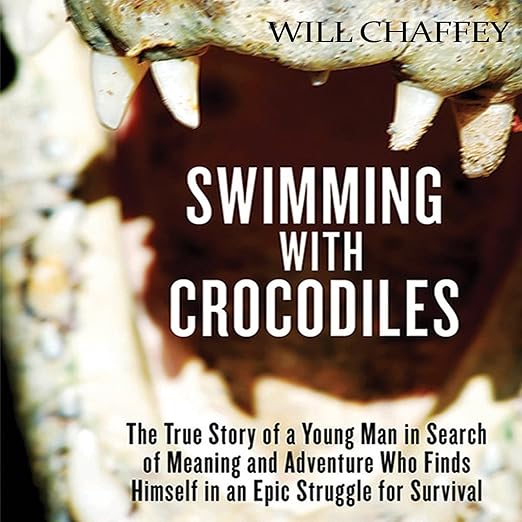
I grew up reading survival narratives, the kind where the author barely lived to write the book and every chapter carries that knowledge as a kind of background hum. Swimming with Crocodiles is that kind of book, but with an additional quality I found disarming: the author is not particularly competent. Will Chaffey is eighteen, working and traveling through Australia, and by his own account the type of explorer who forgets to pack his lunch. One reviewer put it perfectly: he is not Bear Grylls. He cannot start a fire with a rubber band and a carrot. That ordinariness is what makes the book work.
Published in the tradition of Into the Wild, which the synopsis explicitly invokes, this is the story of Chaffey’s journey across Australia’s inland desert to the tropical northwest coast, and then into the remote Prince Regent River alongside a wandering herpetologist. The Prince Regent trek, which the synopsis notes had never been attempted by outsiders, ends with the pair stranded without food, physically depleted, and stalked by a saltwater crocodile that has been an effective predator since the Cretaceous. John Rubinstein narrates, and his calm delivery turns out to be the right choice for material this viscerally threatening.
Our Take on Swimming with Crocodiles
Chaffey’s prose is the kind that earns its descriptions. He writes about landscape, plants, and animals with specific attention, and one reviewer noted you can feel how much he absorbed of the country’s physical reality, not just its danger but its beauty. The book moves between multiple time frames of his young life, weaving the outback story through earlier experiences in a way that gives the survival narrative emotional context without slowing its momentum.
What distinguishes this from the standard adventure memoir is the honesty about incompetence. Chaffey does not retrofit competence onto his younger self. He presents a young man who wrangled a National Geographic grant to explore a river he was arguably not prepared for, and who survived not through expertise but through stubbornness and luck. That honesty makes the fear feel real in a way that more polished survival narratives sometimes lose.
Why Listen to Swimming with Crocodiles
John Rubinstein’s narration is worth discussing specifically. He has a long career in audiobook work, and he brings to this a quality that might be called grounded gravity: he does not oversell the danger, which paradoxically makes the danger feel more present. When the crocodile is introduced, Rubinstein’s tone does not spike. It settles. That restraint is effective.
Reviewers compare the book to Stephen Ambrose’s Undaunted Courage and Nathaniel Philbrick’s In the Heart of the Sea, which is ambitious company. The comparison holds in spirit if not exactly in scope. What all three share is the collision of human limitation with indifferent natural power, and the question of what that collision reveals about who we are.
What to Watch For in Swimming with Crocodiles
The book was originally published in 2009, and the audio release goes back to 2013. Listeners looking for recent memoir with contemporary sensibility should know this is a document of early-aughts adventure culture, written before GPS and satellite phones fully changed the calculus of remote exploration. One reviewer notes that the era makes what Chaffey and his companion did require equal parts daring and stupidity, which feels accurate and intentional rather than naive.
The non-linear structure, moving through multiple time frames, is mostly handled well, but a few reviews mention needing to reorient occasionally. Rubinstein’s consistent voice helps anchor the shifts.
Who Should Listen to Swimming with Crocodiles
Listeners who enjoy survival memoir with genuine literary attention to landscape and character will find this rewarding. Fans of Into the Wild, Undaunted Courage, or adventure writing that takes its natural settings seriously will find Chaffey’s voice distinctive and honest. Those who prefer their survival narratives tidier or their protagonists more obviously capable may find the author’s cheerful acknowledgment of his own unpreparedness frustrating rather than endearing.
Frequently Asked Questions
How does Swimming with Crocodiles compare to Into the Wild?
Both books center on a young man who deliberately enters a wilderness situation beyond his practical experience, and both use the journey as a lens for examining the transition to adulthood. Chaffey is arguably more honest about his unpreparedness than Jon Krakauer’s portrait of Chris McCandless, and the crocodile encounter gives the book a specific sustained danger that Into the Wild approaches differently.
Is John Rubinstein a good fit for this material?
Yes. His calm, unhurried delivery suits both the landscape descriptions and the survival sequences. Several listeners specifically appreciated that he does not sensationalize the more dangerous sections, which keeps the tension honest rather than performed.
Is this a physically intense listen or more reflective?
Both. The book moves between vivid accounts of physical hardship and more contemplative passages about youth, loneliness, and what indigenous people who live in the wild understand that outsiders do not. One reviewer specifically calls out the latter dimension as meaningful, not just adventurous ornamentation.
Do I need any knowledge of Australian geography or wildlife to follow the story?
No prior knowledge required. Chaffey describes the landscape and fauna with enough specificity that listeners unfamiliar with the outback or the northwest coast can orient themselves through his narration. The saltwater crocodile, at least, needs no introduction.