Quick Take
- Narration: Tom Perkins delivers Calvert’s unpretentious prose with a clean authority that matches the captain’s own understated style.
- Themes: Nuclear submarine technology and its limits, Cold War military strategy, the physics of polar ice as an environment to be solved
- Mood: Measured and technically absorbing, with genuine awe at the environment breaking through professional restraint
- Verdict: A companion volume to The Ice Diaries that stands on its own merits, distinguished by Calvert’s exceptional ability to make the reader understand what his crew actually experienced.
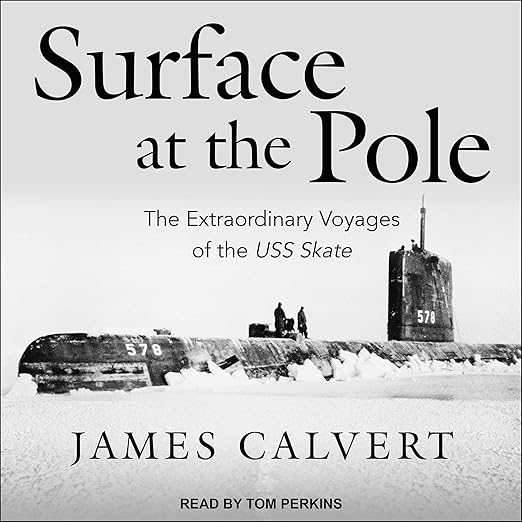
On March 17, 1959, seven months after the Nautilus passed beneath the ice to the North Pole, the USS Skate became the first submarine to surface at the pole. The distinction matters. Anderson’s Nautilus passed underneath. Calvert’s Skate broke through the ice and briefly opened the pole to the atmosphere, completing a different kind of feat. That the world had moved on quickly and that the Nautilus had taken most of the headlines is evident in how this book sits at 4.6 stars across 733 ratings, a quietly impressive performance for a memoir about a mission somewhat overshadowed by its predecessor.
James Calvert is an exceptional narrator of his own experience. The quality that jumps out immediately is his ability to make technical material feel human without removing the technical content. He does not simplify away the complexity of under-ice operations to tell a better adventure story. He finds the drama inside the complexity itself, which is the harder and more satisfying thing to do.
The Physics of Ice as Antagonist
The central challenge of the USS Skate’s mission was not reaching the North Pole but finding a patch of ice thin enough to surface through. The Arctic ice cap is not a uniform surface. It has leads, which are gaps between floes where the ice is thin or absent, and ridges, which are pressure formations where ice can pile to extraordinary thickness. Navigating underneath this surface and finding the specific combinations of ice thickness and submarine position that would allow a controlled surface requires a kind of three-dimensional spatial reasoning applied under time pressure in extreme cold.
Calvert describes this process in ways that are genuinely illuminating. Reviewers have noted, with some surprise, that they finally understood the complexity and dangers of under-ice submarine operations after reading this account, even though the subject seems technical and specialized. That is a specific authorial achievement: making a reader understand something they did not think they could understand.
Two Voyages, Not One
The book covers two Arctic voyages rather than one, which gives it a structural advantage over simpler single-expedition accounts. The first voyage was exploratory and encountered serious difficulties. The lessons learned from those difficulties shaped how the successful second voyage was approached. Calvert is honest about what went wrong on the first attempt, which makes the eventual success of the second feel earned rather than inevitable. Military memoirs sometimes suppress the failures that preceded the triumph, and this book’s willingness to document the learning process distinguishes it from that tradition.
The Cold War strategic context is present but not dominant. Calvert acknowledges the military implications of demonstrating that submarines can operate at the pole, and the connection to the Polaris missile program that Anderson developed more fully in The Ice Diaries is referenced. But Calvert’s primary interest is the human and technological story of his crew, and the strategic context stays in the background where he wants it.
What the Skate Proved That the Nautilus Did Not
The distinction between surfacing and transiting under the ice was militarily significant in ways Calvert makes clear. Anderson’s Nautilus had demonstrated that a nuclear submarine could travel beneath the Arctic ice cap from one ocean to another, opening a new strategic corridor. But to be operationally useful for missile launches, submarines needed to be able to surface in the Arctic, not merely transit beneath it. The Skate’s missions established that surfacing was possible, which transformed the Arctic from a transit route into a potential firing position. Calvert describes this strategic dimension without sensationalism, and his understanding of why the mission mattered beyond the geographical achievement gives the book a weight that a purely adventure-focused account would not have. The Cold War is always present in the background even when the immediate concern is finding a patch of thin ice.
Tom Perkins and Seven Hours of Understated Command
At seven hours and thirty-one minutes, this is shorter than Anderson’s account and benefits from that compression. The narrative does not linger unnecessarily. Calvert’s prose style is lean, and Perkins matches it with a reading that does not editorialize where the text does not. The listen moves efficiently through the material without feeling rushed, and the combination of the author’s restraint and the narrator’s responsiveness to it produces an audiobook that is easier to stay with than its subject matter might suggest to someone unfamiliar with the genre.
A reviewer noted that the awe and wonder at the North Pole environment comes through powerfully in passages describing the ice and the silence and the particular quality of the light in the Arctic, which is not typically how people approach accounts of submarine operations. Those passages are genuinely affecting and they earn their place in a technical narrative.
Who Should Listen and Who Should Skip
This and The Ice Diaries are natural companions and can be listened to in either order. Calvert’s book is slightly more focused on the human and technological dimensions of the mission; Anderson’s covers more political and strategic ground. Together they provide a complete picture of the Cold War Arctic submarine program’s defining moments.
Listeners who have no interest in submarines or Cold War military history will not be converted by this book. Its pleasures are specific. But within its lane, it is an exceptionally well-made example of what a first-person military memoir can achieve when the person who commanded the mission is also a skilled writer.
Frequently Asked Questions
Does this book cover the same events as The Ice Diaries or different ones?
Different events. Anderson’s Ice Diaries covers the Nautilus’s 1958 passage beneath the polar ice. Calvert’s Surface at the Pole covers the USS Skate’s separate 1959 mission, which achieved the first surfacing at the North Pole rather than just a submerged transit. The two books complement each other and together provide a fuller picture of early Cold War Arctic submarine operations.
How technical is the content? Do you need to understand submarine mechanics?
Calvert is consistently praised for making technical material accessible. Multiple reviewers who came to the book with no submarine background report understanding the operations clearly by the end. The technical content is present and specific but explained in terms of the human experience of managing it rather than in engineering terms that require prior knowledge.
Does the book include any ceremonies that took place when the Skate surfaced at the pole?
Yes. Calvert covers what the moment of surfacing at the North Pole was like for the crew. One significant aspect of the mission is that the crew scattered the ashes of Sir Hubert Wilkins at the pole, honoring an earlier Arctic explorer, and that ceremony is part of the narrative.
How does Calvert characterize the risk level of the under-ice surfacing operation?
Honestly and without false modesty. He is clear that the physics of what happens when a submarine attempts to surface through ice of unknown thickness was not fully understood when the missions took place, and that some operations fell into categories where the outcomes could not be reliably predicted. The risk was genuine and he does not sanitize it.