Quick Take
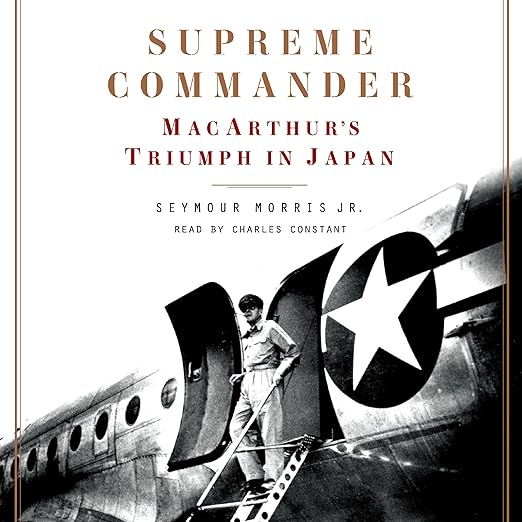
- Narration: Charles Constant brings his characteristic deadpan clarity to a text that blends political history with management analysis, keeping the material brisk across eleven hours.
- Themes: Nation-building and its limits, leadership under unprecedented conditions, the paradox of MacArthur
- Mood: Brisk and energetic, with a business-school lens that occasionally sits uneasily with the historical material
- Verdict: An accessible and genuinely surprising portrait of MacArthur’s most consequential work, though readers should know that Morris frames the Japan occupation partly as a leadership case study.
Douglas MacArthur has one of the strangest reputations in American military history. He is simultaneously the general who waded ashore in the Philippines, the vain commander relieved for insubordination by Truman, and the architect of one of the most successful nation-building exercises in modern history. Most accounts of MacArthur spend most of their time on the first two. Seymour Morris spends his entire book on the third, and the result is both more interesting and more unsettling than most MacArthur biographies.
I listened to Supreme Commander over several evenings, and the experience reminded me of the best kind of history writing: the kind that makes you feel the contingency of things you had assumed were inevitable. The transformation of Japan from a militarist empire to a functioning democracy between 1945 and 1951 was not predestined. MacArthur made specific decisions, with specific reasoning, under specific constraints, and Morris reconstructs those decisions with the attention of a man who clearly finds the management dimension as interesting as the political history.
The Flaming Peacock Who Rebuilt a Nation
Morris does not hide MacArthur’s considerable personal flaws. The book makes clear from early on that the man Washington sent to Tokyo was widely considered insufferable: vain, reclusive, self-aggrandizing, with enemies at the highest levels of the Truman administration who expected and perhaps hoped he would fail. Harry Truman’s closest advisors gave MacArthur little chance of succeeding in what Morris describes as the greatest gamble ever attempted. No nation-building exercise of this scale and ambition had been attempted before, and none has been successfully replicated since.
What Morris traces is how MacArthur’s specific qualities, some of which are the same qualities that made him maddening as a military commander, turned out to be precisely what the occupation required. His theatrical self-confidence translated into a consistent Japanese perception of American authority that prevented the power vacuum that follows most defeated occupations. His insistence on working with existing Japanese institutions rather than dismantling them entirely preserved enough social continuity to prevent the chaos that could have made democratic reform impossible.
The Management Lens and Its Limits
Morris is explicit that he is analyzing MacArthur’s leadership through a contemporary management framework, and this is where at least one reviewer’s objection has real force. One Audible listener wrote that Morris tries to make the book relevant by comparing the occupation of Japan to the occupation of Iraq, but that Japan was a homogeneous society with entirely different historical conditions. That critique lands. The management-case-study framing occasionally flattens historical specificity into transferable lessons that the evidence does not quite support. Japan in 1945 was a unique situation produced by a unique combination of factors, including imperial loyalty that could be redirected, a culturally cohesive population, a surviving administrative infrastructure, and an occupying power that was initially regarded with considerable awe rather than resentment.
These caveats do not undermine the core argument, which is that MacArthur made decisions that were unusual, often counterintuitive, and demonstrably effective. The decision to preserve Emperor Hirohito rather than try him as a war criminal was controversial and remains so. Morris examines it as a strategic choice with specific reasoning, not as moral absolution, and that is the right analytical frame.
Charles Constant and the Rhythm of Leadership History
Constant is a reliable presence for political-military biography and he brings a slightly wry quality to Morris’s prose that suits a text that is itself occasionally dry about extraordinary events. There is no theatrics in his delivery, which is appropriate for a book that is more interested in institutional decisions than in personal drama. At just over eleven hours the runtime is well-matched to the scope; Morris keeps the book tightly focused on the occupation years without trying to write a comprehensive MacArthur biography.
The tension between MacArthur’s autonomy as Supreme Commander and the oversight that eventually led to his dismissal by Truman over Korea runs through the book’s final chapters as a structural irony. The qualities that made him effective in Tokyo were the same qualities that made him impossible in a different kind of war. Morris traces that irony without resolving it into a simple verdict, which is the appropriate response to a historical figure who resists simple verdicts.
The Ideal Audience for This Particular MacArthur
This is the right audiobook for listeners curious about the postwar reconstruction of Japan who want something more analytically rigorous than a military biography but more readable than academic history. It pairs naturally with broader accounts of the Pacific War’s end for context. Listeners who want a full MacArthur biography will need other sources; Morris is deliberately scoped to the occupation period. Those expecting a pure management book with history decoration should know the balance tilts more toward history, despite some of the framing language in the promotional material.
Frequently Asked Questions
Does the book cover MacArthur’s role in the Korean War?
The Korean War appears at the end of the book primarily as context for understanding how MacArthur’s occupation success and his subsequent dismissal by Truman are connected. The occupation years from 1945 to 1951 are the book’s primary focus.
How reliable are Morris’s comparisons between the Japan occupation and the Iraq occupation?
Several reviewers flag this as the book’s weakest element. The comparison is structurally interesting but analytically strained given the profound differences in social cohesion, administrative infrastructure, and political context. Morris’s core historical argument about MacArthur stands independently of the comparison.
Is this suitable for listeners with no prior knowledge of MacArthur?
Yes. Morris provides enough biographical context that the book works as an introduction to MacArthur’s significance, though readers wanting a comprehensive biography of his full career would need to supplement with other sources.
What was MacArthur’s decision about Emperor Hirohito, and how does Morris assess it?
MacArthur chose not to pursue war crimes charges against Hirohito, deciding that the emperor’s symbolic authority was more useful for achieving peaceful occupation than his prosecution would have been. Morris treats this as a calculated strategic decision rather than a moral judgment and examines both the reasoning and the long-term consequences.