Key Details
- Narration: Holter Graham is the sole credited reader on a studio production, carrying dozens of named executives, investors and employees through a single voice.
- Themes: growth at any cost, an internal culture becoming external strategy, the boardroom removal of a founder
- Mood: Fast, sharp and faintly appalled
- Verdict: Reportage rather than analysis, built around one catastrophic year and still moving at speed six years later.
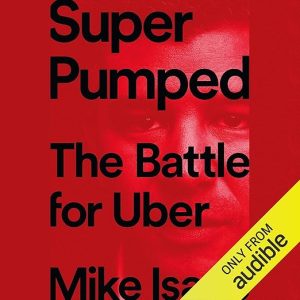
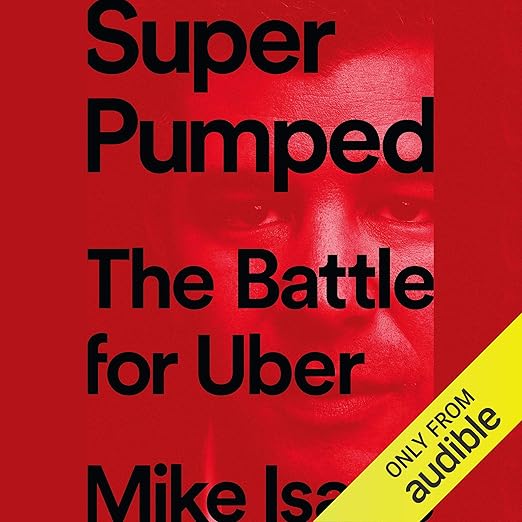
Business books about failed companies are easy to write. Books about a company that won, then nearly destroyed itself, then carried on, are considerably harder, and Mike Isaac's account of Uber's worst twelve months is the second kind. The audiobook runs twelve hours and fifty-two minutes, read by Holter Graham, and the listing calls it Super Pumped without the subtitle one response supplies on its behalf: The Battle for Uber.
The Verdict, Briefly
The single verdict that stops short of five stars is also the most analytical. Filed two weeks after publication, it describes the method exactly: interviews with venture capitalists, current and former employees, allies and adversaries of Kalanick alike, plus bystanders, assembled into a narrative where it is quite clear which accounts the author finds compelling and which get waved away. It calls the result deep reporting and a fascinating story, and its headline complaint is head-scratching errors. Both halves of that assessment matter, and the second has a specific consequence in audio.
Only two ratings feed that average, and five written verdicts sit below it, one at four stars and the rest at five, the newest of them arriving four years after publication. Whatever population produced the displayed 4.5, it is not the population that wrote anything down. The gap deserves naming, because on a book covered this widely the written responses are the only part of the page carrying real information, and a number assembled elsewhere is what summarizes them.
Why Super Pumped Works as an Audiobook
Two days after release, a five-star response written at the halfway mark produced the best image anyone has managed for this book: it reads as though the author had been hiding behind doorways during some of these conversations. That response also calls the reporting fair and even-handed rather than sensational, and reaches for Bad Blood as a comparison while marking the difference, that all of us were using the product and enjoying the convenience while this was going on. Complicity is what makes the Uber story land differently.
Structure follows the collapse. June 2017 is the pivot, when Travis Kalanick was removed in a boardroom coup at the close of what the publisher calls one of the most catastrophic twelve-month stretches in American corporate history. Around it sit the fights with taxi unions and drivers, the internal culture, and the tactics built specifically to get around obstacles. Isaac worked from hundreds of interviews and previously unpublished documents, and that is what the boardroom material rests on.
Holter Graham reads it, and this is the sort of book that gains from a single narrator holding a very large cast. Dozens of named executives, investors and employees move through the story, and one voice gives them a consistent frame, which is often the difference between following a corporate cast and losing track of it. The publisher slot names an audio studio rather than a book imprint, which is why nothing here connects to the print edition four of the five written responses describe reading.
Points to Consider
Praise has held up. An October 2025 five-star response still calls this an absolute page-turner that felt less like a business book than a real-life action movie. It also supplies the subtitle the listing withholds, The Battle for Uber, and the omission carries a cost: Super Pumped on its own is two ordinary English words that tell a browser nothing, which leaves the company's name appearing nowhere except inside the description itself.
Errors are the thing to weigh, and that complaint arrives as a headline with no list attached. In print you can stop, reread the sentence, check it against whatever notes exist, and decide how much it matters. Listening removes all three moves at once: the claim passes at speaking speed with nothing to check it against, and the next scene arrives before you have finished doubting the last one. On investigative reporting that asymmetry is real and worth pricing in.
Dating is the other consideration. Isaac wrote from the vantage point of 2019 and closes on the coup and its immediate aftermath, so everything the company has done since falls outside the frame entirely. That does no damage to the book, which was always about a specific twelve months, but somebody arriving now should expect a period piece rather than a current assessment. The Silicon Valley the copy describes, a mobile era mid-upheaval, is already history.
Should You Listen to Super Pumped?
Business-narrative listeners are the obvious market, and the copy aims squarely at them, invoking Brad Stone's Everything Store and John Carreyrou's Bad Blood by name. Anyone who finished either and wanted the same thing again will recognize the construction immediately. Technology listeners who want to understand how an internal culture turns into external strategy get that connection drawn explicitly rather than left to inference.
Even the informed are served, which is the strongest argument this page makes. A five-star response filed from Australia in October 2023 comes from a former technology journalist who had read every book on the Valley and already knew the Uber story before starting, and still reduced the verdict to one word of praise. Knowing the ending turns out not to be a problem, which is the useful thing to learn about a story covered this heavily.
Save your money if you want a management lesson, because this is reportage rather than analysis and nobody extracts principles for you at the end. Save it as well if you need sources you can check, since the reporting complaint on this page has no remedy in audio. Uber is the subject and the culture is the argument, and twelve hours of watching a company win everything and nearly lose all of it is a specific pleasure that will not suit everyone.