Quick Take
- Narration: Dean Temple delivers a clean, professional read that suits the business-book format well; measured pacing keeps the data-heavy chapters digestible without feeling mechanical.
- Themes: Startup mythology vs. data reality, contrarian entrepreneurship, pattern recognition in venture capital
- Mood: Energizing and counterintuitive, with the brisk confidence of a well-prepared investor pitch
- Verdict: A genuinely useful corrective for anyone who has absorbed too much Silicon Valley folklore, the data forces real reckoning with what actually drives unicorn outcomes.
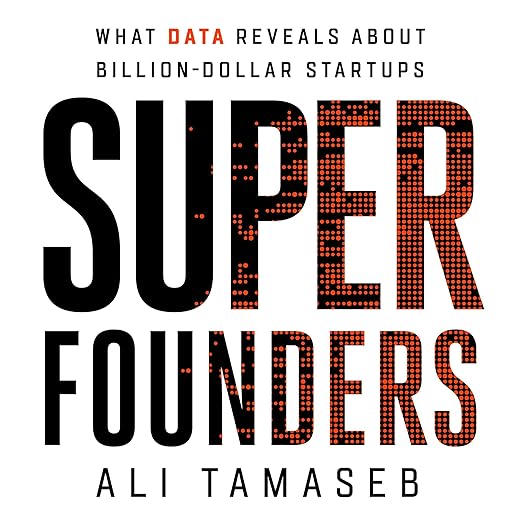
I picked up Super Founders on a Tuesday evening after a particularly frustrating afternoon of reading startup Twitter. You know the kind of day: everyone confidently asserting what founders must be, how old they must be, which accelerator they must have survived. Ali Tamaseb’s book felt like a cold glass of water. I finished it in two long listening sessions, once walking across the city, once stretched out on my couch well past midnight, and I kept pausing to scribble notes that felt less like summaries and more like corrections to things I had believed for years.
Tamaseb is a partner at DCVC, a deep-tech venture fund, and he spent thousands of hours manually building what he describes as possibly the largest dataset ever assembled on unicorn startups: 30,000 data points across nearly every variable you could imagine. The result is a book that takes the mythology of the exceptional founder and runs it through a statistical shredder.
Our Take on Super Founders
The central argument here is not that startup success is random, it is that the conventional wisdom about what predicts it is mostly wrong. Tamaseb’s data consistently undermines the narratives we have all absorbed. Most unicorn founders had no relevant industry experience before building their billion-dollar company. Being a solo founder carries no statistical disadvantage. Fewer than fifteen percent went through a major accelerator like Y Combinator. More than half launched into markets with strong existing competitors, the idea that you need to be first to market turns out to be largely a myth. These findings land with real force because Tamaseb is not editorializing; he is presenting sample sizes and comparisons, then letting you sit with the discomfort of updating your priors.
What gives the data texture and keeps this from reading like a research paper is the interview material. Tamaseb had access to the founders and early investors of Zoom, Stripe, Airbnb, LinkedIn, YouTube, Coinbase, and dozens of others. These are not the polished retrospective anecdotes you find in the standard business-book genre, Eric Yuan of Zoom talking about being a non-technical founder in a technical market, early investors in DoorDash explaining why the company looked uninvestable from the outside. There are previously untold stories about the early days of TikTok’s parent ByteDance and about WhatsApp’s refusal to grow too fast. The combination of quantitative framework and intimate firsthand account makes Super Founders more intellectually honest than most of its peers in the startup-advice genre.
Why Listen to Super Founders
Dean Temple’s narration is the right instrument for this material. His voice has the measured authority of a good economics lecture without tipping into the kind of over-emphatic delivery that makes business audiobooks feel like a motivational seminar. He handles the data-dense passages with clarity, and the transition between Tamaseb’s analytical voice and the interview quotations feels natural rather than staged. At just under nine hours, the listen never drags.
What I appreciate about the structure is that Tamaseb does not pretend his data produces a formula. He is explicit about what the numbers can and cannot tell us, which is a form of intellectual honesty rare in this genre. The book does not promise that if you replicate the statistical profile of a unicorn founder, you will build one. It promises that you will stop making decisions based on myths.
What to Watch For in Super Founders
The book’s limitation is one it acknowledges only obliquely: survivorship bias. Tamaseb is studying companies that became billion-dollar businesses, which means the dataset is by definition backward-looking. The variables he identifies as common among unicorns could also be common among companies that failed at an earlier stage. One of the reviewers on Audible nailed this when they compared the book’s findings to the concept of black swans, rare outcomes that look patterned only in retrospect. Tamaseb is careful, but readers who want a true predictive framework will come away with something more modest than that.
The interview chapters, while compelling, occasionally feel like a curated highlight reel. The founders are articulate and the stories are good, but you are hearing the polished versions. That is not Tamaseb’s fault, it is the condition of doing interviews with extremely successful people about things that happened twenty years ago. Keep that filter in mind, and the material remains highly valuable.
Who Should Listen to Super Founders
This audiobook is well-matched to working founders, early-stage investors, and anyone who thinks seriously about the venture ecosystem. It is also worth the time for MBA students who have been fed the standard Silicon Valley narrative and want their assumptions tested. If you have already read extensively in this space, Venture Deals, Zero to One, High Growth Handbook, Super Founders sits comfortably alongside that shelf, adding rigorous data to conversations that are usually dominated by anecdote. If you are outside the startup world entirely and have no interest in how billion-dollar companies form, the relevance will be limited. But if you have ever wondered whether the Steve Jobs archetype is actually the exception rather than the rule, Tamaseb’s answer is unambiguous: yes, it is.
Frequently Asked Questions
Does Super Founders go beyond the standard startup-advice genre, or is it just more founder mythology?
It actively dismantles the mythology. Tamaseb’s dataset of 30,000 data points on unicorn startups consistently contradicts conventional wisdom, on solo founders, industry experience, accelerators, and first-mover advantage, making it one of the more data-honest books in the genre.
How does Dean Temple handle the data-heavy sections of the audiobook?
Temple paces the analytical material well, keeping it clear and intelligible without slowing things down. The transitions between Tamaseb’s own voice and interview quotations are handled smoothly throughout the nearly nine-hour runtime.
Which founders and investors are featured in the exclusive interviews included in the book?
The interview roster is extensive: founders and early investors from Zoom, Stripe, Airbnb, YouTube, LinkedIn, DoorDash, Coinbase, and Square, along with venture capitalists Peter Thiel, Elad Gil, Alfred Lin of Sequoia, and Keith Rabois of Founders Fund. Previously untold early stories about ByteDance, WhatsApp, and Dropbox are also included.
Does the book offer a practical framework for founders, or is it primarily analytical?
It is primarily analytical, and Tamaseb is transparent about that. He explicitly avoids the promise of a formula, which is refreshing. The value is in dismantling false assumptions rather than prescribing a path, making it most useful as a corrective rather than an operational guide.