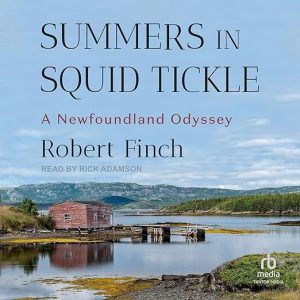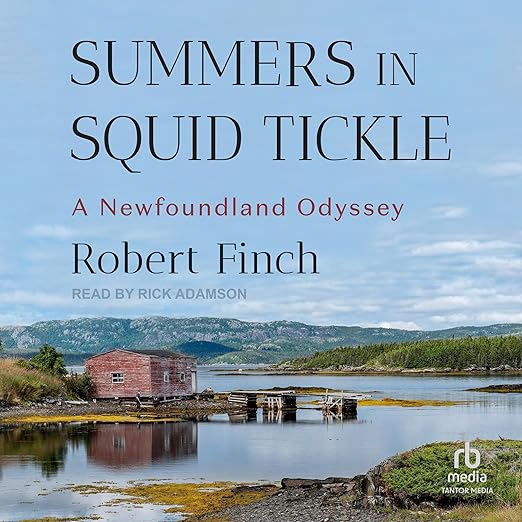
Why would a man whose old life on Cape Cod had fallen to pieces drive north to a Newfoundland outport and end up buying a house there? Robert Finch arrived in Burnside in the summer of 1995, heartsick and directionless by his publisher's own account, and Summers in Squid Tickle is the audiobook he made out of what happened afterward: ten hours and twenty-four minutes, read by Rick Adamson, covering one village on Newfoundland's rugged northeast coast, three generations of the people who live in it, and the collapse of the fishery that used to justify their being there at all.
The first oddity is that the title and the description do not call the place by the same name. The copy introduces the village as Burnside, then spends the rest of its length talking about Squid Tickle's inhabitants and Squid Tickle's waters, without pausing to explain the doubling. That small friction is a decent preview of the book's whole method. This is writing from inside a community rather than about one, and inside a community a place tends to carry a formal name and a working name, with only the second one telling you anything about who lives there. Finch did not stay a visitor. He bought a house, played the organ for the church, fished the local waters, and married a woman he met in the village.
The description closes on a much broader claim, that the book answers a modern desire for quiet and for some rethinking of how we are tied to one another and to the landscape. Treat that sentence as the sales pitch rather than the subject. What the copy actually promises, and what the one substantial review confirms, is far more local and far more valuable: commercial cod fishing rising and then collapsing, young people leaving the outport, and a distant hope pinned on tourism and new industries to sustain a way of life that is disappearing while the author watches. A book about the emptying of a fishing village does not need a wellness frame to justify itself.
The Best Parts of Summers in Squid Tickle
One review here tells you the shape of the thing before you buy it, which is about the most useful service a reviewer can perform. DW calls the book 'essentially a reading of many years of journal entries,' then immediately heads off the obvious objection: 'but lest you think that is boring, this one is not.' The same review credits Finch with 'a genuine affinity for his adopted summer land and all of the people he encounters,' and begins to describe how he brings their values to life before the text is cut short. A reviewer who volunteers the structural risk unprompted is doing a buyer a genuine service.
Knowing it accretes rather than builds changes how the audio should be used. A journal-shaped book has no engine pulling you toward a next chapter, which sounds like a weakness and is partly a strength in listening: lose four minutes to a phone call and you have lost four minutes, not the thread. This is a companionable format for washing up, walking, or driving a familiar route, and a poor one for a listener who wants a question posed in hour one and answered in hour ten. The pleasure on offer is accumulation, the same faces recurring across seasons until you know them.
Rick Adamson is credited with the reading, and the demand here is specific rather than generic. A portrait of 'hardy fishermen, vigorous retirees, and close neighbors' means a narrator introducing named, real, still-living people and their speech, in a region whose speech is famously its own. My concern with a book like this is never dramatic range, it is restraint: an accent handled as characterization is a gift, and the same accent handled as a party trick sinks the entire enterprise inside twenty minutes. I would run the sample looking for a passage of reported village dialogue rather than a passage of landscape description, since the landscape will read well in almost any voice.
Before You Commit to Summers in Squid Tickle
The single most practical sentence attached to this listing is also the shortest. G3TSOM3, the only reviewer here who withheld the fifth star, wrote in full: 'Nice book for someone who knows the area...' That is a qualification, not a dismissal, and it names the real variable. Prior familiarity with Newfoundland, or with any coastal community that lost its industry, will multiply what this book gives you. Without it, a listener may find the parade of neighbors and boats harder to hold onto, because the reward is recognition rather than revelation.
Weigh the evidence base honestly too. The 4.3 average rests on a moderate pool of ratings, and of the three written notices attached here, one is a single line about the area, and one reports only that the book was bought as a gift and 'was well received and highly complimented upon completion,' with nothing said about the contents. That leaves one substantive account of what reading it is like. It is a good and specific account, but a buyer should know how much weight it is carrying alone. Note also that the travel category attached to this listing oversells the destination angle: nobody plans a trip from this book, and the fishery it describes is going or gone.
Should You Listen to Summers in Squid Tickle?
Place writing is a real genre with real devotees, and this sits squarely in it. Anyone who reads for the texture of a specific coastline, a specific church organ, a specific set of neighbors, will find the ten hours well spent. So will listeners who have watched a working town lose its work, in Newfoundland or anywhere else, and who want that experience described by someone who chose to stay through it rather than report on it and leave. The elegiac register is earned here, not applied.
Skip it if you want an itinerary, a plot, or momentum. Skip it too if you need a clear narrative question to keep you going, because the structure DW identified is exactly what it sounds like and it will not reward impatience. One further practical caution for the audio specifically: a book assembled from years of entries is the kind of thing print readers dip into over months, and a listener needs decent chapter marking to do the equivalent. If your habit is fifteen minutes at a time, check how this edition is divided before you commit.
Before You Press Play
- Voice: Rick Adamson reads a portrait of named Newfoundland villagers, so the reported local speech is the part of the sample worth testing.
- Big ideas: The collapse of the cod fishery, outport out-migration, healing by relocation, community portraiture.
- Atmosphere: Unhurried and elegiac, closer to a long letter home than to travel writing.
- Worth it?: Absorbing for readers of place writing, and frustrating for anyone who expects narrative momentum.
Frequently Asked Questions
Is Summers in Squid Tickle a travel guide to Newfoundland?
No, despite the travel category on the listing. Finch writes as a summer resident who bought a house, played organ for the church and fished the local waters, and the subject is the village's decline: the collapse of commercial cod fishing and young people leaving. Nobody plans an itinerary from this.
How is the book structured, and does that suit the audiobook format?
One reviewer calls it essentially a reading of many years of journal entries. That accretive shape has no plot engine, which makes it forgiving if you listen in short bursts but unsatisfying if you want a question raised early and resolved late. Check the chapter marking before committing.
Do I need to know Newfoundland to enjoy this audiobook?
It helps considerably. The one reviewer who stopped short of five stars wrote simply that it is a nice book for someone who knows the area. Familiarity with the region, or with any community that lost its industry, turns the parade of neighbors and boats into recognition rather than an unfamiliar roll call.