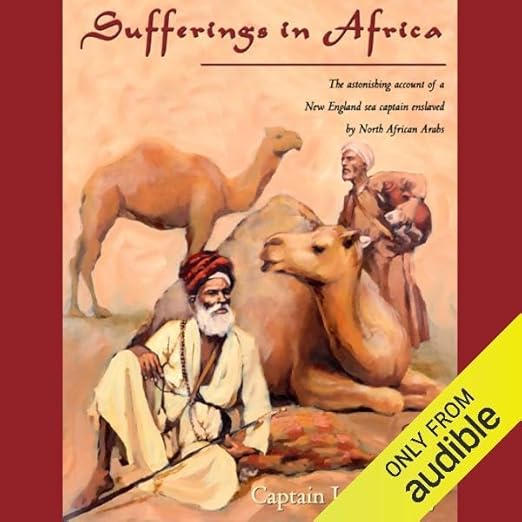
Quick Take
- Narration: Brian Emerson reads Riley’s first-person account with the urgency the extreme conditions demand, handling the extended desert sequences without letting the pace drag.
- Themes: Survival under absolute extremity, the moral complexity of slavery when witnessed from inside it, faith as psychological resource
- Mood: Relentless and physically immediate, with the occasional surface of something almost philosophical
- Verdict: One of the strangest and most important captivity narratives in American history, with a direct line to Abraham Lincoln’s moral development, fully deserving of its obscure-classic status.
I came to Sufferings in Africa through a footnote, which is where the best obscure books usually live. A biography of Abraham Lincoln mentioned it among the small list of books Lincoln credited as formative influences, and I filed it away. Months later, reading about Barbary Coast captivity narratives in a different context, the name came up again. James Riley, an American sea captain, shipwrecked off the western coast of Africa in 1815, captured by nomadic Arabs, sold into slavery in the Sahara. The book sold over a million copies in Riley’s lifetime. It influenced Lincoln so significantly that Lincoln listed it alongside the Bible and Pilgrim’s Progress in his intellectual formation. And yet I had never heard of it until I started specifically looking.
Brian Emerson narrates nine hours and fifty-four minutes of this text, and the casting works well. Riley’s prose is direct and unadorned, the account of a practical man in impossible circumstances, and Emerson reads it with an urgency that builds appropriately as the desert conditions become more extreme. The sections in the Sahara, when Riley and his surviving crew are reduced to desperate physical conditions that he describes with painful precision, are some of the most effective survival writing I have encountered in audio.
The Shipwreck That Began Everything
Riley’s ship Commerce ran aground on a reef off the western Sahara coast in August 1815. The crew survived the wreck but were immediately confronted with a landscape and a set of conditions for which nothing in their experience had prepared them. The western Sahara in 1815 was not territory under any colonial power’s control. The nomadic Arab tribes who found the survivors were operating in a legal and social framework that American sea captains had no framework to understand. They were very quickly enslaved.
The account of the capture and the initial period of captivity is handled by Riley with a kind of numb observation. He is documenting what is happening to him, partly because documentation is what he knows how to do and partly because the alternative is despair. Emerson’s narration captures this quality without imposing emotional commentary on it. The listener is left to experience the escalating horror directly, which is the correct choice.
The Sahara Crossing and Its Theology
The most extraordinary portion of the book is the Sahara crossing. Riley and a few surviving crew members are marched across what is now Western Sahara and southern Morocco under conditions that should have killed them. The physical description of their state, the dehydration, the sun exposure, the starvation, the treatment by their captors who were themselves operating on very limited resources, is unflinching in ways that would be difficult to credit if the basic facts were not subsequently verified.
Riley’s faith becomes central to this section in a way that does not feel performed. He was not a particularly devout man in conventional terms, but the Sahara crossing produced in him a theological engagement that reads as genuinely arrived at rather than retrospectively imposed. The reviewers who note that this was one of Lincoln’s formative books on the question of slavery are pointing at something specific: Riley’s position as a white American enslaved in North Africa forced him into a perspective on the institution that his own country was simultaneously defending. The parallel is not made explicit in the text, partly because the politics of 1817, when the book was published, would have made explicit comparison dangerous. But it is there.
The Bargain That Saved His Life
Riley’s eventual rescue involved a remarkable negotiation with a Moroccan merchant named Sidi Hamet, who agreed to ransom Riley and some of his crew in exchange for a promise that Riley would arrange payment from the American consul in Mogador. The transaction required Riley to convince Sidi Hamet to take him on credit across a desert, based solely on Riley’s word that the money would be waiting. That Sidi Hamet agreed, and that Riley’s word was good, and that the rescue worked, is one of the more extraordinary episodes in early American maritime history.
Emerson handles the negotiation sequences with appropriate care. They are the pivot of the entire narrative, and their success or failure is experienced by the listener as genuine uncertainty despite the obvious fact that Riley survived to write the book.
Who Should Listen, Who Should Skip
This audiobook is for listeners drawn to primary-source American adventure history who are prepared to engage with both the survival narrative and its political implications. The Lincoln connection is not a piece of trivia; it is a genuine entry point into understanding how a young Illinois lawyer in the 1820s and 1830s was reading his way toward a moral position on slavery before that position was politically available. Listeners expecting a contemporary survival memoir’s emotional register should be prepared for Riley’s more restrained period prose. The genuine horrors he describes are not amplified for effect, which makes them more affecting.
Frequently Asked Questions
How did Abraham Lincoln encounter this book, and what specifically did he take from it?
Lincoln appears to have read Sufferings in Africa as a young man in Indiana or early Illinois, and it is consistently mentioned in accounts of his reading alongside the Bible and Pilgrim’s Progress as books that shaped his moral thinking. The specific argument scholars have made is that Riley’s account of American slavery from the perspective of a white man who experienced enslavement in North Africa provided Lincoln with a visceral framework for understanding the institution that his own society was normalizing.
Is the account of Riley’s captors presented with any nuance, or are they portrayed as simply villainous?
Riley’s account of his captors is more complicated than simple villainy. The nomadic tribes who enslaved him were operating in conditions of genuine scarcity, and some descriptions of their treatment reflect economic logic as much as cruelty. Sidi Hamet, the merchant who ransomed him, is portrayed with something approaching respect. The nuance is not always comfortable, but it is present.
How does the text handle the Arabic and Berber names and geographical references?
Brian Emerson reads the names and place references with clarity. The geographical reconstruction of Riley’s route across the western Sahara has been done by subsequent researchers, and a supplementary map available online would enhance the listening experience for those who want to track the journey spatially.
Is this book more adventure narrative or more political document?
It was written as adventure narrative and read in its own time primarily as such. Its significance as a political document, particularly in relation to American slavery, was understood by some contemporaries and more fully by subsequent historians. For contemporary listeners, both dimensions are available and neither is fully separable from the other. The survival narrative is genuinely extraordinary on its own terms.