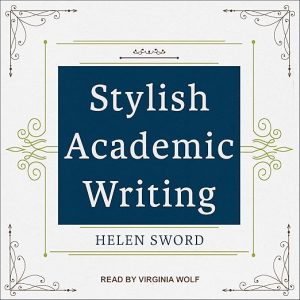
A thousand peer-reviewed articles across ten academic disciplines sat on Helen Sword's desk before she wrote a single chapter of Stylish Academic Writing, alongside a hundred published style guides she cross-referenced for points of agreement and disagreement. That is the scene worth picturing before pressing play on this six-hour audiobook, not an inspirational pep talk about finding your voice, but the output of genuine empirical research into why so much academic prose reads exactly the way frustrated readers, and frustrated academics themselves, have always suspected it does.
Editors Welcome Clear Prose, the Data Shows
Sword's central finding, that journal editors and readers actually welcome clear, vivid writing far more than the field's own conventions would suggest, reframes a problem a lot of academics assume is structural and unavoidable. Reviewer Rebecca Mugridge lays out the scale of the underlying research plainly: a thousand articles studied across ten disciplines, a hundred additional style guides analyzed for where they align and where they diverge, and that empirical backbone is what separates this from a lighter, opinion-driven writing-advice book.
The book's chapter-by-chapter structure, addressing titles and headings, chapter openings, and overall architecture as discrete, masterable elements, gives it real practical utility beyond the myth-busting premise. Reviewer kathryn torres, working through a graduate degree in Early Childhood Development at the time, describes the book as genuinely liberating, crediting it with giving her 'the courage and confidence to be brave in style' rather than defaulting to the impersonal, jargon-heavy prose her field seemed to expect.
Two Reader Profiles, One Shared Diagnosis
The synopsis specifically names two distinct reader profiles Sword is writing for: scholars frustrated with their own discipline's conventions, and specialists hoping to reach a larger audience beyond academia entirely. Those are related but genuinely different problems, one is about writing better within the existing system, the other is about writing a bridge out of it, and Sword's willingness to address both without picking a single lane broadens the book's real usefulness.
An obvious, almost unavoidable meta-test sits inside a book arguing for vivid, accessible prose: does Sword's own writing clear the bar she is setting for everyone else? Reviewer kathryn torres's specific praise for 'flair and mild humour' suggests yes, which matters more here than in most writing-advice books, since a stylist telling other writers to loosen up while writing in the exact stiff, hedged academic register under critique would undercut the entire argument.
Reviewer kathryn torres's review carries the title 'ensuring I am better equipped to critique other's work,' which points to a use case beyond simply writing more stylishly oneself: the book also sharpens a reader's ability to evaluate other people's academic prose, whether as a peer reviewer, a dissertation committee member, or an editor. That dual function, improving your own writing while giving you sharper critical language for assessing others', extends the book's practical value well past a single writer's personal style.
Virginia Wolf, Judged on This Performance Alone
Narrator Virginia Wolf doesn't have an extensive narration history that I could track down, so this performance is worth assessing on its own terms. The material demands a register that can shift between academic argument, genuinely funny example-driven prose, Sword's own writing carries real wit, per multiple reviewers, and clear instructional guidance without any one mode overwhelming the others, since Sword is simultaneously arguing a thesis, presenting research, and teaching transferable technique across a single six-hour runtime. That same get-help-where-you-actually-need-it logic runs through the whole book: a researcher who struggles specifically with dry titles but already writes lively chapter openings does not need generic encouragement to write better, she needs guidance aimed precisely at the titles problem, and treating academic writing as a set of separable, individually improvable skills rather than one intimidating monolith is part of what makes the book function as genuine instruction rather than motivational filler.
Reviewer dhydavid identifies with real specificity the exact bad habits Sword is diagnosing, defaulting to impersonal passive constructions, avoiding first-person pronouns entirely, treating those choices as the price of sounding objective. That kind of direct, personal recognition from a reviewer is a strong signal that the book's diagnosis lands accurately for its intended audience, academics who suspect their own writing habits but have not had them named this clearly before.
Narrower Than Pinker, Aimed at Academics Only
This is written primarily for practicing academics and graduate students navigating the specific pressures of peer review and publication, not for general readers simply looking to improve everyday writing. The examples, case studies, and stakes throughout are drawn specifically from scholarly publishing, and listeners outside that world will find real, transferable insight here but should expect the framing to stay academic-specific throughout.
Because Sword's argument depends heavily on specific before-and-after examples pulled from real published articles, some of the most concrete illustrative material may land with slightly less impact in audio than it would on the page, where a reader can pause and study a sentence's construction directly. The broader principles translate cleanly to listening, but writers doing serious revision work alongside the book may want the print or ebook edition open for direct reference.
Readers familiar with Steven Pinker's The Sense of Style, a comparable book making a related argument for general nonfiction writing, will recognize the underlying project here, myth-busting the assumption that difficult ideas require difficult prose, but Sword's version stays specifically anchored in the pressures and incentive structures of academic publishing rather than Pinker's broader cognitive-science framing. That narrower focus is a real strength for the specific audience this book targets, even though it means less crossover appeal for general readers outside academia.
The book's diagnosis extends beyond individual writer habits into the incentive structures of academic publishing itself, tenure pressure, disciplinary gatekeeping, the assumption that difficulty signals rigor, and listeners should expect Sword to address those systemic pressures directly rather than placing the full burden of change on individual writers alone.
At roughly six and a half hours, the audiobook compresses an enormous amount of underlying research, the full analysis of a thousand articles and a hundred style guides, into a genuinely efficient listen, which is worth noting for busy academics weighing whether they have time for one more book on writing craft this semester.
Graduate Students and Early-Career Academics Fit Best
This is an excellent match for graduate students, early-career academics, and any established researcher who suspects their own writing has calcified into jargon without quite knowing how to fix it. It is equally valuable for academics specifically hoping to write for a broader public audience beyond their own discipline's journals, since Sword's techniques are explicitly built to bridge that exact gap.
Skip this one if you want general-audience writing advice disconnected from academic publishing specifically, the examples and stakes throughout assume a scholarly context. For the audience it is actually built for, academics who want their ideas taken seriously without sacrificing readability, it delivers on Sword's own promise: elegant ideas deserve elegant expression, and this audiobook models exactly that case by case.
Quick Take
- Voice: Virginia Wolf navigates academic argument, dry wit, and clear instruction without letting any one register dominate.
- Big ideas: Academic writing myths, research-backed style guidance, structure and voice within scholarly publishing.
- Atmosphere: Sharp, practical, and occasionally funny, grounded in real empirical research rather than opinion.
- Worth it?: A genuinely useful, evidence-based guide for academics who want to write with more clarity and personality.