Quick Take
- Narration: Sonja Field delivers Weiland’s technical framework with precision and enough warmth to keep the instructional content from feeling clinical, a reliable performance for a guide that requires clarity above all else.
- Themes: Story architecture and plot timing, the relationship between structure and character arc, identifying and correcting structural weaknesses
- Mood: Systematic and encouraging, analytical about craft without making the craft feel mechanical
- Verdict: The most structurally rigorous writing guide available in this format, revised and expanded after a decade to include three new chapters, essential for fiction writers who need architecture, not just inspiration.
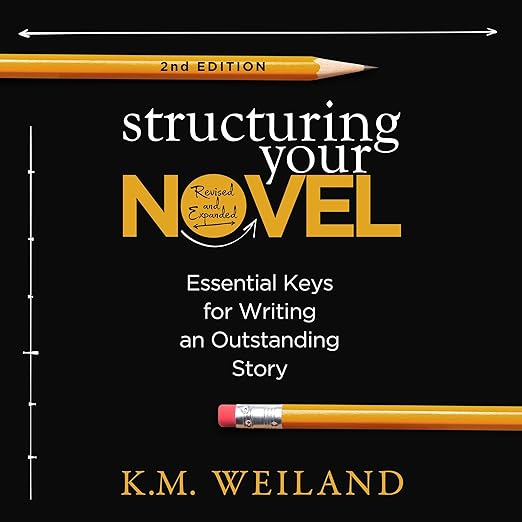
I was three chapters into a novel that had stalled when I first encountered the original Structuring Your Novel. I remember sitting in a coffee shop with the book open and realizing, somewhere around the discussion of the first plot point, exactly where I had gone wrong. The structure had been there all along, like a skeleton I’d been trying to ignore. The second edition, now available in audio narrated by Sonja Field, has been revised and expanded with three new chapters after ten years of feedback from a generation of writers who used the original to fix precisely these kinds of problems.
K.M. Weiland writes the Helping Writers Become Authors series, which spans multiple volumes addressing different craft dimensions. This is Book 3 in that series, and it is the one most writers encounter first, because structural problems are often the most visible and the most paralyzing. You can feel that a story isn’t working without being able to diagnose why, and Weiland’s framework gives you a diagnostic language.
The Clock Underneath Every Story
Weiland’s central argument is that successful stories are structured around a small number of major events that must occur at precise relative positions in the narrative. The first plot point, the midpoint, the second plot point, the climax, these are not conventions imposed from outside but descriptions of how stories that work are already organized. If your first plot point occurs at the wrong moment, the middle will sag regardless of how much action you fill it with. If your midpoint is not actually a shift in your protagonist’s approach to their problem, the second half of the story will repeat the emotional register of the first.
The analogy I find useful is music. Sonata form describes a structure that appears across hundreds of years of composed music not because composers were copying each other but because the emotional logic of exposition, development, recapitulation, and resolution maps onto something in how human beings process narrative. Weiland is making a similar claim about story: the structure she describes is not arbitrary, and understanding it gives you a map of where you are and what the reader needs to feel next.
The Advice You Won’t Find Elsewhere: Why Constant Conflict Is Wrong
One of the three pieces of structural advice Weiland includes that I found most counterintuitive, and most useful, is her argument that you should never include conflict on every page. This runs directly against standard screenwriting and fiction advice about keeping every scene conflicted. Her point is that conflict without contrast produces numbness. The reader needs variation in emotional intensity to feel the high points as high. Scenes that establish normal, scenes that build toward conflict rather than containing it, scenes that allow characters to process what has happened, these are not structural flaws but structural requirements.
This argument is more compelling in its full context than in summary, and Sonja Field’s measured narration is good for the patient explanation Weiland provides. Field does not rush the reasoning sections; she allows the logic to develop, which is what technical craft instruction requires. At six hours and twenty-one minutes, the book is long enough to develop its arguments fully, and Field’s pacing respects that development.
What the Revision and Expansion Add
The three new chapters in this second edition address aspects of structure that the first edition either skimmed or left for a follow-up volume. Without complete chapter-by-chapter comparison, I can observe from the reviewer response that the new material feels additive rather than repetitive, the reviewer who has been with the book for seven years and found the second edition revolutionary suggests that the new chapters address gaps in the original framework rather than simply expanding what was already there.
The structural framework for scene construction is where I expect the expanded material is most dense. Weiland’s discussion of saggy middles and the “centerpiece” concept is the section that most frequently gets cited by writers who found this book transformative, and an expansion of that section with updated examples and new application frameworks would represent real value for returning readers as well as newcomers.
Bird by Bird This Is Not, and That Is Fine
The other writing guides in this batch approach the craft from different angles: Lamott’s Bird by Bird is about sustaining the will to write, Allen’s Good Writing is about sentence-level precision, Weiland’s book is about architecture. These are not competing approaches; they address different layers of the problem. A writer who wants to finish a novel needs all three: the psychological stamina to keep going (Lamott), the sentence craft to make each page work (Allen), and the structural understanding to know what story shape they are building toward (Weiland).
What Weiland cannot do is make the writing itself feel emotionally alive, that is the writer’s responsibility, and no structural guide can substitute for it. What she can do is ensure that the structure underneath the prose is doing its job: creating momentum, placing revelations where they have the most impact, and building toward an ending that satisfies because it has been earned by everything that precedes it.
Frequently Asked Questions
Is this the same as the original Structuring Your Novel, or has the content changed significantly in the second edition?
The second edition is a revision and expansion of the original, celebrating the book’s tenth anniversary. It updates existing material and adds three new chapters. Writers who have used the first edition will find new content rather than simply a reformatted version, reviewers who have worked with the original for years report that the new chapters address gaps and provide fresh applications of the core framework.
Does this book work for genres other than literary fiction, or is it primarily aimed at one type of novel?
Weiland’s framework is explicitly genre-agnostic. She argues that the structural principles, plot points, midpoints, character arc alignment, scene progression, describe how stories work regardless of whether they are thrillers, romance, fantasy, or literary fiction. The examples she uses span genres, and the framework has been applied successfully to everything from commercial genre fiction to more experimental narrative structures.
How does Structuring Your Novel fit with Weiland’s other books in the Helping Writers Become Authors series?
This is Book 3 in the series, but it functions as a standalone, you don’t need to have read the earlier volumes to benefit from it. The series addresses different craft dimensions: character arcs, structure, outlining. Writers who find this book useful often proceed to the character arc volume, which complements the structural framework by showing how the protagonist’s internal journey maps onto the external plot structure Weiland describes here.
Is this audiobook useful for someone who is planning a novel but hasn’t started writing yet, or is it better suited to someone who has a draft to fix?
Both, at different stages of usefulness. Weiland writes for writers at any point in the process, from pre-drafting to revision. Pre-draft, the framework helps you plan where your major structural events will land before you begin writing, which prevents many of the problems she describes. In revision, it gives you a diagnostic tool for identifying why a draft isn’t working and what to do about it. Most readers report that the book is most immediately impactful when they have a draft in front of them, but the concepts are concrete enough to apply at the planning stage.