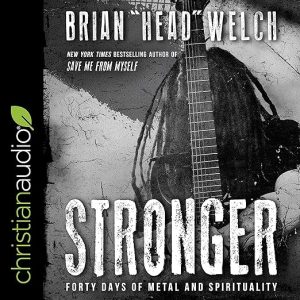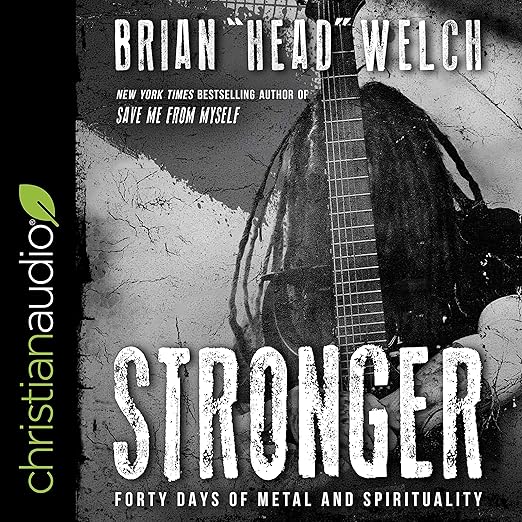
Brian "Head" Welch wrote Stronger as a 40-day devotional, and the audiobook format at three hours and fifty-seven minutes reflects that structure: short chapters designed to be engaged with one day at a time rather than consumed in a single sitting. Adam Verner narrates throughout, but the material belongs entirely to Welch, whose journey from lead guitarist of Korn through addiction to Christian faith is the spine everything else runs along.
What distinguishes this devotional from the category in general is the source of its testimony. Most 40-day devotionals are written by pastors, theologians, or career Christian authors, people who have inhabited the faith tradition for most of their adult lives and whose accounts of spiritual struggle are, by necessity, somewhat domesticated. Welch is none of these things. He is a metal musician who spent years in what he describes as a life consumed by substance abuse, found Christianity through a specific and disorienting encounter with faith, and then wrote about it without the softening that institutional religion often applies to conversion narratives.
The Bible passages Welch selects across the 40 chapters are explicitly the ones that mattered most to him personally on his journey from addiction to what the synopsis calls "salvation." He does not provide a scholarly exegesis. He provides a musician's response to verses that, at particular moments in his life, landed with specific force. One reviewer described this as "something very real and powerful about Brian Welch and his testimony, something that just simply sets you on fire." Another praised "the honesty and openness of this devotional," noting that "so much we read doesn't include real life situations."
That honesty is the book's core asset. Welch is "uncompromisingly honest about his demons," as the synopsis puts it, and "equally fervent about his faith." The combination produces a devotional that does not feel like a product. It feels like a document of an actual person's actual experience, which is rarer than it should be in the genre.
Verner Avoids Both Flat Affect and Theatrical Excess
Adam Verner's narration approach is well-calibrated for this material. He reads with a quiet sincerity that avoids both the flat affect of disengaged narration and the overemphasis of theatrical performance. Devotional content, which is designed for repeated, reflective engagement, benefits from a narrator who stays out of the way of the listener's own relationship with the text. Verner does that consistently across the four-hour runtime.
The audiobook format suits the 40-day structure particularly well because it allows for natural daily listening sessions of roughly six to eight minutes per chapter. Listeners who use the audiobook with that rhythm, one chapter per day, will likely find the content more impactful than those who listen straight through. Welch's reflections are designed to be held, not processed rapidly, and the structural pacing of the book rewards that approach.
For listeners who encountered Welch through his New York Times bestselling memoir Save Me From Myself, Stronger operates as a companion text rather than a standalone introduction. It assumes some familiarity with the arc of his story and focuses on the specific Bible passages that accompanied his recovery and faith development. Those coming to Stronger without that context will still find the chapters comprehensible, but they will have less background for the specific references Welch makes to his past.
A Devotional First, a Music Story Second
The devotional format means this audiobook is structured around Christian scripture and Welch's personal faith, and the content is unambiguously evangelical in orientation. Listeners who are interested in Welch's story from a biographical or cultural perspective, rather than from a place of shared faith, will find the material more challenging. Welch does not write for a secular audience; he writes for people who are either already Christians or who are open to the tradition his testimony represents.
At under four hours, this is a short audiobook, and the brevity is a direct function of the 40-day devotional format rather than any lack of depth. Listeners who encounter it expecting the scope of a full memoir will be surprised by the compression. Each chapter is deliberately brief, designed for a single sitting of reflection, and the audiobook's total runtime reflects forty such chapters rather than a conventional narrative arc.
Some listeners who encountered Welch initially as a rock musician may find the devotional format more spiritually explicit than expected. The subtitle references his "trying journey from substance abuse to salvation," and the book delivers on that framing comprehensively. The music context is present throughout as biographical backdrop, but this is a devotional first and a music story second.
Welch's Voice Is Useful for Listeners in Recovery
This audiobook is aimed squarely at young Christians and rock music fans who want a devotional rooted in genuine testimony rather than institutional faith. Listeners in recovery, or those who have struggled with addiction themselves and are looking for a faith-oriented perspective from someone who has navigated similar territory, will find Welch's voice specifically useful. People who found conventional Christian devotionals too smooth or too distant from lived difficulty may respond strongly to his approach.
Listeners who are looking for a broader account of Welch's life, his career with Korn, or the cultural history of Christian metal will be better served by Save Me From Myself, his memoir. Stronger is not a biography; it is a devotional, and it performs that function with integrity and conviction. Within its stated purpose, it delivers what it promises.
Quick Take
- Performance: Adam Verner reads Brian Welch's 40-day devotional with a quiet sincerity that suits the intimate, confessional register of the material.
- What it covers: addiction recovery, Christian faith, devotional practice
- Feel: Raw and personal, earnest without being preachy
- Our call: A 40-day devotional from the Korn guitarist who found Christianity after drug addiction, valuable specifically because Welch refuses to sand the rough edges off his testimony.
Common Questions
Do you need to read Brian Welch's memoir Save Me From Myself before listening to the Stronger audiobook?
No, but the memoir provides useful context. Stronger is a standalone devotional organized around 40 Bible passages, and each chapter is self-contained. However, Welch makes references to his past that are more fully explained in Save Me From Myself. Listeners who have read the memoir will find the devotional chapters richer; those who have not can still follow the content without having done so first.
How long is each individual chapter in the Stronger audiobook, and does it work better as a daily practice or a straight listen?
The 40 chapters across roughly four hours average about six minutes each. Welch designed the book for daily engagement over 40 days, and that rhythm works better in the audiobook format than listening straight through. The chapters are reflective and designed to be held rather than processed rapidly, and the daily structure gives each passage time to settle before the next arrives.