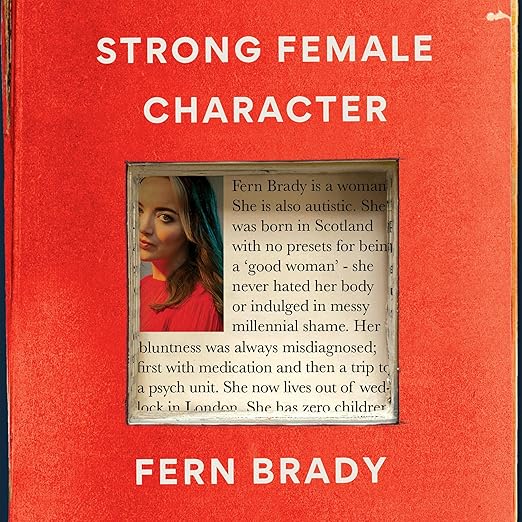
Quick Take
- Narration: Fern Brady narrating her own memoir is not a stylistic choice but a structural necessity, the book is built around what her inner voice sounds like, and no hired narrator could replicate that quality.
- Themes: Late autism diagnosis, the performance of acceptable femininity, the gap between how you appear and how you function
- Mood: Raw and funny and furious, with stretches of real tenderness
- Verdict: The British Audiobook of the Year for 2024, and it earns the distinction, one of the more honest accounts of late female autism diagnosis written by someone who is also consistently, genuinely funny.
I started listening to Strong Female Character on a Sunday morning when I had an hour free, and I canceled the plans I’d made for the afternoon. Not because the book is harrowing, though it has harrowing sections. Because it’s the kind of memoir that demands your full attention, where you want to hear every sentence rather than have it fill the background.
Fern Brady won the British Book of the Year Audiobook prize in 2024, and while awards mean less and less as they proliferate, this one is meaningful because of what it says about who found the book and why it landed with them. The reviews here include a listener who discovered her own autism spectrum identification and ADHD through reading it, she’s over fifty and had no framework for her own experience until Brady gave her one. That’s a specific kind of impact that distinguishes a memoir from a comedy book, and Strong Female Character is genuinely both.
The Masking Problem That Is Also the Book’s Central Argument
The premise in the synopsis is deceptively simple: Brady was told she couldn’t be autistic because she’s had loads of boyfriends and is good at eye contact. The book unpacks why this is both funny and devastating. What Brady describes, with precision and without self-pity, is the process of masking, of learning to perform neurotypical femininity so effectively that even professionals couldn’t see past the performance to what was actually happening. The specific ways that being female interfered with her autism recognition form the spine of the book. Girls are trained to suppress the outward signs that get boys diagnosed earlier. The social expectations of femininity, make eye contact, be agreeable, modulate your intensity, read the room, are precisely the behaviors autistic women learn to fake, which makes them functionally invisible to diagnostic criteria designed around autistic boys.
The Comedy That Isn’t Separate from the Diagnosis
One reviewer notes that the book is less consistently funny than expected from a stand-up comedian, and this is worth addressing directly. Brady’s comedy here is not deployed to lighten difficult material or to reassure the reader that everything is fine. It’s structural. The way she describes her childhood, her relationships, her working life in the sex industry, and her eventual path to comedy all have the quality of someone who learned to process experience through observation and analysis rather than immediate emotion. The humor comes from the gap between what was happening and what Brady was able to understand about it at the time. That’s different from a memoir that’s funny because the author has decided to be entertaining, and it’s more durable.
The Sections That Are Just Hard
Brady does not soften the difficult material. Her account of working as a stripper in her early twenties, the specific degradations of that experience, and the way her undiagnosed autism made her both more vulnerable to certain situations and less able to advocate for herself in them, is delivered without the protective frame of retrospective wisdom that most memoirs apply. She knew it was bad at the time. She didn’t have the tools to leave. She’s not asking for sympathy, which paradoxically makes the passages more affecting. Brady’s narration through these sections is flat in a way that’s clearly deliberate, the affect of someone reporting rather than performing, which is more disturbing and more honest than heightened emotion would be.
Who Should Listen / Who Should Skip
Strong Female Character is aimed at an adult audience who can engage with explicit material and frank discussion of trauma without requiring constant reassurance. It’s not a dark listen in the way that crisis memoirs can be, Brady’s analytical intelligence keeps the material from becoming unbearable. But this is not a comfortable audiobook. If you want to understand what late female autism diagnosis actually feels like from the inside, or if you’re a Brady fan who knows her stand-up and wants the full context for where that comedy comes from, this is essential. The self-narration is irreplaceable.
Frequently Asked Questions
Is Strong Female Character primarily a comedy memoir or an autism memoir? The genre classification seems uncertain.
Both, genuinely, and they’re not separable in the way you might expect. Brady’s comedy comes from the same observational mechanism that characterizes her autistic thinking. Readers expecting a comedy memoir will find more depth than they anticipated; readers expecting a clinical account of diagnosis will find it considerably funnier.
How does Brady handle the more difficult subject matter, the sex industry sections, the mental health struggles?
Directly and without softening. She describes her time working as a stripper and the specific ways her undiagnosed autism made her vulnerable to exploitation. The mental health sections are equally frank. Brady’s approach is analytical rather than cathartic, which some readers find easier to engage with than heightened emotional performances of trauma.
What won the British Book of the Year Audiobook award specifically, the narration or the content?
Both are intertwined. Brady’s self-narration is central to the book’s impact: the flat affect she brings to difficult sections, the comedic timing in the funnier passages, and the specific quality of her voice as someone performing her own internal experience rather than translating it for an actor. The award recognizes the audio version as its own distinct work.
Is this book useful for people who suspect they might be autistic, or is it primarily Brady’s personal story?
Multiple readers have described it as providing a framework they hadn’t encountered elsewhere, particularly around female autism presentation and masking. It’s not a diagnostic guide, but Brady’s detailed account of how autism manifested in her specific life has been genuinely useful to readers who recognized their own experience in hers.