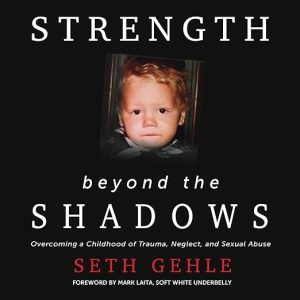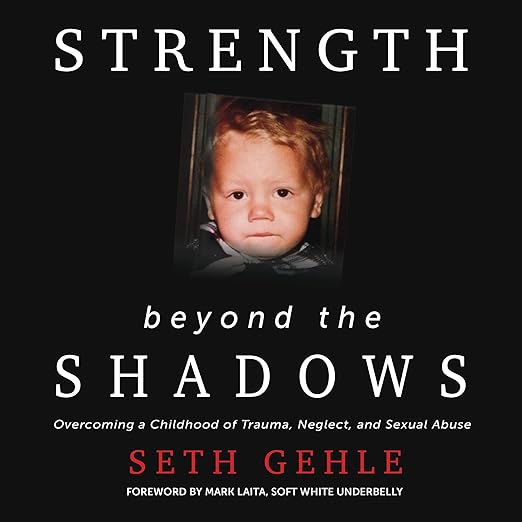
- Narration: Seth Gehle's self-narration gives the memoir a rawness and authenticity no outside narrator could replicate.
- Themes: childhood trauma and abuse, survival and resilience, reclaiming one's own story
- Mood: Heavy and unflinching, but ultimately grounded in genuine strength
- Verdict: A powerful, difficult listen that earns its emotional weight through total honesty rather than melodrama.
Sixteen years of documented childhood trauma sit at the center of Seth Gehle's memoir, and this audiobook earns its emotional weight by refusing to soften a single one of those years into something more palatable. Gehle, who first told parts of his story on the interview channel Soft White Underbelly, narrates his own account of growing up in a home defined by abuse and neglect, and the resulting audiobook reads less like a redemption arc with the hard parts trimmed out and more like an honest reconstruction of what survival actually required. Nick Lavery, a Green Beret and Special Forces veteran, blurbs the book as 'a raw, hard-truth' account few people have the courage to tell, and that description holds up across the full six hours and forty minutes.
A Masterclass in Reclaiming One's Own Voice
Gehle's decision to narrate his own material is the single biggest factor in how this book lands. Reviewer Angela Spain writes that the book is 'not just a memoir of survival' but something closer to 'a masterclass in reclaiming one's voice after trauma,' and hearing that reclaimed voice actually speak the words adds a layer no professional narrator could replicate, however skilled. An unavoidable rawness comes through when a survivor reads his own account of abuse aloud, pacing and pauses shaped by lived memory rather than performance choices.
Reviewer Kristen Harrison calls it 'one of the most raw and honest accounts of childhood trauma, neglect, and long-term sexual abuse' she has encountered, and specifically praises Gehle for refusing to sugarcoat the broken-home origins of his story. That refusal is consistent throughout: the synopsis itself frames his willingness to recount these experiences as the anomaly, since so many survivors of childhood trauma never get the chance, or the audience, to tell their full story. Gehle's project is explicitly framed as bringing understanding to what millions of other survivors also endured, not just documenting his own case.
The book's title rewards a second look. Beyond the shadows does not promise an escape from darkness so much as continued movement in relationship to it, strength built alongside trauma rather than strength that arrives only once the trauma is fully resolved. That framing shows up throughout Gehle's account, which resists the tidy redemption-arc structure many trauma memoirs default to, choosing instead a more honest, ongoing negotiation with what happened to him.
From Soft White Underbelly to the Full Story
The Soft White Underbelly connection matters for context. That channel has built a substantial audience specifically around unfiltered, long-form interviews with people who have lived through addiction, trauma, and circumstances most media sanitizes or avoids, and Gehle's appearance on that channel is where many listeners will have first encountered his story in fragments. This audiobook is the fuller version, with room to build context and aftermath that a single interview segment cannot provide.
Reviewer Heather Hawley says she finished the book 'very quickly' and found it 'amazing very relatable,' which is a notable reaction to material this heavy. That relatability, despite the extremity of what Gehle survived, points to a memoir less interested in shock value than in the specific texture of what long-term trauma actually does to a developing sense of self, and how a person claws back from it. The audiobook format, hearing Gehle's own cadence as he describes his lowest points, makes that specificity land harder than a summary ever could.
No Ghostwriter, No Smoothed-Over Arc
Unlike many trauma memoirs from public figures, this one carries no co-writer or ghostwriter credit, no polished narrative arc smoothed by an outside editorial hand. That absence is audible in the pacing, and reviewer Heather Hawley's description of finishing it quickly reads less like praise for narrative propulsion and more like an account of being unable to look away from something rawer than a professionally shaped memoir usually allows.
Nick Lavery's endorsement is worth sitting with specifically because of who he is. As a Green Beret and U.S. Army Special Forces veteran who went on to found his own company, Lavery's praise for a story about surviving what he calls unspeakable crimes carries the weight of someone whose own path required a comparable kind of unrelenting persistence. That endorsement signals the book's intended register clearly: survival literature aimed at listeners who respect hard-won resilience over polished inspiration.
The synopsis frames Gehle's experience as 'all too common,' a careful, specific claim rather than a sensational one. Gehle is not positioning himself as a uniquely tragic exception; he is positioning his willingness to speak as the unusual part, while the underlying experience of childhood trauma and abuse remains, by his own account and reviewer Kristen Harrison's independent assessment, something a great many survivors carry silently. That distinction is part of what gives the memoir its stated purpose: not just personal catharsis, but a deliberate attempt to speak for people who have not yet found their own voice.
One Survivor's Account Rather Than an Investigation
This is not a book to start casually. The synopsis is direct about covering childhood sexual abuse in detail, and Gehle does not use euphemism to soften those sections. Listeners with their own trauma history around abuse or neglect should go in with that awareness, ideally with some emotional bandwidth available rather than as background noise during a commute.
At six hours and forty minutes, the book moves at a pace that allows real reflection between the heaviest sections, but it is still a sustained, single narrative arc rather than an anthology of easier entry points. Listeners looking for a lighter trauma narrative, one with more distance from the material, will find Gehle's account considerably more intimate and unguarded than that comparison implies.
Listeners should also know this is fundamentally a solo account, Gehle's own perspective on his own life, rather than a journalistically verified investigation with corroborating outside sources. That is standard and expected for a memoir, but it is worth naming plainly: the book asks listeners to trust one survivor's account of his own experience, which is exactly the kind of trust his growing audience through Soft White Underbelly and now this longer memoir suggests he has earned.
Simply Honest About What It Contains
This audiobook is suited to listeners drawn to survivor memoirs that refuse easy redemption arcs, and to anyone who has followed Gehle's story through Soft White Underbelly and wants the complete, contextualized version in his own words. It will also resonate with listeners working through their own trauma recovery who find value in hearing someone else's account narrated with unflinching honesty rather than distance.
Skip it if detailed accounts of childhood sexual abuse are not something you can safely engage with right now. That is not a failure of the book. It is simply honest about what it contains, and the honesty is the point.