Harvard Was a Total Moonshot for Blankfein
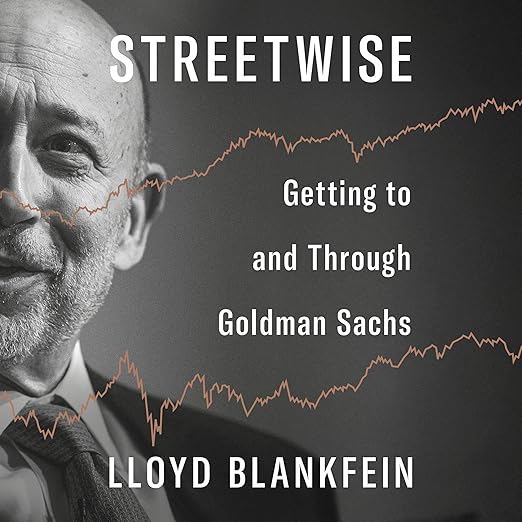
Lloyd Blankfein narrating his own memoir is an unusual proposition. The long-tenured head of Goldman Sachs, described by Bloomberg as funny, mainly blunt, unexpectedly vulnerable, and rarely apologetic, is not an obvious fit for the quieter requirements of audio performance. But the audiobook of Streetwise works precisely because Blankfein's voice carries the quality his writing is built around: a democratic, street-sharpened intelligence that cuts through the usual grandiosity of C-suite memoir without either false modesty or defensive posturing. I came into this one expecting the kind of careful institutional positioning that Wall Street books usually deliver. What I found was something considerably more honest, and something that genuinely required his own voice to land the way it does.
Blankfein grew up in the notorious public housing projects of East New York, Brooklyn. His path, through a chaotic high school he did not feel safe leaving during class time, through Harvard as a total moonshot, through Harvard Law, through tax law and commodities trading into Goldman Sachs, is not the story of a man who arrived pre-polished. The chip on his shoulder never fully left. Neither did the wry, resilient humor that helped him survive environments in which he was perpetually the outsider. Streetwise is about how both of those things shaped a leader, and Blankfein's willingness to include the times he and the firm got things wrong is what separates it from the genre's average product. The East New York chapters are the most gripping passages in the book, and hearing Blankfein tell those stories in his own voice adds an authenticity that no hired performance could replicate.
An Exception to Usual Business Memoir Aversion
The self-narration choice is the right one here. Blankfein's memoir is built on voice, not the abstracted voice of prose style but the actual quality of a person who thinks in quick pivots, who finds absurdity in formal situations, who has genuine warmth underneath the boardroom register. A professional narrator reading this text would flatten those qualities into performance. Listening to Blankfein deliver his own stories, the financial crisis account, the culture-of-partnership sections, the reflections on managing brilliant competitive people, is listening to someone who was actually in those rooms describe what they saw from inside them.
One reviewer described the book as having a great mixture of crisp, telling little details with wit, which is an accurate characterization of both the prose and the narration. The Goldman Sachs global financial crisis section is the memoir's centerpiece, and Blankfein walks through the decision-making with enough specificity to be informative and enough personal stakes to be emotionally engaging. His reflections on managing a firm whose competitive culture was also its primary risk factor are among the book's more useful professional insights for anyone who has ever led a team of exceptionally talented and exceptionally difficult people. Another reviewer noted they are usually averse to business memoirs because the grandiosity overrides the substance, and that this book is the exception. That exception is partly the writing and partly the voice delivering it.
The Slight Pause Before a Punchline
Listeners who approach this book expecting Goldman Sachs confession literature, a full reckoning with the firm's role in various controversies, will find the memoir more selective than that. Blankfein is open about personal and institutional failures in ways that feel genuine, but he is also writing from inside the institution he helped shape, and the book reflects that positioning. Jim Cramer's claim that no one has gotten inside the secret walls of Goldman Sachs like this is marketing language; the book is candid but not comprehensive, and certain episodes will read as glossed or incomplete depending on your prior knowledge of the firm's history. The partnership culture sections are detailed and affectionate; the sections on Goldman's public controversies are noticeably lighter.
At just under fourteen hours, the runtime is substantial for a business memoir. The Brooklyn and Harvard chapters are the most propulsive; the middle sections on Goldman culture and risk management are rewarding but move at a slower cadence. Listeners who approach it in segments, commute listening, or breaking the institutional chapters into multiple sessions, will find the content more digestible than trying to push through the finance sections in one extended stretch. The book rewards patience in those middle chapters with a financial crisis account that earns the buildup.
A specific note on the audiobook as a format for this memoir: Blankfein's humor is deadpan in the way that reads differently when heard than when read. On the page, a dry observation about the absurdity of Wall Street ritual or his own improbable trajectory requires the reader to infer the timing. In his own voice, the timing is already there, the slight pause before a punchline, the drop in register that signals he knows exactly what he is saying. Multiple reviewers who listened rather than read this book note that the voice reveals something the text alone does not. For business memoirs that are explicitly comedic in register, self-narration is an underrated advantage, and Streetwise is evidence of why.
Told From His Own Vantage Point
This audiobook will resonate most with readers interested in Wall Street culture and financial leadership who want a frank perspective from someone who ran one of the most prominent institutions in global finance. The Brooklyn-to-boardroom arc also gives the book genuine class mobility interest that extends beyond finance readers, Blankfein's account of navigating institutions as a permanent outsider is as useful a frame for understanding career trajectories as anything in the more explicitly career-advice category.
Listeners who want an impartial or externally critical account of Goldman Sachs should supplement with journalism and other accounts. Streetwise is a memoir, not an audit, and Blankfein tells his story from his own vantage point with the candor that naturally entails. Within those limits, it is one of the more honest and readable books in the business memoir genre, and his narration makes it worth the nearly fourteen hours.
Before You Listen
Does the Streetwise audiobook cover the 2008 financial crisis in detail?
Yes. The global financial crisis section is among the memoir's most substantial. Blankfein discusses Goldman's decision-making during that period with specific detail and genuine personal stakes, though his account is written from inside the firm and should be read alongside external accounts for a complete picture.
Is Lloyd Blankfein an effective narrator for this audiobook?
Yes, more so than you might expect. His voice carries the same democratic, street-educated directness that characterizes the writing, and hearing him deliver his own stories about East New York, Harvard, and Goldman's partnership culture adds authenticity that professional narration would not replicate. The self-narration is a genuine asset, not just a celebrity gesture.