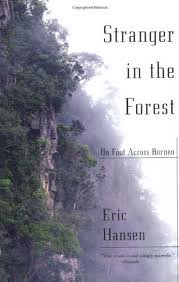
I started listening to Stranger in the Forest on a Sunday morning with no particular expectations, having only a vague awareness of the book's reputation. By the time Eric Hansen described his first week in the rainforest, disoriented, physically wrecked, completely dependent on the goodwill of people whose language he did not speak, I had cancelled everything else I had planned for the day.
Eric Hansen crossed Borneo's interior on foot in 1982, spending seven months living with indigenous communities whose longhouses were still decorated with the headhunting swords of their ancestors. He did this with a pair of ratty sand shoes and a knapsack full of trade goods, which is the kind of sentence that either signals foolhardy adventure writing or something more honest about the nature of such undertakings. In Hansen's case, it is the latter.
Where This One Lands
What distinguishes this from expedition writing of its era is Hansen's fundamental humility about his position. He is a foreigner in every possible sense, linguistically, culturally, physically, and he does not attempt to paper over this with bravado or competence narratives. He is genuinely at the mercy of the communities who take him in, and he knows it. The book is built on encounters, with individual people, with specific places, with particular hardships, rather than on the heroic assertion of self against nature.
The Borneo of 1982 that Hansen describes is a world that has since changed substantially. The rainforest he walked through faces ongoing deforestation and commercial pressure, and the tribal communities he lived with exist now in a very different relationship to the outside world. Reading this as a historical document, a record of a place and a way of life captured at a particular moment, adds a dimension that Hansen could not have intended when he wrote it but that a contemporary listener will inevitably bring.
Why Stranger in the Forest Works as an Audiobook
Richard Poe's narration suits the book's character. Hansen writes in a composed, observational register, he is not a maximalist, he does not inflate his experiences into drama, and his humor emerges from understatement rather than performance. Poe understands this. His delivery is unhurried, with a quality of attention that matches how Hansen writes about paying attention to his surroundings. The result is an audiobook that feels genuinely immersive rather than dramatized.
At just under nine and a half hours, the book is long enough to develop its world but not so long that the episodic structure, each community, each section of jungle, each encounter with illness or exhaustion, becomes repetitive. The pacing is essentially dictated by the pace of the journey itself, which is to say slow and cumulative.
What Gives Us Pause
This is not an action narrative. Listeners who come to adventure travel writing wanting kinetic pacing, near-death set pieces, or protagonists who conquer their environments will be wrong-footed by Hansen's approach. The drama here is interior and relational, how he learns to be useful to the people he travels with, how he manages physical suffering without self-pity, what the encounter changes in him.
The book was first published in 1988, and its representation of indigenous communities reflects the sensibilities of that era. Hansen is respectful and genuinely curious, but contemporary readers attuned to the politics of outside observation, who gets to write about whom, and how, will notice moments where the framing shows its age.
Who Should Pick Up Stranger in the Forest
This belongs in the same conversation as Redmond O'Hanlon's Into the Heart of Borneo (which covers adjacent geography with more comic energy) and Peter Matthiessen's The Snow Leopard for listeners who want travel writing that is also about interiority and genuine cross-cultural encounter. Those who loved Wild by Cheryl Strayed for its interior journey may find Hansen's quieter, more outward-facing approach differently rewarding. Anyone drawn to Borneo specifically, its ecology, its tribal cultures, its pre-deforestation landscape, will find this irreplaceable.
In Brief
- Read by: Richard Poe gives Hansen's understated, observational prose a composed authority that suits the slow rhythms of jungle travel and extended human encounter.
- At its heart: Cross-cultural endurance, the ethics of the outside observer, the interior transformation of long immersive travel
- Vibe: Quietly immersive and unhurried, best suited to listeners who want adventure measured in weeks, not action sequences
- Short version: A classic of immersive travel writing that rewards patient listeners, Hansen's Borneo crossing remains one of the more remarkable personal accounts of its kind.
Is Stranger in the Forest factually accurate, or does Hansen embellish his account?
Hansen is known for meticulous honesty about his experiences, including his failures and dependencies. The book does not read as embellished, if anything, it underplays the physical hardship rather than dramatizing it.
How does Richard Poe's narration handle the descriptions of indigenous communities and their practices?
Poe treats these sections with the same composed respect that characterizes his handling of the rest of the text. He does not exoticize, which is appropriate given how Hansen himself writes about the communities he encountered.
Is this a good listen for someone interested in Borneo's ecology and environmental history?
Yes, though indirectly. The rainforest Hansen traverses in 1982 is described from the inside, through the experience of moving through it, rather than explained ecologically. But the sense of what has been lost to deforestation since then is deeply present for a contemporary listener.
How does Stranger in the Forest compare to Redmond O'Hanlon's Into the Heart of Borneo?
O'Hanlon's book is more comedic and self-deprecating, foregrounding the absurdity of two literary men entering the jungle. Hansen's account is quieter and more sustained in its cultural engagement. They complement each other well for listeners who want multiple perspectives on the same region.