Quick Take
- Narration: Romesh Ranganathan reading his own autobiography is exactly the right decision, his timing is the instrument the material requires, and his delivery of self-deprecating material has a sharpness a hired narrator would blunt.
- Themes: Race and identity in provincial England, comedy as survival, the maths teacher who quit
- Mood: Sharp, self-deflating, and occasionally surprisingly raw
- Verdict: A British stand-up memoir that distinguishes itself by spending more time on what went wrong than what went right, read by the person who should be reading it.
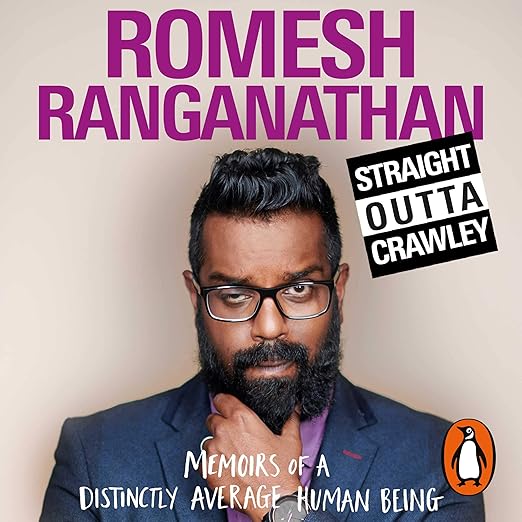
I was midway through a long Sunday afternoon walk when Romesh Ranganathan delivered his opening description of himself as ‘the most in-demand overweight vegan Sri Lankan comedian in Britain’ and I laughed out loud at a hedge. The specific formulation of that sentence, the accumulation of qualifiers, each one slightly more absurd than the last, is exactly the kind of comedy that works as well in your ears as it does from a stage, which is not as guaranteed as it sounds.
Straight Outta Crawley is his memoir, and at five hours and forty-one minutes it sits in the comfortable range for this kind of book, long enough to develop some genuine texture, short enough that he cannot pad his way to a word count. It was written and read by Ranganathan himself, and the self-narration matters enormously here.
Crawley as Character
The geographical specificity of this memoir is one of its quiet strengths. Crawley is not the glamorous backdrop that most British comedian origin stories require. It is a new town in West Sussex that exists primarily to house Gatwick Airport workers, and Ranganathan does not romanticize it. His descriptions of growing up there as the child of Sri Lankan immigrants carry an edge of cultural friction that is rare in British comedy autobiography, not because such friction does not exist, but because comics usually sand it down into something more comfortable for general audiences. He does not do that.
The section on Crawley’s race riots and what it meant to grow up brown in a town with that history is handled with more directness than you might expect from a book that opens with a Pontin’s talent competition anecdote. He does not dwell on it at the expense of the comedy, but he does not skip it either. His self-deprecating humor and hilarious stories are the book’s engine, as one reviewer put it, but there is something running underneath the engine that gives the self-deprecation some actual weight.
Twenty-Two Years Between Gigs
The structural conceit of the memoir is the twenty-two-year gap between his debut performance at age nine and his return to stand-up at thirty-one, having spent the intervening years as a maths teacher. This is a genuinely interesting premise for a comedian’s memoir, because it inverts the usual trajectory of obsessive early ambition and rapid ascent. Ranganathan did not pursue comedy relentlessly from childhood; he retreated from it entirely and found it again by accident, or something close to accident.
His account of the teaching years is not treated as a comedy-free interlude between the real story. He clearly enjoyed being a teacher, felt competent at it, and wrestled with the decision to leave in ways that are described honestly rather than retrospectively smoothed into an obvious choice. The contrast between the stability of classroom life and the chaos and rejection of the comedy circuit is drawn with real specificity.
The Self-Narration as Delivery System
Romesh Ranganathan’s comedy voice on stage has a particular quality that is very difficult to describe without resorting to imprecise adjectives like ‘dry’ and ‘deadpan.’ What it actually is, is carefully timed disappointment, he performs a version of himself that expects the worst and is therefore never surprised when it arrives, which is the foundation of his best material. In this audiobook that quality comes through in the reading of every single sentence. The timing is not just the delivery of punchlines; it is the way he reads descriptions, moves between topics, and pauses inside sentences.
One reviewer described snorting with laughter from the first page. That matches my experience of the middle stretches of the book, where the comedy finds its stride and the observations about vegan cheese, Sri Lankan hospitality, and the specific humiliations of early stand-up gigs pile up with real momentum.
Who Should Listen and Who Should Skip
This is the right audiobook for people who have already encountered Ranganathan through Asian Provocateur, Hypothetical, or his stand-up specials and want to understand the backstory. It is also accessible to listeners who came to him recently and want context for the persona. Anyone who prefers neat redemption-arc structure will find the memoir occasionally jumpy, one reviewer specifically noted it is ‘more of a jumpy around memoir thing,’ which is an accurate description. That structural looseness is a feature rather than a flaw for listeners who like their comedy memoirs to feel like long conversations rather than formal narrative.
Frequently Asked Questions
Does the audiobook cover Ranganathan’s television work including Asian Provocateur and The Misadventures of Romesh Ranganathan?
The memoir predates much of his television work, so coverage of those programs is limited. The book primarily covers his childhood, teaching career, and early stand-up years through to his initial breakthrough.
How explicitly does the book address racism and Ranganathan’s experience as a Brown man in Britain?
More explicitly than you might expect from a comedy memoir. He addresses the race riots in Crawley and what it meant to grow up as the child of Sri Lankan immigrants in that context, though the treatment is frank rather than sustained polemic.
Is this book accessible to listeners unfamiliar with British comedy or UK cultural references?
Some references will land more fully for UK listeners, but the core story of family, ambition, and finding a second career is broadly accessible. His Sri Lankan heritage adds a layer of cultural specificity that actually makes the memoir more interesting to international audiences rather than less.
Does Ranganathan’s self-narration match the delivery of his stand-up performances?
Yes, closely. The specific quality of his comedy voice, the timed disappointment, the deadpan accumulation of qualifiers, comes through in the narration. Fans of his live work will find the reading style immediately recognizable.