Quick Take
- Narration: Clifford Ponder delivers a clear, businesslike read that suits the instructional tone well, steady pacing without drama.
- Themes: Commercial real estate investing, self-storage as alternative asset class, passive income strategies
- Mood: Practical and motivating, like sitting across from a knowledgeable mentor
- Verdict: A focused, well-organized introduction to self-storage investing that gives residential real estate investors a credible new direction to explore.
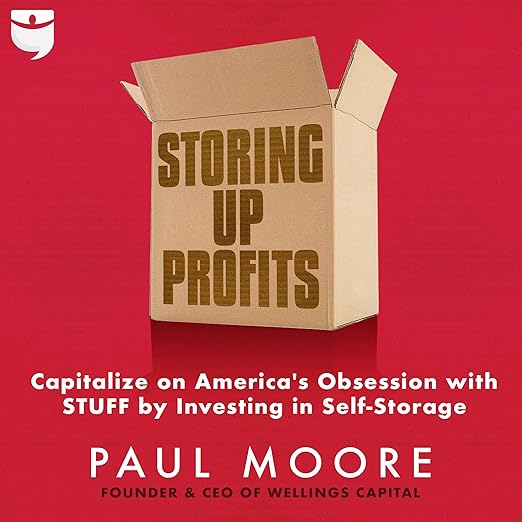
I picked this one up on a Tuesday evening after spending the previous weekend reading about yet another frothy housing market report. I was deep into researching alternatives to multifamily syndications and kept hitting the same wall: everything either costs too much to enter or requires you to quit your day job to manage. Then a colleague mentioned self-storage, and I figured an audiobook from a fund manager who actually operates in the space was a better use of my commute than another podcast episode.
Paul Moore is not a theorist. He runs a self-storage fund and writes from that position throughout. That practical grounding is what makes this title worth the time, even if it occasionally bumps up against the limits of a broad overview format.
Our Take on Storing Up Profits
What Moore does well is reframe the conversation around why self-storage deserves serious attention from investors already active in real estate. His central argument is brisk and well-supported: the asset class is fragmented, dominated by mom-and-pop operators who have not yet modernized, and therefore full of opportunities for buyers who know what to look for. He walks through four distinct acquisition strategies and devotes real attention to due diligence steps that residential investors often skip entirely when evaluating commercial assets. Reviewer Paul Capobianco notes that the book gives a good foundation for understanding what to look for in the investment space, and that rings true. Moore is not speaking vaguely about opportunity. He is laying out a framework.
The section on tax advantages is worth listening to twice. Moore identifies ten specific benefits for commercial self-storage investors, and his explanation of how many operators legally pay zero taxes is detailed enough to feel actionable. That is the section most reviewers flag when they call this a practical resource.
Why Listen to Storing Up Profits
The audiobook earns its runtime by staying specific. Unlike titles that spend the first half convincing you that real estate is a good investment, Moore starts from the assumption that you already believe that and moves quickly to the mechanics of self-storage specifically. He covers how to locate a mom-and-pop facility in the path of population growth, how to evaluate existing operations, and how to think about exit strategies. For listeners who are already comfortable with real estate concepts but have never considered commercial storage, the learning curve here is manageable. Reviewer Zeliang Z. appreciated the practical tips on starting the business and noted the book is easy to follow, though she honestly flags that the economies-of-scale sections can feel discouraging if you are starting small. That is a fair read.
What to Watch For in Storing Up Profits
The stat Moore opens with is arresting: there are more than 54,000 self-storage facilities in the United States, roughly equivalent to the combined count of Starbucks, McDonald’s, and Subway locations. That number is meant to convey scale, and it does. But the book occasionally leans on figures like this without going deeply into market saturation in specific geographies or the risk of oversupply in secondary markets, which is a real consideration. Experienced investors may find the risk discussion thinner than they would like. The overview format works well for beginners but may leave seasoned commercial investors wanting more granular modeling. Clifford Ponder’s narration is clean and serviceable. This is a book that benefits from a businesslike delivery rather than a theatrical one, and Ponder provides exactly that.
Who Should Listen to Storing Up Profits
This is best suited to residential real estate investors who are curious about commercial real estate but have not yet made the leap, passive investors evaluating syndicated deals, and anyone who wants to understand the self-storage business model before engaging a fund manager or operator. It is also a reasonable listen for accredited investors looking to diversify away from single-family rentals without taking on active management. If you are already an experienced commercial real estate operator, you will likely find the content introductory rather than revelatory. If you have zero background in real estate, the book assumes some baseline familiarity with terms like syndication and due diligence, so a quick primer first would help.
Frequently Asked Questions
Do I need experience in commercial real estate before listening to this audiobook?
Some basic familiarity with real estate investing concepts is helpful. Moore explains self-storage-specific terms clearly, but he does assume listeners know what syndications, due diligence, and cap rates mean. Residential real estate investors will feel right at home.
Does Paul Moore cover self-storage fund investing as well as direct ownership?
Yes. Moore addresses both active ownership and passive fund investing. He explains how to vet operators and syndicated deals, making the content relevant for both hands-on investors and those who prefer a passive role.
Is the tax benefit section specific enough to be genuinely useful?
Reviewers consistently highlight the tax section as one of the most concrete parts of the book. Moore identifies ten specific benefits and explains how depreciation and cost segregation work in commercial storage. It is not a substitute for a CPA, but it gives you the vocabulary to have that conversation.
How does narrator Clifford Ponder handle the technical material?
Ponder reads at a steady, professional pace that suits the instructional nature of the content. He does not inject personality or drama, which works well for a business title where clarity matters more than performance energy.