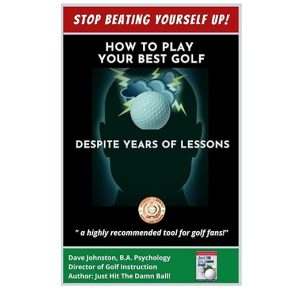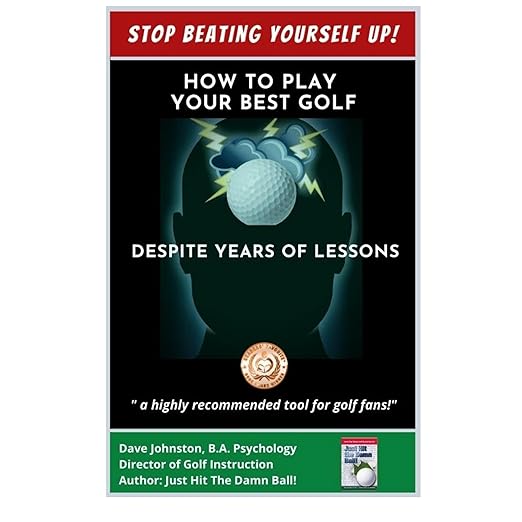
Dave Johnston structures his golf psychology books as conversations, and the craft decision that runs through the entire 'Just Hit The Damn Ball!' series is the choice to let a single student's frustrations carry the argument. STOP BEATING YOURSELF UP!, the fourth book in that series, distills those conversations to their sharpest form in a runtime of thirty-seven minutes: not a full-length audiobook but a focused primer for the golfer who already knows Johnston's framework and needs a concentrated dose of the core principles. This is not a standalone listen for newcomers; it is a closing chapter for readers who have been through the earlier volumes.
A Two-Dollar Loss Sets the Book in Motion
John, the fictional golfer at the center of the series, is a recognizable figure: a once-a-week player who practices, takes lessons, and cannot consistently break 90. His two-dollar loss to a friend who has not played in four years sets the fourth book in motion, and the teaching professional who becomes his guide walks him through seven conversations that challenge the mental assumptions built into conventional golf instruction. The arguments at the heart of this volume, the muscle memory myth, the delusion of consistency, the gap between practice performance and course performance, are familiar to readers of the earlier books, but Johnston's achievement is presenting them clearly enough that a short-form recap still carries instructional weight.
This is not a book that tries to be comprehensive. Thirty-seven minutes is enough time to argue one thing well, and Johnston uses it to argue that the biggest obstacle in the average golfer's game is the reaction to a bad shot rather than the bad shot itself. The self-punishment cycle, the replaying of mistakes, the erosion of confidence that follows a poor hole, costs more strokes than most technical errors. That argument is simple enough to state in a sentence, but Johnston builds it through John's specific frustrations in a way that makes the insight feel earned rather than imported from a self-help template.
The Virtual Voice narration is worth naming honestly. AI-generated narration has improved considerably, and for a text of this type, short and dialogue-forward, the delivery is functional. It lacks the warmth and calibration of a human narrator, particularly in the moments where emotional resonance would deepen the impact of a conversational exchange. Listeners who have followed the series in human-narrated editions may find the shift noticeable. Listeners coming to the audio format fresh for this volume will find it clear and adequately paced.
A Pre-Round Listen in the Car Park
The thirty-seven-minute runtime is both its strength and its boundary. As a pre-round listen in the car park, a quick reset between lessons, or a focused revisit to the Johnston framework before a tournament, this works exactly as intended. At its actual length, it fits the use case of a golfer who does not have time for a full book but wants a structured reminder of principles they have already absorbed.
Johnston's approach consistently draws on his conversations with more than eleven thousand students, which gives his observations about common mental patterns an empirical grounding that distinguishes them from generalized sports psychology. The specific patterns he describes, shooting 85 one round and 95 the next, playing better with less preparation, practicing solidly and performing poorly, will feel immediately recognizable to the once-a-week golfer who has lived them.
The 2019 Reader's Favorite recognition is relevant context: the book was evaluated against its genre peers and found to be among the stronger entries. That recognition applies to the full series rather than to this volume in isolation, but it speaks to the consistency of Johnston's approach across the four books.
Dialogue That Benefits From Human Calibration
New listeners should start with book one of the series. Reader feedback is clear that this volume presupposes familiarity with Johnston's framework and character, and jumping in at book four means losing the cumulative development that makes John's transformation in this final volume meaningful. The reviewer who called this the book that 'wraps up all of them' was describing a series endpoint, not a standalone primer.
The Virtual Voice narration is not a disqualifying factor, but it is an honest limitation. Listeners sensitive to AI narration will notice it throughout. The dialogue sections in particular benefit from human calibration that the automated reading cannot fully replicate.
At thirty-seven minutes, this is not a complete treatment of golf psychology. It is a focused argument about one specific mental pattern. Listeners seeking a comprehensive approach to the mental game should treat this as a companion to the full series rather than a replacement for it.
Johnston's insight about the gap between practice and course performance is the one piece of this audiobook that most recreational golfers will recognize immediately and carry with them. The phenomenon of hitting consistently at the range and then losing that consistency the moment competition or consequence enters the picture is almost universal at the recreational level, and conventional instruction often has no good account of it beyond urging the golfer to practice more or think less. Johnston's argument that the problem is mental architecture rather than technical failure, that John's self-punishment after a bad shot is literally disrupting the muscle memory process that produced the good shots, reframes the familiar experience in a way that opens the possibility of change. At thirty-seven minutes, this volume cannot develop every implication of that insight, but it states it clearly enough that the listener can take the framework onto the course and test it against their own game. That testability is the best argument for a short-form audiobook in a practical genre: the listener can verify the argument immediately rather than waiting for it to be confirmed by additional reading.
A Compact Synthesis for Existing Readers
Golfers who have read Johnston's earlier three volumes and want a compact synthesis of the series' core lesson will find this exactly what they need. Coaches working with recreational golfers who struggle with the self-punishment cycle may find the framing useful as a resource to recommend. Listeners new to golf psychology should begin with the first book in the series and treat this fourth volume as the conclusion it was designed to be.
Questions Listeners Ask
Can I listen to this audiobook without reading the earlier books in the series?
The book is designed as a series conclusion and assumes familiarity with Johnston's framework and the character of John. New readers should start with book one of the 'Just Hit The Damn Ball!' series before coming to this fourth volume.
How long is the STOP BEATING YOURSELF UP! audiobook?
The runtime is thirty-seven minutes. This is intentionally a short-form focused listen, not a full-length audiobook, and should be approached as a concentrated recap rather than a comprehensive treatment.
What is the central argument of this audiobook for golfers?
Johnston argues that the biggest obstacle in the recreational golfer's game is not technical but mental: the self-punishment cycle after a bad shot costs more strokes than the shot itself. The seven conversations in the book build this case through a fictional student's specific frustrations.
Is the audiobook narration human or AI-generated?
The narrator credit is Virtual Voice, indicating AI-generated narration. The delivery is clear and functional for this text type, but lacks the nuance a trained human narrator would bring to the dialogue-forward structure.