Quick Take
- Narration: Eckhart Tolle’s own voice, with its particular stillness and slight accent, is inseparable from the material, and hearing him read these passages creates an experience that a hired narrator could not replicate.
- Themes: Present-moment awareness, the thinking mind, suffering and release
- Mood: Meditative and unhurried, best listened to slowly
- Verdict: Less a book to be listened to than a practice to be returned to, this is most valuable for readers already engaged with Tolle’s work and least useful as a first introduction.
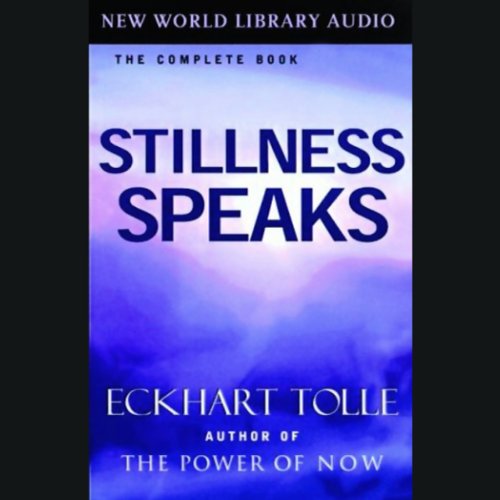
I first encountered Stillness Speaks on a long flight, and I made the mistake of trying to listen to it straight through in the same way I would a narrative audiobook. It does not work that way. Eckhart Tolle’s second book is a companion and extension of The Power of Now, organized into ten clusters of short aphoristic entries on topics ranging from stillness and silence to relationships, nature, and the end of suffering. Each entry is designed to stand alone and to be held rather than consumed. The two-and-a-half-hour runtime is technically short, but the book is not meant to be experienced as a single sitting.
Tolle narrates his own work, and this is one of those cases where the author’s voice is not simply a practical choice but an essential part of the experience. His cadence has a particular quality of stillness that readers familiar with The Power of Now will recognize immediately. There are pauses in his delivery that feel deliberate, space built into the narration that mirrors the content’s invitation to stop and let the words settle before moving to the next entry. One reviewer described him as the real thing after attending a five-day retreat with him at the Omega Institute, and while that kind of personal testimony is not transferable, the narration does carry something of that quality even through earbuds on a Tuesday morning.
Our Take on Stillness Speaks
The ten clusters cover ground that will feel familiar to readers of The Power of Now: the tyranny of the thinking mind, the vibrancy of the present moment, the way suffering arises from resistance rather than from circumstance. What Tolle adds here is a distilled format, shorter entries that can function as daily readings or as anchors in a contemplative practice rather than as extended arguments requiring sustained attention. One reviewer keeps the book on their desk and opens it at random. That is probably the most honest description of the right use for this material in any format.
Why Listen to Stillness Speaks
The audiobook format rewards listeners who can treat each entry as a pause rather than a step in a progression. Unlike most audiobooks, this is not a book that builds toward a destination. The clusters are thematically organized but not sequential in any strict sense, which means returning to a specific section does not require re-listening to everything before it. Tolle’s narration makes it possible to listen during something slow and low-demand, a walk, a quiet morning, the interval between tasks, and have the content function as a kind of accompaniment rather than a lecture requiring note-taking.
What to Watch For in Stillness Speaks
Listeners coming to this without prior exposure to Tolle’s work may find the entries cryptic or frustratingly brief. The aphoristic style assumes a certain baseline familiarity with the concepts developed more fully in The Power of Now. One reviewer noted that Stillness Speaks works best as a helpful revisit of the main signposts from that earlier book rather than as an independent introduction to Tolle’s ideas. If you have not read or listened to The Power of Now, start there. This book is not designed to carry the argument from scratch or to convince skeptics; it is designed to deepen an existing practice.
Who Should Listen to Stillness Speaks
This audiobook is best suited for existing Tolle readers who want a companion to The Power of Now in a format that allows daily, fragmentary use. It also works for anyone drawn to meditative listening practices and comfortable with content that does not resolve into a single argument or actionable conclusion. Skip it if you are new to Tolle and looking for a first introduction to his ideas, or if you prefer audiobooks with clear narrative momentum and a sense of building toward something. As a first encounter with his work, The Power of Now is the more complete and better-structured experience.
Frequently Asked Questions
Can Stillness Speaks be listened to as a first introduction to Eckhart Tolle’s work?
Technically yes, but in practice the aphoristic format assumes familiarity with the concepts developed more fully in The Power of Now. Most reviewers recommend starting with The Power of Now and treating Stillness Speaks as a companion or daily-practice follow-up.
How should this audiobook be used in a daily listening practice?
Rather than listening straight through, the format supports picking up one or two clusters or individual entries at a time and letting them settle before continuing. Several readers describe keeping the book available for moments of transition or reflection rather than designated full listening sessions.
Does Tolle’s narration make the audiobook meaningfully different from the print version?
Yes. His particular cadence, the deliberate pauses and quality of stillness in his delivery, adds a layer to the experience that a third-party narrator would not replicate. If you are choosing between formats, the audiobook version carries something the text alone cannot.
Is Stillness Speaks suitable for listeners who are not coming from a spiritual or religious background?
Tolle explicitly draws on multiple spiritual traditions rather than a single one, and the content is framed in psychological as much as religious terms. Secular listeners who are comfortable with concepts like presence and the thinking mind will find it accessible without a religious framework.