
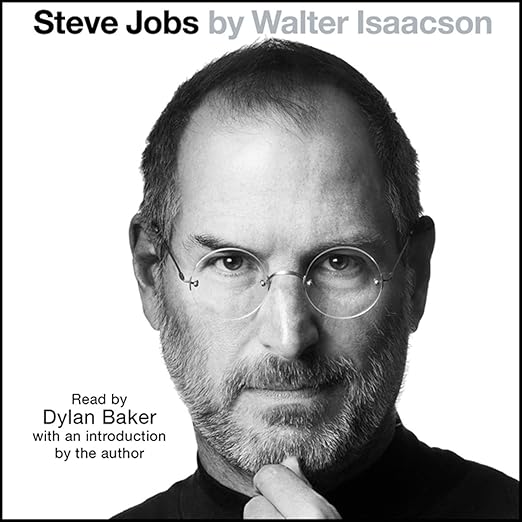
Walter Isaacson's biography of Steve Jobs rests on one of the most unusual commission arrangements in recent publishing history: Jobs asked for the book and then asked for no control over what was written. He put nothing off-limits. He encouraged the people around him to speak honestly. He himself spoke candidly, sometimes brutally so, about the people he worked with and competed against. The result is a biography that functions as a genuine portrait of a genuine egomaniac who happened to revolutionize six industries, and Dylan Baker's narration across 25 hours and 18 minutes keeps pace with both dimensions: the genuine brilliance and the genuine ugliness that coexisted in the same person throughout his career. This audiobook was a finalist for the 2012 Audie Award for Audiobook of the Year, a recognition that captures something real about the match between source material and narration.
I listened to sections of this during a week of travel, in airports and on planes, which felt appropriate for a biography conducted at the velocity of a man who believed he was running out of time even before he knew he was. Isaacson matches that velocity in the writing, and Baker's performance captures it without turning into a performance of urgency that would make 25 hours exhausting rather than compelling.
What Isaacson manages, across forty direct interviews with Jobs and more than a hundred with his family members, friends, adversaries, competitors, and colleagues, is a portrait that refuses to resolve into either hagiography or indictment. Jobs was 'driven by demons,' the biography notes, and those demons produced both the ferocity that built Apple and the behavior that made him a difficult, sometimes cruel human being to work for and with over any sustained period. Isaacson does not adjudicate between these. He narrates, and the material adjudicates itself by accumulation.
Reviewer J.S. Greenfield compares this to Isaacson's Einstein biography, noting that it 'did a profoundly better job of explaining' its subject's distinctive thinking than alternative accounts. The comparison is apt: Isaacson is particularly good at making a particular kind of non-linear, intuition-driven intelligence legible to readers who operate differently. Jobs's insistence on integrating hardware and software, his aesthetic commitments that seemed irrational to engineers until they were not, his understanding that creativity and technology needed to function as an integrated system rather than adjacent domains: these come through clearly in the biography's analytical moments and in Baker's confident handling of them.
Why It Works in Audio
Dylan Baker's narration handles the tonal complexity this biography requires. Jobs's own quoted speech is direct and often brutal; his colleagues' accounts of him range from admiring to wounded to both simultaneously; the biographical analysis Isaacson provides is more measured and more considered. Baker navigates between these registers without flattening them into a single consistent tone. A narrator who played Jobs's own words as simple villain speech would miss what Isaacson is doing; Baker understands that the same person can be brilliant and contemptible in the same moment and that the biography is not trying to reconcile the two dimensions into something tidier.
At 25 hours, this is a long listening commitment by any measure, but the material sustains it without effort. Reviewer Emc2 describes reading it over 'almost two weeks' with 'a sensation of wanting for more' at the end, which captures the particular quality of a biography that leaves its subject genuinely alive even after it formally concludes. Baker's pacing manages the length without listener fatigue by keeping the forward momentum of the narrative always present even in the more reflective analytical sections.
Before You Commit to Steve Jobs
The biography's access is its defining quality and also its inherent limitation. Jobs cooperated fully and then died before the book was published, meaning Isaacson has Jobs's own perspective on his life in remarkable depth, but Jobs had no opportunity to respond to what was ultimately written about him. Some of the more damaging characterizations, of his behavior toward family members, his treatment of colleagues, his capacity for cruelty in personal relationships, rest on accounts he cannot challenge from the other side. The biography acknowledges this structural fact but cannot resolve it.
Readers looking for a technical account of Apple's product development will find what they want here, but embedded in biographical narrative rather than presented as organizational analysis. This is a life story that uses technology as its context, not a technology story that uses a life as its frame. The distinction matters for setting accurate expectations about what 25 hours will give you.
The biography also captures something important about the relationship between Jobs's aesthetic commitments and his institutional behavior that other accounts miss. His insistence on integration, on hardware and software functioning as a unified system rather than separate products, was not simply a design preference. It reflected a genuine belief about how beauty and function relate to each other that drove his management decisions as much as his product decisions. Understanding this connection, which Isaacson makes clear through the accumulated interviews, explains why Jobs made choices that seemed irrational to rational-actor models of corporate behavior and why they produced results those models could not have predicted.
Who Will Get the Most From It
Business and biography listeners who want access to one of the most extensively reported portraits of a twenty-first century innovator will find this audiobook essential. The Audie Award finalist status reflects genuine quality in both the source material and Baker's narration, and 25 hours at this level of access to a figure this significant is a genuine investment that pays returns commensurate with the time committed.
Listeners who want either a straightforward celebration of Jobs's achievements or a simple accounting of his failings will find the biography's commitment to complexity demanding. Isaacson holds both dimensions without resolving them into something more comfortable, which is the right approach to a subject this contradictory, but it requires a listener willing to sit with that unresolved tension for the full length of the audiobook.
Is the Steve Jobs audiobook the same as the full print biography?
Yes. Dylan Baker narrates the complete text of Isaacson's biography. At 25 hours and 18 minutes, this is the unabridged version.
How does Dylan Baker's narration handle Jobs's own quoted words versus Isaacson's analysis?
Baker differentiates the registers clearly, giving Jobs's direct speech its characteristic bluntness while keeping the biographical analysis more measured. He does not editorialize through tone, which is the correct choice for a biography this committed to letting the material speak.
Does the Steve Jobs audiobook require any prior knowledge of Apple's history?
No. Isaacson builds the context as he goes, and the biography is designed for general readers as well as technology enthusiasts. Familiarity with Apple's product history enriches the reading but is not required.
Is this audiobook a celebration of Steve Jobs or a critical examination?
Both simultaneously, which is what makes it unusual. Isaacson had unprecedented access and no editorial control from his subject. The portrait is complex enough to show genuine brilliance and genuine cruelty without resolving either.







