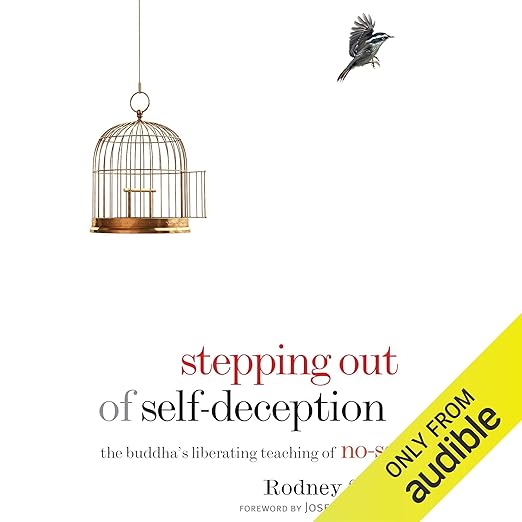
Quick Take
- Narration: Tom Pile reads the material with measured calm, appropriate for the subject but occasionally too even for passages that carry genuine revelatory weight.
- Themes: Buddhist no-self, the illusion of permanent identity, liberation from self-improvement thinking
- Mood: Dense, contemplative, and genuinely challenging
- Verdict: Not an introductory Buddhist text and never pretends to be. For practitioners willing to sit with difficulty, Smith offers a rare map of interior territory most teachers avoid.
I picked this one up during a period when I was actively frustrated with the self-improvement framing that dominates most mindfulness content. Something about the promise embedded in every wellness audiobook, that a better version of you is waiting just beyond your next habit, had started to feel less like encouragement and more like a specific kind of restlessness. Rodney Smith’s Stepping Out of Self-Deception arrived at the right moment: it opens by arguing that the entire premise of self-improvement is the problem, not the solution.
The book takes on anatta, the Buddhist teaching on no-self, which is genuinely one of the more philosophically difficult concepts in any religious tradition. Smith does not simplify it into palatability. He also does not perform the pseudo-mystical vagueness that sometimes substitutes for actually engaging with the concept. What he does instead is approach anatta as a practitioner’s map, something useful for navigating actual meditation and daily life rather than a puzzle to be solved in theory.
Our Take on Stepping Out of Self-Deception
The framing that anatta is not about the nonexistence of self but about the temporary, assembled nature of what we call self is philosophically careful and practically useful. Smith’s observation that the self reading any given sentence is a configuration of elements that will not persist is not an invitation to nihilism but a genuine reorientation of attention. The book’s central argument, that the perspective of selflessness is the key to moving past self-improvement and into something closer to deep insight, is one that Western Buddhist practitioners often struggle to find articulated clearly. Smith articulates it clearly. A reviewer who described it as a map for navigating interior practice in relation to this teaching in everyday life captured the book’s actual utility exactly. Another reviewer, writing from a background that included formal retreat experience, spoke to the book’s accuracy in ways that confirm Smith is writing from genuine practice rather than theory.
Why Listen to Stepping Out of Self-Deception
This is a book that rewards multiple passes. The 10-hour runtime is long enough that single-listen comprehension is genuinely difficult for the more concentrated passages. Tom Pile’s narration is clean and unobtrusive, which serves the material without particularly elevating it. The audiobook format has a specific advantage here: listening while walking or during a quiet morning routine allows the more challenging passages to settle before the next section arrives, rather than encouraging the visual reader’s tendency to press forward through confusion. The audiobook form, used patiently, suits this text well.
What to Watch For in Stepping Out of Self-Deception
This is not an entry-level text, and Smith does not write as though it were. One reviewer with average Buddhist exposure and serious meditation experience still found many passages genuinely difficult to hold. Smith’s lines of thought are complex and do not always resolve into summary statements. If you are hoping for the clarity that Thich Nhat Hanh or Pema Chodron provides, this is a different register entirely. The book expects the reader to sit with difficulty and return to passages after reflection. In audio format, that means being willing to pause and rewind rather than pressing through to the end. Listeners hoping for practical techniques or step-by-step instructions will find this frustrating. It is a conceptual and experiential map, not a training manual.
One more aspect worth noting: Smith writes about the movement from an unconscious somebody to a conscious nobody with a kind of poetic precision that is rare in religious nonfiction. The language does not achieve this through abstraction. It achieves it through accumulated concrete observation about how the mind works, how it constructs a self from available material, and how that construction feels from the inside. That quality is what makes the book valuable enough to revisit multiple times as a practitioner, and what makes the audiobook format, with its option to replay and pause, a genuinely useful vessel for the content.
Who Should Listen to Stepping Out of Self-Deception
Dedicated meditation practitioners who have encountered anatta in their practice and want a serious, non-scholarly engagement with the concept. Anyone who has found the self-improvement framing of popular mindfulness dissatisfying and wants to understand why Buddhist teaching challenges that framing at a fundamental level. Not recommended for those new to Buddhist thought or those looking for accessible introductions to meditation. The 4.5 rating across 112 reviews understates the intensity of the book’s demands on the listener, and the commitment those demands require.
Frequently Asked Questions
Is Stepping Out of Self-Deception suitable for someone new to Buddhism?
No, and Smith does not write as though it is. Multiple reviewers with substantial practice experience found it challenging. A more accessible introduction to Buddhist concepts would be a better starting point before returning to this text.
How does Smith’s approach to anatta differ from other Buddhist teachers?
Most teachers either avoid the no-self teaching or soften it considerably for Western audiences. Smith addresses it directly and in practical terms for daily meditation practice, which reviewers with serious meditation backgrounds found both rare and valuable.
Does Tom Pile’s narration add anything to the text, or is reading the book preferable?
Pile reads cleanly without obvious interpretation. The audiobook format may actually help by allowing passages to settle during walking or quiet activity, rather than encouraging the visual reader’s impulse to push through difficult material.
Is this a book about meditation techniques or more of a philosophical exploration?
Primarily philosophical and experiential. It provides a conceptual framework for understanding selflessness in practice rather than specific meditation instructions. Reviewers who expected technique-focused content found it disorienting.