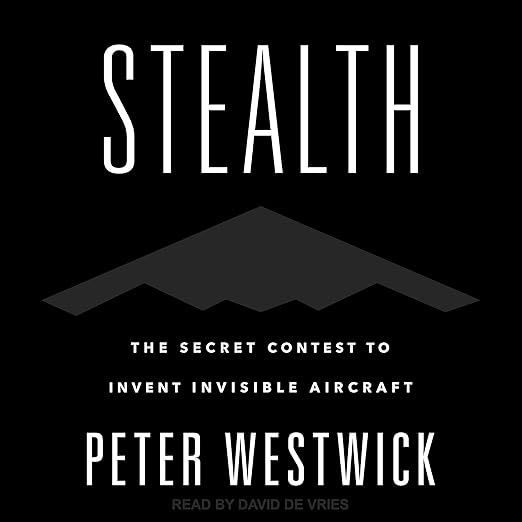
Quick Take
- Narration: David de Vries brings measured authority to a technically dense subject, keeping the engineering and organizational history engaging across nearly eight hours.
- Themes: Cold War aerospace innovation, secrecy and institutional culture, the intersection of physics and military strategy
- Mood: Methodical and absorbing, with genuine thriller energy in the operational chapters
- Verdict: A serious, well-sourced history of stealth aviation that rewards both aviation enthusiasts and general readers interested in Cold War technology.
I came to Stealth by Peter Westwick through a conversation with a retired aerospace engineer I met at a conference in Pasadena. He mentioned it almost as an aside, ‘the one book that actually gets the culture right’, and I filed it away. A few months later I pulled it up on a long drive through the California desert, which felt, in retrospect, like exactly the right landscape for a book about aircraft designed to disappear. By the time I reached the outskirts of Las Vegas, I had burned through four of the nearly eight hours and was recalibrating everything I thought I understood about the relationship between World War II radar development and the F-117 Nighthawk.
What Westwick has written is not a simple technology chronicle. It is a genuinely layered account of how a seemingly impossible engineering problem, making a large aircraft invisible to radar, became the defining aerospace achievement of the Cold War era, and how two very different organizations, Lockheed’s Skunk Works and Northrop, approached that problem from fundamentally different directions. The result is a book that works simultaneously as institutional history, biography, engineering explainer, and Cold War narrative.
The Physics Before the Drama
One of the things Westwick does exceptionally well is establishing the scientific stakes before he gets to the human stories. The early chapters on radar’s development, its critical role in World War II, the specific investments the US made that exceeded even the Manhattan Project in financial terms, build a foundation that makes the stealth problem feel genuinely urgent rather than abstractly historical. The claim that radar won the war more than the atomic bomb ended it is not presented as provocation but as a historically grounded argument, and Westwick supports it carefully before using it as the springboard for everything that follows.
The technical explanation of how stealth works, how aircraft can be engineered to return a radar signature the size of a ball bearing despite a 60-foot wingspan, is handled with impressive clarity. Westwick does not condescend to non-engineers, but he also does not shy away from the actual physics. He explains the competing approaches taken by Lockheed, which relied on faceted surfaces and mathematical modeling from Soviet physicist Pyotr Ufimtsev, and Northrop, which pursued curved surfaces and a different set of engineering intuitions. The contrast between these methodologies is one of the book’s richest threads.
The Skunk Works Culture and What It Explains
Reviewers with direct experience in the aerospace industry flagged that Westwick captures the Southern California aerospace culture with unusual accuracy, and that credibility extends to his portraits of the institutional environments that made stealth possible. The Skunk Works model under Kelly Johnson, small teams, minimal oversight, radical secrecy, is contrasted with Northrop’s more conventional organizational structure, and Westwick traces how those differences shaped the resulting aircraft. The F-117, angular and faceted, reflects Lockheed’s mathematical-first approach. The B-2, with its smooth curves and flying-wing design, reflects Northrop’s different engineering philosophy.
The human portraits throughout are among the book’s genuine pleasures. Westwick sketches figures like Johnson with the kind of specificity that makes institutional history feel personal, and his account of how government procurement processes in the 1970s and 1980s shaped what was ultimately possible is clear-eyed without becoming cynical. One reviewer noted that the book dispels a number of persistent myths about stealth aircraft, and that is accurate, Westwick is careful about distinguishing what stealth can and cannot do, and he is appropriately skeptical of the more hyperbolic popular accounts of the technology.
Baghdad, January 1991
The book opens with the combat deployment described in the synopsis, a dozen aircraft appearing over Baghdad as if from nowhere, each leaving a radar footprint the size of a ball bearing despite their actual scale, and it earns that dramatic opening by the time you have heard the rest of the story. The Gulf War chapters work precisely because Westwick has spent the preceding hours building the reader’s understanding of what it took to produce those aircraft. The operational success is not a surprise so much as a culmination, and the emotional weight of it lands differently than it would in a conventional military history.
David de Vries narrates with the kind of careful authority that suits technically dense material. He does not over-dramatize, which is the right call for a book that earns its drama through accumulated historical weight rather than editorial heightening. His pacing through the engineering sections is patient without becoming tedious, and he handles the organizational names and technical terminology with confidence throughout the eight-hour runtime. The one area where the narration feels slightly flat is in some of the biographical sketches, where a more varied vocal approach might have brought the characters to life more vividly. It is a minor note in an otherwise strong performance.
Who Should Seek This Out and Who Might Struggle
Stealth is genuinely accessible to non-specialist listeners, but it does ask for patience with technical content. Readers who come to it primarily for the Gulf War action will find the first two-thirds, the Cold War development history, slower going, though Westwick works hard to keep the narrative propulsive. Aviation enthusiasts, Cold War historians, and anyone interested in how large bureaucratic and engineering organizations actually generate innovation will find this consistently rewarding. Those seeking a pure tactical military history may find the institutional focus less engaging than they expected. Listeners who have already read books on the Skunk Works or the B-2 specifically will find significant new context rather than familiar territory retold.
Frequently Asked Questions
Does Westwick cover both the F-117 and the B-2, or does the book focus on one aircraft?
Both aircraft receive substantial coverage, along with the prototype programs Have Blue and Tacit Blue. The book traces the divergent engineering approaches at Lockheed and Northrop in parallel, which means the F-117 and B-2 serve as the culminating expressions of two different institutional philosophies rather than separate stories.
How technically demanding is this audiobook for a listener without an engineering background?
Westwick writes for an intelligent general audience and handles the physics clearly without requiring prior knowledge. The radar and electromagnetic concepts are explained from first principles, and the engineering differences between the two stealth programs are framed in ways that make intuitive sense even without technical training.
Does David de Vries’s narration handle the aerospace terminology and proper names accurately?
Yes, de Vries handles the technical vocabulary and names with consistency and apparent confidence. Some listeners may find his approach slightly flat in the biographical sections, but for a book this dependent on accurate technical delivery, his reliability is more valuable than expressiveness would be.
Is this book primarily about the Cold War period or does it extend into post-Cold War stealth development?
The core narrative runs from World War II radar development through the Gulf War deployment of the F-117. Post-Cold War developments are touched on but not the focus. Listeners looking for a history that extends into 21st-century stealth programs like the F-22 or F-35 will need to supplement this with other sources.