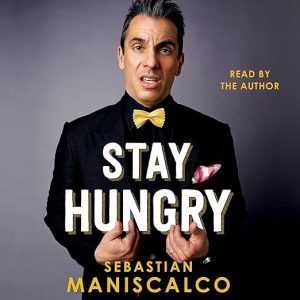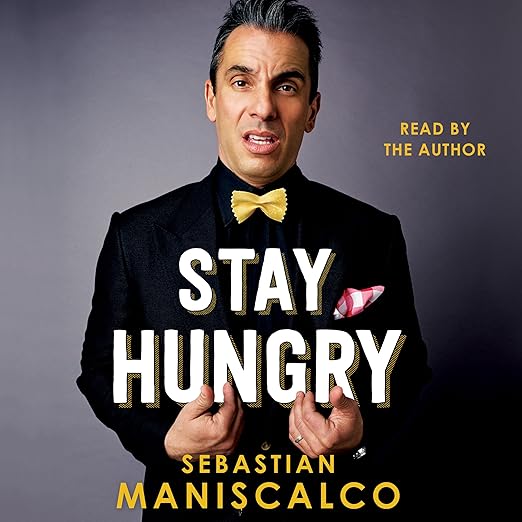
Sebastian Maniscalco narrating Stay Hungry himself is not merely a format detail. It's the entire point of this audiobook. His comedy depends on voice, on the particular Italian-American rhythms he absorbed growing up in the Chicago suburbs, on the way he lands a pause before a punchline. To hear someone else read this collection of essays about his two decades of anonymous hustle would be to miss the thing that makes the hustle legible. The book is a performance as much as a memoir, and Maniscalco knows it.
The story he tells here covers the twenty years between arriving in Los Angeles at 24 with a suitcase and saved-up minimum wages, and landing on Forbes' list of highest-earning comedians. The raw math of that trajectory is remarkable. But what Maniscalco is actually interested in is the texture of those years: the bowling alleys and boxing rings, the stolen food, the mentors, the moments of humiliation that he has since converted into material. This is not a success story told in reverse. It's a success story told at human scale.
A Closer Look at Stay Hungry
Maniscalco's comic voice is often described as observational, but that undersells it. He's specifically interested in the gap between how things are supposed to go and how they actually go. Between the dignity people claim and the indignities they absorb. His Italian immigrant family background shapes this in ways the book makes explicit: his father worked as a waiter and believed in the dignity of that work, and his mother believed in abundance and presentation. The combination produced a comedian who is simultaneously cynical about pretension and deeply earnest about effort.
The mentor anecdotes are among the book's best material. Maniscalco writes about advice and access from Andrew Dice Clay, Vince Vaughn, Tony Danza, and Jerry Seinfeld: figures who occupy very different corners of American comedy, and the diversity of that list says something about how he navigated the industry. He wasn't waiting for permission from any single tradition. He was collecting wisdom wherever he could find it while working as a waiter at the Four Seasons for years before comedy provided a living wage.
What Makes Stay Hungry Worth Hearing
Reviewer Valerie Goodman notes that "his honesty about his emotions, fears, and joys is refreshing and endearing," and that combination is what lifts Stay Hungry above the standard comedian memoir format. Maniscalco doesn't perform confidence he didn't feel. The book documents real anxiety, real financial precarity, and real self-doubt alongside the humor. He was booed off stages. He spent years performing for crowds that didn't respond. The fact that he kept going isn't framed as inevitable. It's framed as a choice that was genuinely difficult and often irrational.
The audiobook format amplifies this considerably. When Maniscalco describes the specific shame of a bad set or the particular joy of a crowd finally understanding what he was doing, the delivery carries information that the prose alone can't. His voice breaks slightly in places where a different narrator would read straight through. His laugh at his own past absurdity is audible. The listening experience across all 7 hours and 33 minutes is closer to sitting across from him than it is to reading a book, and that's not a small thing.
Things to Know Before Starting Stay Hungry
With only a single listener rating in the database, this particular edition is undersurveyed, though Maniscalco's broader catalog of recorded performances suggests his fans respond strongly to his self-narration. The essays are organized around themes rather than strictly chronologically, which works well for the overall shape but occasionally creates slight redundancy. The same formative period gets revisited from different angles, and listeners expecting a clean timeline may find the structure slightly meandering.
The book is also unambiguously positioned within an Italian-American family framework. Reviewer Amazon Customer mentions how it evoked memories of Italian family life in the Detroit suburbs, and that cultural grounding is integral rather than incidental. Listeners who don't share that background will still follow the narrative, but the specific flavor of Maniscalco's comedy: the particular combination of machismo and sentimentality, the specific relationship to food and family and embarrassment, is rooted in a cultural context that rewards some prior familiarity with his stand-up specials.
The book also rewards close listening for its structural honesty about comedy as labor. Maniscalco doesn't romanticize the hustle in the way that success narratives often do in retrospect. He's specific about what the years of obscurity cost him, financially and psychologically, and he's specific about the moments when quitting would have been the rational choice. The fact that he didn't isn't presented as grit or destiny but as a combination of stubbornness and the inability to imagine doing anything else. That honesty is rarer than it appears in a genre where struggle tends to be repackaged as heroic preparation for eventual triumph.
Who Sebastian Maniscalco Is Writing For
Existing Maniscalco fans are the obvious first audience, and for them this audiobook is essentially non-optional. It's the backstory for everything they've watched him perform. But the book also works for listeners interested in the mechanics of comedic careers: the grind, the humiliation, the eventual breaks, and the long period where success seems entirely hypothetical. It sits in the same territory as other comedian memoirs about the pre-fame years, but the self-narration makes it more immediate than most.
Skip it if you're unfamiliar with Maniscalco's comedy and haven't warmed to his style in other formats. The book assumes a certain amount of affection for his persona. Skip it also if you want a conventional memoir with a linear structure and clear emotional climaxes. Seek it out if you want to hear a comedian tell the truth about what the years before success actually felt like, in the voice that made those years ultimately worth it.
Good to Know
Does Maniscalco self-narrating Stay Hungry actually improve the audiobook experience?
Significantly. His comedy depends on timing, vocal emphasis, and the specific Italian-American cadence he uses in performance. A hired narrator would deliver the words accurately, but Maniscalco's own pauses, vocal breaks, and audible reactions to his past absurdity carry meaning the prose alone can't convey.
Do I need to be familiar with Maniscalco's stand-up specials before listening to this audiobook?
Familiarity with his stand-up helps, particularly with his four Showtime specials including Why Would You Do That?, because the book provides backstory for the persona his fans already know. That said, Stay Hungry reads on its own terms as a story about two decades of grinding obscurity before success, and new listeners will follow it without prior exposure.
How does Stay Hungry handle the emotional side of the story versus the comedy?
More honestly than most comedian memoirs. Maniscalco doesn't perform confidence he didn't actually feel during those years. The book documents real financial precarity, genuine humiliation from bad sets and hostile crowds, and self-doubt alongside the humor. The balance between funny and sincere is one of the audiobook's genuine strengths.
Is this audiobook suitable for listeners who don't share an Italian-American background?
Yes, though the cultural grounding is significant. His relationship to family, food, dignity, and embarrassment is specifically rooted in the Italian immigrant experience his father modeled. Non-Italian listeners will follow the narrative without trouble, but the specific flavor of his comedy rewards some familiarity with that cultural register.