Quick Take
- Voice: Kelly Wilkinson brings appropriate sensitivity to Cynthia Star’s first-person memoir, reading with warmth and restraint that honors the author’s vulnerability without over-dramatizing it.
- Big ideas: eating disorder recovery, self-worth and the pursuit of love, the thirteen-year arc from illness to healing
- Atmosphere: Raw and intimate, with a genuine undercurrent of hard-earned hope
- Worth it?: A memoir that earns its recovery lessons by grounding them in real experience; most valuable to listeners who are on their own path through disordered eating or supporting someone who is.
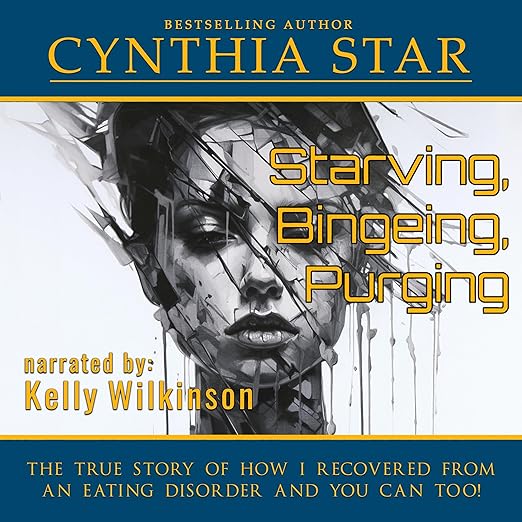
What does thirteen years of fighting your own body actually look and sound and feel like from the inside? Cynthia Star’s Starving, Bingeing, Purging is an answer to that question, and it does not negotiate its honesty to make the listener more comfortable. Narrated by Kelly Wilkinson across seven hours and thirty minutes, this memoir moves through anorexia, bulimia, purging behaviors, and food addiction as lived experience rather than clinical description. The audiobook format gives Star’s first-person voice an intimacy that the page version can only approximate; heard aloud, the account of those thirteen years carries the weight of real time, not just the summary of it.
Star’s framing device is the pursuit of worthiness. The opening of the book establishes this directly: all she wanted was to be worthy of love, and the eating disorder became the instrument through which she tried to earn that worthiness and, simultaneously, punished herself for failing to achieve it. That psychological architecture is familiar to anyone who has worked in or around eating disorder recovery, but what distinguishes this memoir is the granularity. Star does not stay at the level of insight. She goes back into the specific patterns, the specific moments of choice and compulsion and despair, in ways that make the account credible as testimony rather than just survivorship narrative.
Wilkinson Avoids Reaching for Easy Catharsis
The twenty-one recovery lessons that conclude the book are the element that most distinguishes Starving, Bingeing, Purging from a pure literary memoir. Reviewer AvidReader noted that Star provides concrete tools alongside her story, and that dual function, witness account and practical guide, is exactly what makes this audiobook useful beyond its emotional impact. The lessons are drawn directly from Star’s own path through recovery and are specific enough to have genuine utility. They are not the kind of generic affirmations that fill the back pages of recovery titles as a checkbox; they emerge from the narrative and feel earned because the listener has followed the journey that produced them.
Kelly Wilkinson’s narration carries the material with notable restraint. A common failure mode in reading trauma memoirs aloud is the tendency to over-perform the emotional peaks, reaching for catharsis in a way that actually distances the listener from the experience being described. Wilkinson avoids this. Her reading of the darker passages is steady and present rather than theatrical, which keeps the listener inside the experience rather than observing it from outside. Reviewer David described Star’s account as filled with wisdom hard-won through lived experience, and Wilkinson communicates exactly that quality in her performance: this is someone who went through something, not someone performing having gone through it.
A Human Voice That Can Penetrate Defenses
The seven-and-a-half-hour runtime sits in a productive range for memoir. It is long enough to develop genuine depth and follow the arc of Star’s recovery through its stages rather than compressing it, but it does not overstay. The audiobook is particularly well suited to listeners who process difficult emotional material better through sound than through the visual experience of reading. There is something about hearing a survivor’s story in a human voice that can penetrate defenses that the act of reading sometimes leaves intact. For listeners who are currently in eating disorder recovery, this quality is both a potential resource and a reason for care; the material is confrontational in the best sense, and timing matters. For loved ones trying to understand what someone they care about is experiencing, this audiobook offers access to an interior life that is difficult to describe in the abstract.
The distinction between memoir and self-help is one that Starving, Bingeing, Purging navigates with more awareness than most recovery titles. Star does not resolve the narrative tension too quickly by reaching for reassurance before it has been earned. The account of her thirteen years unfolds at the speed of real life rather than the speed of insight, which means the reader sits inside the disorder for a significant portion of the runtime before the work of recovery begins to feel real and possible. That pacing is a deliberate ethical choice. Presenting recovery as the dominant register from the start would falsify the experience and reduce the book's usefulness to people who are not yet anywhere near the recovery stage. By staying inside the difficulty, Star creates space for listeners who are in the middle of their own fight to feel seen rather than lectured.
The Courage It Takes to Heal
Potential listeners should be aware that the memoir describes specific behaviors associated with anorexia, bulimia, and food addiction in some detail. The intention is always illumination rather than instruction, and Star’s frame is consistently one of recovery and hope, but the specificity that makes the account authentic also means it should be approached thoughtfully by listeners in active recovery. The 4.5 rating across 41 listeners reflects genuine appreciation for the memoir’s honesty, with the most effusive reviews coming from readers who recognized themselves in Star’s experience. Reviewer Tony N noted the courage it takes to heal and the depth of the look into disordered eating habits, which captures both what the book offers and what it asks of its audience.
Approach with Care and Ideally with Support
This audiobook is most directly valuable for people who are themselves navigating eating disorder recovery or supporting someone who is. The combination of raw personal testimony and structured recovery lessons makes it genuinely useful rather than purely cathartic. Mental health professionals who work with eating disorder clients will find Star’s first-person account a valuable perspective on the lived experience behind the clinical framework. General memoir listeners who engage with addiction and recovery narratives will find it compelling, though those with no personal or professional connection to eating disorders may find some of the behavioral detail more confronting than illuminating. Listeners who are in a fragile place in their own recovery should approach with care and ideally in consultation with a therapist or support network.
Questions Listeners Ask
Does this audiobook contain detailed descriptions of eating disorder behaviors that could be triggering?
Yes. Cynthia Star describes specific behaviors associated with anorexia, bulimia, and food addiction with the kind of granularity that makes the memoir feel authentic. The framing is consistently one of recovery, but listeners in active recovery or with a personal history should approach thoughtfully and ideally with professional support.
What are the 21 recovery lessons in this audiobook, and are they practically useful?
The lessons are drawn directly from Star’s own recovery journey and cover concrete strategies for healing from disordered eating. Reviewers have consistently noted that they feel earned rather than generic because they emerge from the narrative; they are not a separate self-help appendix but an extension of the memoir itself.
How does Kelly Wilkinson’s narration handle the more painful passages in this audiobook?
Wilkinson reads with steady warmth and restraint, avoiding the over-performance that can undermine trauma memoir narrations. Her approach keeps the listener inside the experience rather than observing it at a distance, which serves the intimate, first-person nature of Star’s account well.