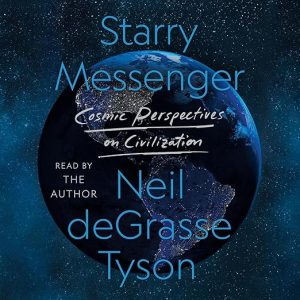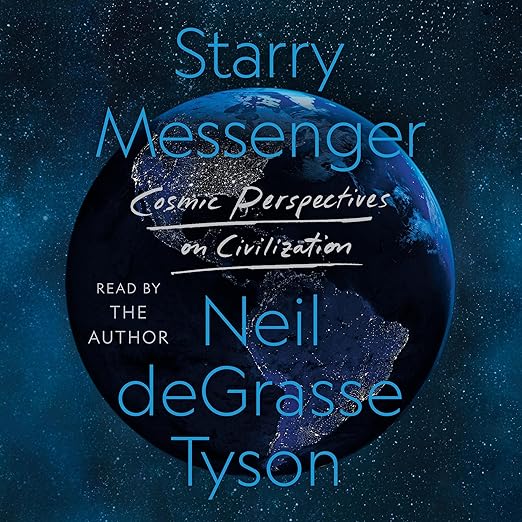
Astrophysics is not really the subject of this book, which is the single most useful thing to know before pressing play. Neil deGrasse Tyson has written an essay collection about war, politics, religion, truth, beauty, gender and race, and the science functions as a vantage point rather than as content. He reads the audiobook himself, a choice two trade outlets quoted on the listing treat as the decisive production decision, and at seven hours and seventeen minutes it moves quickly across a great deal of contested ground.
What Neil deGrasse Tyson Delivers
The argument is stated plainly in the copy: Tyson brings a cosmic perspective to civilization on Earth and shines new light on what he calls the crucial fault lines of our time. Alongside that sits a passionate case for what the copy names "the twin chariots of enlightenment", a cosmic perspective and the rationality of science. The claim underneath all of it is that scale rearranges priorities, that knowing where you are standing in the universe should change what you are willing to fight about down here.
Whether the move works is the interesting question, and my answer is that it works unevenly and in a way worth arguing with. Some chapters are genuinely bracing, particularly where Tyson turns the lens on how confidently people hold positions they have never tested. Others are a little too tidy, because zooming out is a rhetorical operation as much as an epistemic one, and the disputes that dissolve under a cosmic perspective tend to be the ones the author already regarded as dissolvable. That does not make the book less worth hearing. It does mean you should listen to it as a position rather than as a settlement.
What Neil deGrasse Tyson Gets Right
This is the rare listing that supplies actual evidence about the recording rather than leaving you to guess. Library Journal's blurb argues that "This engaging, conversational book begs to be read aloud, and who better than its author?" AudioFile adds that "Tyson's voice flows smoothly as he delivers complex topics and positive perspectives on the future". Two trade outlets independently identifying self-narration as the right call is a stronger signal than any publisher's line about crystalline prose.
The format also matches how most people already encounter Tyson, which is talking rather than writing. Jason B's review makes that connection directly: he has "loved listening to NdGT on science and history channel shows", follows the short clips, and finds that "reading this book pulls many of them together". An audio edition of a conversational text by a broadcaster is not a translation of the book into another medium so much as a return of the material to its natural one.
The most persuasive evidence, though, comes from the two reviewers who arrived from outside the science-popularization audience. R. Silber, an ordained protestant pastor with an undergraduate degree in psychology, was worried the book would be scientifically difficult and instead "found it very reasonable to comprehend". G. A. BRAVO-CASAS reads the whole project as a presentation of a global perspective on nature, one "at the core of the yoga teachings and Indian philosophy". A book with a chapter on religion winning five stars from a pastor and from a reader steeped in Indian philosophy tells you something real about its tone.
Where Neil deGrasse Tyson Loses Some Ground
The mismatch risk is the obvious one. Come here for astronomy and you get culture from an astrophysicist. Every subject the copy names is a human one, and none of them is a planet. For some listeners that is the appeal and for others it will feel like arriving at the wrong lecture, so read the subject list before the blurbs.
The essay-collection structure has its own cost. Chapters are self-contained arguments and the connective tissue is Tyson's voice rather than a developing thesis, so the book reads as a sequence of positions rather than a case built in stages. Audio actually softens that, since leaving and rejoining costs you nothing, but do not expect the cumulative pressure of a single-argument book. What you get instead is a set of related provocations delivered by someone unusually good at holding a room.
The commentary attached to this listing is also worth handling carefully. The ratings pool is tiny, small enough that the average conveys nothing. All three written reviews are unqualified five stars, and none of them pushes back on a single political argument. That is a narrow slice of the response a book about gender, race and religion will provoke, so it will not help you predict how the harder chapters will land with you.
Who Should Pick Up Starry Messenger
This suits anyone who already enjoys Tyson in conversation and wants the long-form version of the same voice. It suits listeners drawn to arguments about scale and proportion, and readers of humane, generalist nonfiction who want something short enough to finish in a week. Book groups will find plenty to disagree about, which is more than most popular science offers.
If you have only ever met Tyson in short clips, the audio edition is the natural way in, and seven hours is a modest price for hearing the whole framework assembled rather than glimpsed. Give it a miss if you wanted observational astronomy, if you suspect the cosmic-perspective framing works as a shortcut around genuinely hard political disagreement, or if one confident voice on contested subjects sounds less like an evening and more like an ordeal.
Is this audiobook actually about astronomy?
Not really. The subjects the copy names are war, politics, religion, truth, beauty, gender and race. Astrophysics supplies the vantage point rather than the material, so the science here is a way of looking rather than a topic in itself. Anyone expecting stars will be surprised within the first chapter.
Does Neil deGrasse Tyson narrate Starry Messenger himself?
He does, and the listing makes a point of it. Library Journal's blurb calls this a book that begs to be read aloud and asks who better than its author. AudioFile describes his voice flowing smoothly through complex topics. Self-narration is the form this particular text was built for.
How long is the audiobook and does it divide well?
Seven hours and seventeen minutes, produced by Macmillan Audio for Henry Holt and Company. The essay structure means chapters stand alone, so it splits neatly across commutes. It moves faster than the subject list suggests, largely because the register stays conversational rather than academic throughout.