Quick Take
- Narration: April Ajoy narrates her own memoir with the comic timing and warmth reviewers describe, self-narration that clearly serves the material.
- Themes: Christian Nationalism, deconstruction, faith and American politics
- Mood: Funny, sharp, and personally candid
- Verdict: A pointed, funny insider's account for anyone questioning the fusion of American politics and evangelical faith, not a neutral policy primer.
April Ajoy once performed an original song called 'America Say Jesus' on the Jim Bakker Show, marched in Jesus Marches across the country, and posted YouTube videos campaigning for Mitt Romney, all while considering herself simply a good, faithful, Republican Christian. This audiobook is her account of watching that identity crack open, and it is narrated by the person who lived it.
Star-Spangled Jesus is built as part memoir, part guidebook, part call to action, tracing how Ajoy's politics and religion had fused in her mind so completely that she could not always tell where one ended and the other began. The central questions she poses along the way, questions about God, country, and whose interests actually get served when the two get fused, sound like jokes until the book makes clear how seriously she once meant them.
Echoing The Star-Spangled Banner Closely Enough to Land
The memoir tracks a specific unraveling: a social media influencer and podcast host who built an identity around Christian Nationalist symbolism slowly noticing the cracks in it, then having to decide what to do with what she saw. Ajoy does not present herself as always having known better. Part of what makes the book work is her willingness to render her former self, song-writing, march-attending, Romney-campaigning, without either mocking that person entirely or letting her off the hook.
The back half shifts more explicitly into argument and instruction, the guidebook and call-to-action components the synopsis promises, making the case that the fusion of American nationalism and Christian identity has done real damage and needs to be named and undone. This is where the book stops being purely personal and starts asking something of the listener, a structural choice that pays off if the memoir section has already earned the reader's trust, which reviewers suggest it does.
Part of what gives the memoir its edge is Ajoy's existing platform. She arrives with a real, built-in audience already familiar with her voice, her comedic timing, and her specific journey, rather than introducing a stranger's story cold. That built-in familiarity is part of why the tonal balance between humor and genuine critique lands as naturally as reviewers describe.
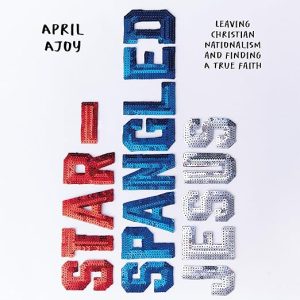
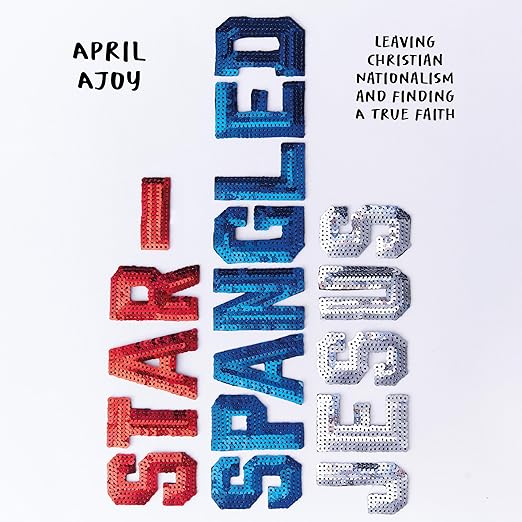
The title itself is doing quiet double duty, echoing The Star-Spangled Banner closely enough that the joke registers before a listener even presses play, a small piece of craft that sets up the book's whole method: take something treated as sacred and beyond question, and hold it up at a slight, revealing angle. That the joke works equally well as a pun and as a thesis statement says something about how deliberately this book was built, not just written.
Ajoy's Comic Timing Is Carrying the Joke
Ajoy narrates her own material, and self-narration is doing real work here rather than functioning as a nice-to-have. She is an established podcast host and social media personality with a public comedic voice already built, and reviewers confirm that voice survives the transition to long-form audio. One reviewer calls the book 'a heartwarming read with a lot of laughs,' and another describes it as 'pleasantly lighthearted and hopeful' even while tackling a genuinely heavy subject, which is a difficult tonal balance to strike and an even harder one to fake.
What stands out across the attached reviews is how far the book's resonance travels beyond its most obvious audience. One listener raised LDS, a tradition many evangelicals do not even consider Christian, says she identifies with a great deal of Ajoy's story and has already recommended it to friends. Another reviewer, a Black man who grew up in the Black church in the American South, finds real crossover with his own experience of evangelical culture, particularly around how conformity gets enforced. A book this specific to one person's Christian Nationalist upbringing reaching listeners with such different starting points says something about how well the underlying dynamics are drawn.
Tom P's review frames the book as 'a very readable discussion of a movement that yearns for the good old days that never really existed,' which is as clean a one-line summary of the book's actual argument as any of the marketing copy manages. That a reader arrives at that description organically, rather than the publisher supplying it, is a reasonably strong signal that the argument itself lands clearly in audio.
The book's recurring callback, asking whether it is truly 'by His red, white, and blue stripes' that a nation gets healed, is a sharp piece of writing worth noticing on its own terms. It inverts a real scriptural line about Christ's suffering into a pointed joke about nationalist scripture-twisting, and landing that kind of allusion in audio, where a listener cannot pause to catch the reference, depends on Ajoy's own comic timing carrying the joke without a footnote.
Her Own Contended Case, Never Settled Fact
This is not, and does not pretend to be, a neutral policy examination of Christian Nationalism as a political phenomenon. Ajoy writes and narrates from the specific position of someone who was inside the movement and left it, and her arguments should be understood as her own contended case rather than settled, uncontested fact, however persuasively she makes it. Listeners should go in expecting a passionate former insider's account, not a balanced academic survey weighing both sides evenly.
At just over eight hours, the book also asks listeners to move between two different registers, personal memoir and political-religious argument, sometimes within the same chapter. That range is a real strength, but it does mean the pacing occasionally shifts more abruptly than a straight memoir or a straight polemic would, and listeners who strongly prefer one mode over the other should expect some sections to land better than others.
Listeners should also know this is very much a first-person account of one specific corner of Christian Nationalism, evangelical, politically Republican, culturally tied to figures like Jim Bakker, rather than an attempt to survey every strand of religious nationalism in America. That specificity is a strength for anyone who recognizes the exact subculture Ajoy describes, and a mild limitation for anyone hoping for a broader comparative account of religious nationalism more generally.
Not a Split-the-Difference Treatment of Nationalism
The clearest audience is anyone with roots in evangelical or politically inflected American Christianity, especially listeners currently questioning pieces of that framework themselves. It also works well for readers who simply enjoy memoir with a real argumentative spine, in the vein of a personal essay collection that builds toward a thesis rather than just recounting events for their own sake. The specificity of Ajoy's own trajectory, from Bakker Show performer to outspoken critic, gives the book a concreteness that more general political commentary usually lacks.
A neutral, split-the-difference treatment of Christian Nationalism was never the goal here, and listeners wanting exactly that kind of even-handed policy debate will find Ajoy's clear point of view frustrating rather than persuasive. The same goes for anyone still fully committed to the framework she is critiquing; this book is written from outside that position looking back, and it does not pretend otherwise.