Quick Take
- Narration: Joel Leslie handles the ensemble road trip dynamics with real warmth, navigating the banter between Simon and Charlie without letting either character’s sharp edges soften into mere likability.
- Themes: Self-knowledge through proximity, the gap between public persona and private self, found belonging
- Mood: Warm and funny with quiet emotional depth building underneath
- Verdict: Cat Sebastian’s transition into contemporary romance is assured and specific, with a central dynamic that earns its slow burn through genuine character work.
I listened to the first two hours of Star Shipped on a weekend morning when I had nowhere to be, which turned out to be exactly the right conditions for a book that is fundamentally about what happens when two people are finally forced to have nowhere to be together. Cat Sebastian’s reputation was built on historical romance, on the particular pleasures of constraint and period texture, and her first contemporary novel was the subject of genuine reader anticipation. The question everyone seemed to have was whether the qualities that make her historical fiction exceptional, the precise emotional observation, the comedy that sharpens rather than deflates tension, the structural patience, would survive the genre shift. Having spent ten hours with Simon and Charlie, I can confirm that they do, with a few interesting adjustments.
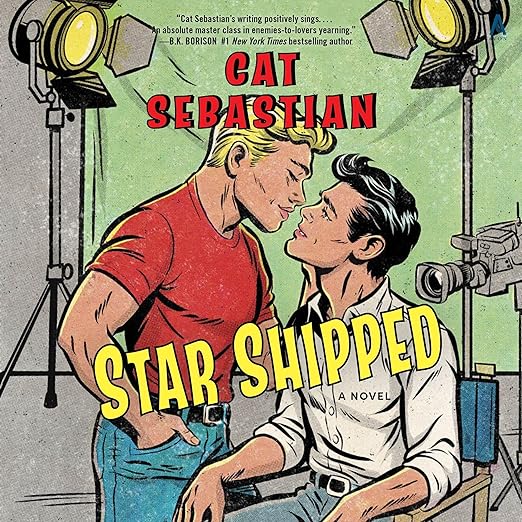
The setup is familiar enough on the surface: two costars on a long-running sci-fi show who have spent seven years being publicly hostile and privately more complicated. When Simon’s contract ends and he needs to manage the industry perception of his departure, the solution is a staged public friendship. When Charlie has a family emergency, the staged friendship becomes a road trip. The road trip is where the book actually starts.
The Show Within the Show and What It Earns
Sebastian’s decision to root Simon and Charlie in the specific world of long-running genre television pays dividends that a more generic celebrity-romance background would not. The sci-fi fandom element, and the love letter to fan communities that several reviewers identify, gives the romance a social context that grounds what might otherwise feel like an isolated emotional chamber piece. These characters exist in a world where people have opinions about them, where their public dynamic has been watched and interpreted and fan-fictioned for years. That pressure is always present in their interactions, and it makes the moments where they choose authenticity over performance feel genuinely earned rather than simply choreographed. Joel Leslie understands this context and voices both characters’ public and private registers distinctly enough that the transitions carry weight.
Simon’s Difficulty as Narrative Substance
Sebastian is quite specific about what Simon is. He is difficult to work with. He does not get along with people. He knows this about himself and has accepted it as a fact rather than a problem to solve. This is a riskier protagonist choice in contemporary romance than it would be in historical fiction, where social difficulty can be more readily attributed to period constraint. Sebastian commits to Simon’s social limitations as character rather than trauma-backstory, and the payoff is a dynamic where Charlie’s genuine liking for Simon, despite knowing him so well, functions as the book’s most credible emotional beat. Reviewer warpammer’s appreciation for the third-person present tense omniscient voice, which is opinionated and far from neutral, captures how this works formally: the narrator knows more than Simon about what is happening between them, and that gap generates both comedy and genuine tension.
The Road Trip Logic and Its Payoff
The forced proximity convention is well-worn, but Sebastian uses it specifically rather than generically. Simon goes to places he would never willingly have chosen to visit, and this is not merely a mechanism to keep the characters together but a genuine character development tool. The places Charlie takes Simon, and Simon’s reluctant discovery that he is not having a terrible time, chart the same emotional arc as the romantic plot in a way that structural parallels rarely achieve this cleanly. The three thousand miles of planned distance at the novel’s end provides appropriate structural pressure that keeps the book from drifting into cosiness before it is ready.
Who Should Listen and Who Should Pass
Sebastian fans who came for the historical fiction will find the contemporary setting adjustment minor compared to the continuity of her voice and her particular gifts. Romance readers who enjoy slow burn enemies-to-lovers with genuinely prickly protagonists rather than characters who are secretly sweet all along will be well served. Listeners who prefer their romance narrators to soften protagonists into immediate likeability may find Simon’s first few hours a test of patience. Joel Leslie does not soften him. That is the correct choice.
Frequently Asked Questions
Is Star Shipped Cat Sebastian’s first contemporary romance, and does it require familiarity with her historical fiction?
Yes, this is Sebastian’s first contemporary romance after building her reputation in historical fiction. No familiarity with her prior work is required, though existing fans will recognize her voice, structural patience, and commitment to genuine slow burn dynamics.
The synopsis lists specific tropes. Does Star Shipped execute them all with equal success?
The enemies-to-lovers and slow burn elements are the strongest, as Sebastian’s particular gift is for the gradual accumulation of intimacy. The forced proximity is used structurally rather than as mere convention. Opposites attract is present but complicated by the book’s interest in how the characters are actually more similar than they initially appear.
How does Joel Leslie’s narration handle the third-person present tense omniscient voice, which one reviewer found initially disorienting?
Leslie navigates the unusual narrative voice with consistent commitment, treating the opinionated omniscient narrator as a feature rather than an obstacle. Once the narration’s register settles in the first few chapters, it becomes one of the audiobook’s pleasures rather than a technical challenge.
Is the sci-fi television show backdrop important to the story, or is it purely setting?
It is substantive rather than merely decorative. The fandom community around the fictional show, and the way Simon and Charlie’s public dynamic has been interpreted and shipped by viewers for years, creates specific social pressure that shapes their interactions throughout the road trip. Reviewers who are themselves part of fandom communities have noted the book’s love letter quality toward that culture.