Quick Take
- Narration: Corey Martin Craig self-narrates, and his stand-up delivery instincts make the instructional content feel like a workshop rather than a textbook.
- Themes: Finding your comedic voice, writing craft, self-confidence through performance
- Mood: Encouraging and practical, with genuine warmth from someone who clearly loves what he teaches
- Verdict: A solid entry point for first-timers that works best as a companion to actual stage time, not a substitute for it.
I came to this one with a specific question in mind: can a craft book about stand-up comedy actually work as an audiobook? The worry with any instructional title in audio is that you lose the ability to flip back, underline things, or work through exercises at your own pace. With a subject as embodied and visceral as stand-up, the question felt even more acute. Two hours and fifteen minutes later, I had a partial answer.
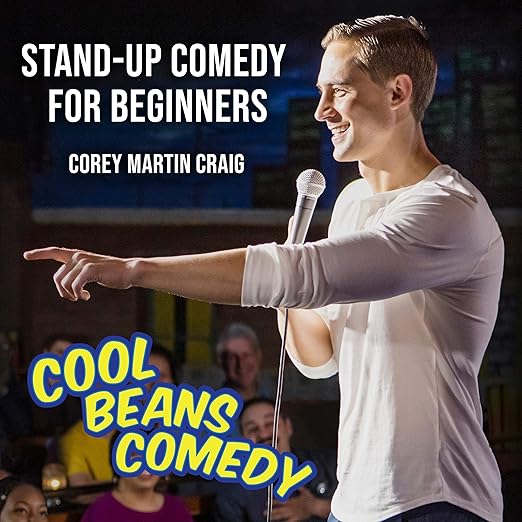
Corey Martin Craig runs Cool Beans Comedy, a stand-up training program whose alumni have landed roles on Nickelodeon, appeared on America’s Got Talent, and performed at comedy clubs across the country. That track record is worth noting because it grounds the advice here in something beyond theory. This is material that has been tested with real students, from ages eight to eighty according to the synopsis, which accounts for a certain clarity and practicality in how Craig breaks things down.
The Teacher Who Reads Like He Teaches
Self-narration is hit or miss across instructional audiobooks. When the author is also a performer, it tends to land better than when an academic is simply reading their own dense prose. Craig falls firmly in the former camp. His reading voice has the rhythm of someone accustomed to timing, to waiting a beat before the punchline, to letting silence do some work. The chapters on writing exercises, which reviewers specifically called out as a highlight, translate reasonably well to audio because Craig frames them conversationally rather than as written prompts you are supposed to complete on a page. You would still benefit from pausing and actually working through them, but the instruction itself communicates clearly without visual aids.
Reviewer Jack Sullivan, who took Craig’s live workshops, notes that the book is a collection of methods Craig teaches and does not disappoint as a standalone. That endorsement from someone who has experienced both formats is meaningful. It suggests the audio version captures something authentic about how Craig actually teaches, not just a transcription of a workshop you cannot attend.
What the Book Asks of You
Craig is direct about the book’s purpose: to help you find your comedic voice and build confidence through the art form. That second piece is not throwaway. The best section of the audiobook, based on reviewer responses and the synopsis framing, seems to be the material on identifying what makes you specifically funny, the particular combination of perspective, experience, and timing that no template can manufacture. That self-excavation work is harder to do alone with an audiobook than in a class where someone can respond to you, but Craig acknowledges this throughout.
The credentials section of the synopsis reads a bit like marketing copy, heavy on the resume and light on context. But the reviewer named E. Garcia, a returning stand-up after a seven-year hiatus, found the book genuinely useful for going back to basics. That is actually a more interesting endorsement than the beginner testimonials: it suggests the framework has enough structural clarity to function as a reset tool, not just an introduction.
Where the Format Reaches Its Limits
Two hours and fifteen minutes is a lean runtime for a craft book covering everything from material writing to stage presence to building self-confidence. You can feel Craig moving quickly through chapters that could sustain considerably more time. The comedy writing exercises in particular would benefit from more worked examples and discussion. The before-and-after punchline demonstration that Adam Bloom’s book in this same genre uses extensively would have served Craig’s content well here too.
The title positions itself for beginners, but the more advanced Bloom book is better for working professionals. Craig’s book occupies a different space: it is the most accessible entry point in this genre, intentionally so, and it succeeds at that level. If you are trying to decide between this and something more advanced, start here. The techniques are designed to be generative even for experienced performers revisiting fundamentals.
Who Should Listen / Who Should Skip
Listen if: You are genuinely considering your first open mic, you have taken a hiatus from performing and want to recalibrate, or you are a comedy fan who wants to understand how material is actually constructed. Skip if: You have been doing stand-up for several years and are looking for advanced craft analysis, or you need a written companion to work through the exercises properly.
Frequently Asked Questions
Does Craig’s narration include actual comedy examples or is it purely instructional?
Craig uses illustrative examples throughout, and his delivery naturally incorporates comedic timing, which keeps the instructional content from feeling dry. However, this is primarily a how-to guide rather than a comedy performance.
Can the writing exercises actually be completed while listening, or do you need a print version?
The exercises are presented conversationally and can be engaged with mentally while listening, but most listeners would benefit from pausing and writing actual responses rather than proceeding straight through.
How does this compare to a more advanced stand-up craft book for someone newer to the form?
Craig’s book is the more appropriate starting point. Advanced texts on comedy craft target working comedians with existing stage experience. Craig covers fundamentals of finding your voice and building confidence before worrying about technical punchline mechanics.
Is the Cool Beans Comedy methodology distinctive from standard stand-up training approaches?
The emphasis on identifying your unique comedic characteristics rather than teaching formula-based joke structures is a defining feature of the Cool Beans approach, and that self-discovery framework does differentiate it from more technical treatments of the subject.