At a Glance
- Performance: Gary Noesner narrating his own memoir lends the audiobook an authority and specificity that no actor could fully replicate, and his pacing reflects the deliberate, measured quality of a man trained to slow things down.
- What it covers: crisis negotiation and de-escalation, the psychology of standoffs, institutional tensions inside the FBI
- Feel: Methodical and compelling, with genuine stakes throughout
- Our call: Noesner's career account doubles as a persuasive argument for communication over confrontation, and it is more gripping than most thrillers.
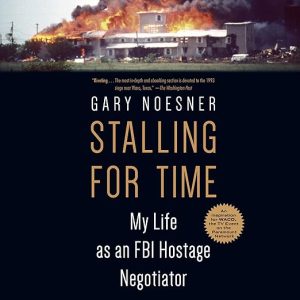
Gary Noesner spent over two decades as the FBI's chief hostage negotiator, and his career ran through some of the most consequential standoffs in American law enforcement history. Stalling for Time is his account of that work: how negotiation operates under pressure, what it takes to keep people talking when everything is falling apart, and what happens when the institutions responsible for public safety decide that patience is a weakness. This audiobook, narrated by Noesner himself, is among the most genuinely instructive memoirs in the law enforcement genre, and the self-narration is central to why it works.
Noesner is a professional communicator, someone whose entire career was built on the ability to modulate voice, pace, and tone in order to lower temperature in extreme situations. That training is audible in how he reads his own material. He does not rush. He does not dramatize artificially. He presents the cases with a measured gravity that reflects the actual stakes involved and refuses to sensationalize in the way that most true-crime presentations do. One listener described the book as so insightful and well written that it ranks among the best books they have ever read, and both qualities are audible in the narration as much as on the page.
Is Stalling for Time Worth Your Time?
Noesner's central argument is deceptively simple: the single most effective tool in a hostage or barricade situation is sustained, genuine communication. Not tricks or manipulation, though those have their place, but the willingness to listen, acknowledge, and keep the conversation going long enough for the emotional temperature to drop to a point where rational choices become possible again. He makes this argument not through theory but through accumulated case history, and the cases he has access to are among the most extreme test cases in modern American law enforcement.
The book covers Noesner's work across several decades and multiple categories of crisis: domestic hostage situations, prison riots, standoffs involving extremist groups, and eventually the largest and most consequential of all, the Branch Davidian compound at Waco, where his approach was ultimately sidelined in favor of tactical escalation with catastrophic results. That chapter is the center of gravity for the entire book, and Noesner handles it with a restraint that makes it more devastating than any amount of outrage would achieve. His experience is directly relevant: he was present throughout the negotiation phase and was overridden before the final assault.
The Best Parts of Stalling for Time
The value of Noesner's perspective on Waco is that it is not primarily about blame, though the institutional failure is clearly documented. It is about methodology. He shows, in careful detail, what the negotiation team was achieving in the weeks before the final assault: the slow reduction of tension, the people who had already come out, the lines of communication that remained open. And then what was lost when the tactical commanders decided that patience had run out. The contrast between negotiation as a process and tactical intervention as an imposition of will is the book's sharpest argument, and it holds up under scrutiny.
Noesner also writes well about the psychology of people in crisis, the specific thought patterns that produce standoffs, the ways that perceived humiliation and fear compound into situations that look irrational from outside but have their own internal logic. This material is useful well beyond law enforcement, and it is delivered with the accumulated wisdom of someone who has spent a career studying it at close range. The audiobook format suits this writing particularly well because the explanatory passages benefit from Noesner's own pacing and emphasis, which reflect how he actually teaches this material rather than how an external narrator would guess it should be performed.
Before You Commit to Stalling for Time
The structural choice to organize the book by case rather than chronologically means that some of the broader institutional tensions take time to emerge. Pay attention to the recurring theme of negotiators being overridden by tactical commanders. It appears in case after case, and by the time the Waco chapter arrives, the pattern is fully established and fully damning. The book is building an argument about how American law enforcement conceives of force, and the individual cases are the evidence for that argument.
Also worth noticing is what Noesner does not say directly but allows the reader to infer. He is a loyal FBI man writing within institutional constraints, and his criticism is always measured and specific rather than systemic. The restraint is itself informative. A man who spent his career holding people in conversation under extreme duress has learned exactly how much to say and when to stop, and the same skill is visible in how he manages what this audiobook includes and what it leaves implicit. That gap between the stated and the implied is worth following carefully through the eleven-hour runtime.
Should You Listen to Stalling for Time?
This audiobook rewards anyone interested in the psychology of high-stakes communication, not just law enforcement professionals but anyone who has ever had to manage conflict, negotiate under pressure, or find a way to keep a conversation alive when one party wants to end it. Fans of true-crime nonfiction who prefer the procedural and psychological to the sensational will find this far more substantive than most entries in that genre. If the Waco standoff has ever struck you as a case study in institutional failure, Noesner gives you the inside account from the person best positioned to have prevented it. The runtime is well-earned, and the self-narration makes it one of those audiobooks that genuinely could not be improved by a professional actor.
Before You Listen
Does Gary Noesner narrating his own audiobook affect the listening experience?
Significantly and positively. Noesner is a trained communicator whose career was built on voice modulation and deliberate pacing, and those skills are fully audible in his narration. He delivers the material with a measured authority that no actor could fully replicate, and his restraint in the more dramatic sections makes them land harder rather than softer.
How much of this audiobook covers the Waco standoff specifically?
The Branch Davidian standoff receives the most extended treatment and functions as the book's central case study. Noesner was present throughout the negotiation phase and was sidelined before the final tactical assault, which gives him a unique and damning perspective on what went wrong and what the negotiation process had been achieving.
Does the audiobook cover cases beyond the famous FBI standoffs, or is it mainly the high-profile incidents?
Noesner covers the full range of his career, from domestic hostage situations and prison riots to the high-profile cases the book is known for. The less famous cases often provide the clearest illustrations of negotiation technique because the stakes are easier to follow without the noise of prior media coverage.