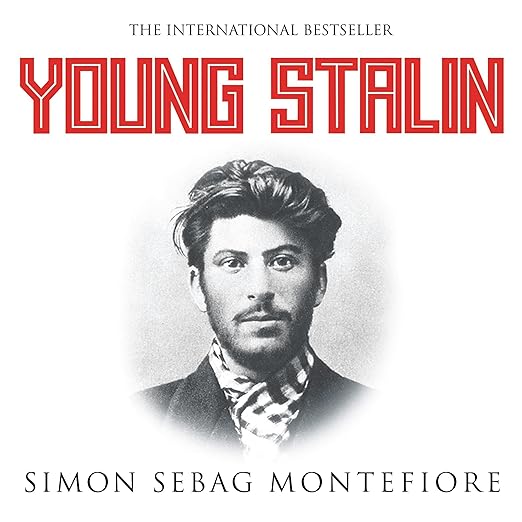
A shoemaker's son destined for the priesthood became a poet, then a gangster, then Stalin, and Simon Sebag Montefiore's Costa Biography Award winner spends its entire runtime on exactly that transformation. This audiobook does not open with the purges, the war, or the death that most listeners associate with the name; it opens with a Georgian seminary student writing verse good enough to be noticed, and it ends with the 1917 revolution, before the man in question had consolidated the power history remembers him for. That's a deliberately narrow lens, and narrator Jonathan Aris has to carry a genuinely strange range across it, seminarian, romantic, career criminal, revolutionary operative, without the benefit of the familiar dictator archetype to lean on.
Aris Moves Between Registers, Never Resetting
Montefiore's real subject here is formation, not rule. The synopsis poses the book's guiding questions directly: was Stalin a Tsarist agent, or Lenin's bandit? Was he responsible for his wife's death? When did the killing actually start? Montefiore answers these with what one reviewer, P.K. Ryan, calls a 'magnificent chronicle,' built on research thorough enough that another reviewer, Burgmicester, specifically praises its lack of agenda, just a tightly focused account of how a specific, ambitious young man accumulated the skills, contacts, and ruthlessness that later made him unstoppable.
Jonathan Aris brings a controlled, watchful quality to the narration that suits a book more interested in psychology than spectacle. He doesn't perform young Stalin as a cartoon villain in waiting; the seductive charm the synopsis describes, 'prolific lover' among the other roles, comes through as genuinely persuasive rather than telegraphed menace, which makes the character's turn toward 'murderous revolutionary' land with more weight than it would if Aris had played the ending from the opening page.
Aris is a recognizable character actor from British television and film, and that background shows in how comfortably he modulates tone within a single chapter rather than resetting between the book's very different registers, seminary discipline, romantic verse, underworld menace, political theory. Keeping those shifts fluid rather than treating them as separate performative modes is exactly what a formation narrative like this one needs, since the entire argument depends on the listener believing all of these traits belong to one continuous, developing person rather than a checklist of biographical facts. That range across nearly nineteen hours is a genuinely demanding narration assignment, and it holds up from the first chapter to the last.
The book carries real institutional credibility behind its Costa Biography Award, a prize with a long history of recognizing books that combine serious archival research with genuinely readable prose rather than academic monographs written mainly for specialists. That context matters for anyone deciding whether an 18-hour-plus biography justifies the time: this was built, and specifically recognized, for a general audience rather than a niche scholarly one.
Still Known to Readers as Young Stalin
Several listener reviews refer to this book by its other common title, Young Stalin, which gets at exactly what makes it worth the runtime: this isn't a cradle-to-grave biography competing with a dozen similar surveys, it's a tightly scoped character study of how an ordinary, talented, angry young man becomes capable of the things Stalin later did. Burgmicester calls it 'a terrific biography on how Stalin came to be the power figure that everyone feared,' which is a more interesting question than most dictator biographies bother asking directly.
The book also rewards listeners who like their history in a specific research tradition. Reviewer BC describes following Montefiore's work the same way readers of Anthony Beevor's Stalingrad and The Fall of Berlin tend to chase down that author's full catalog, calling this one 'a great follow up to Red Tsar,' Montefiore's companion volume. If you already gravitate toward that particular strand of meticulously sourced, narrative-driven Soviet history, this book sits comfortably alongside it.
What separates this from a simpler dictator biography is that Montefiore treats his own guiding questions as genuinely open rather than settling them in advance for narrative convenience. Each one gets weighed against the actual surviving evidence rather than resolved for dramatic effect, and that restraint is part of the book's credibility, even when a more sensational, tidier answer would probably have sold just as well to a less careful biographer. It asks more patience of a listener than a book that simply asserts its verdicts, but it also means the eventual picture that emerges feels earned rather than assumed.
Ends in 1917, Before the Great Terror
At 18 hours and 43 minutes, this is a substantial commitment for a book that stops at 1917, and listeners expecting the Great Terror, the wartime leadership, or the postwar Soviet empire will not find any of that here; this volume ends roughly where the more famous chapters of Stalin's life begin. That's not a flaw so much as a scope decision worth knowing in advance, since the title alone doesn't signal the cutoff the way 'Young Stalin' would.
The density of Montefiore's research, drawing on what the synopsis calls 'revelatory' archival material, means the middle stretch moves through a genuinely large cast of fellow revolutionaries, informants, and Okhrana agents. Aris keeps the major names distinct through tone and pacing rather than exaggerated voicing, but a listener half-attentive during a commute may want to rewind a section here and there to keep the web of alliances straight.
Part of what makes the 'prolific lover' side of the synopsis more than a lurid detail is the kind of evidence it signals Montefiore is working from: love letters, private diaries, and personal testimony rather than only party records and political documents. Building a portrait from that more intimate archive is a genuinely different methodology than most political biography attempts, and it's part of why the book reads as character study first and political history second, even though the political stakes never disappear from the background.
For Readers Who Already Follow Montefiore or Beevor
This is a strong pick for readers who already know Montefiore's other work, or Beevor's, and want psychological depth over a broad survey; for anyone drawn to the question of how ordinary ambition curdles into something monstrous rather than just cataloguing atrocities after the fact; and for listeners who prefer a biography that trusts them to sit with 18-plus hours of buildup before the subject becomes the figure the history books usually start with.
Listeners specifically hoping to understand the Stalin of the Gulags, the purges, or World War II should look elsewhere first, since none of that falls inside this book's 1917 cutoff, and treating this as a complete Stalin biography will leave a real gap in the story exactly where most readers expect the climax to be.
Quick Take
- Voice: Jonathan Aris plays young Stalin's charm as genuinely persuasive rather than telegraphed menace, letting the turn toward violence land with real weight.
- Big ideas: Revolutionary formation, ambition and ruthlessness, early Soviet history
- Atmosphere: Watchful and psychologically dense
- Worth it?: A meticulously researched character study of Stalin's rise through 1917, best for listeners who want formation and psychology rather than a full cradle-to-grave dictator biography.