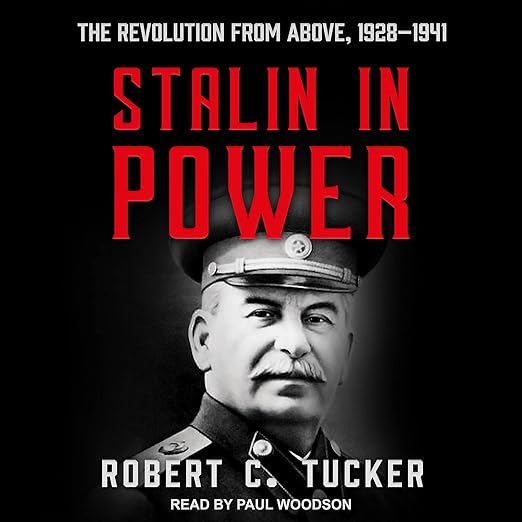
Quick Take
- Narration: Paul Woodson delivers a clear, measured performance that suits the scholarly tone of Tucker’s biography, though at 34 hours the steady academic register requires an engaged listener.
- Themes: Totalitarian psychology, revolutionary terror, Stalin’s identification with Ivan the Terrible
- Mood: Dense and sobering, with flashes of genuine analytical brilliance
- Verdict: Tucker’s biography is the most psychologically penetrating account of Stalin’s rise to murderous dominance available in audio, and Woodson’s narration does it justice, even if the sheer detail demands committed listening.
I started Stalin in Power on a long weekend when I had been reading around the subject for a while, and I had already worked through several shorter accounts of the Great Terror and the collectivization campaigns. I thought I understood the broad shape of what Tucker was going to argue. I was wrong about how differently he would frame the same events. By the time he began tracing Stalin’s psychological identification with Ivan the Terrible as a model for the terror of the 1930s, I had my notepad out and was listening with a different kind of attention.
Robert C. Tucker spent decades as one of the foremost Western scholars of Soviet history, and this second volume of his Stalin biography, covering the period from 1929 to the Nazi-Soviet pact of 1939, shows what that kind of sustained scholarly immersion produces: not just historical narrative but something closer to a psychoanalytic case study of the most consequential political paranoid of the 20th century.
Our Take on Stalin in Power
Tucker’s central argument is unusual in the historical literature on Stalin, and worth stating clearly: he believes Stalin was not simply a cynical political operator but a man genuinely shaped by a specific ideological and psychological identity, one that he traces to Stalin’s reading of Russian imperial history and his deep identification with Ivan Grozny, Ivan the Terrible. This is not biography as political science. Tucker is interested in what Stalin believed, what he feared, and what internal logic governed decisions that, from the outside, appear as simple exercises in murderous self-preservation.
Reviewer Nataša MV captures the heart of this argument, noting Tucker’s revelation that Stalin “was identifying himself with Ivan Grozny whom he considered as hero of Russian history” and that this identification shaped the terror’s specific form, including the destruction not just of enemies but of their entire families and entourages, a practice directly mirrored from Ivan’s own methods. This layer of analysis is what elevates Tucker’s work above most Stalin biographies, which tend to treat the terror as self-explanatory political logic rather than the product of a specific historical imagination.
Reviewer WallyWorld, who describes the book as “superb in its depth, breadth and clear understanding of Stalin,” credits Tucker with revealing “the psychological forces driving Stalin and his deadly machinations.” That assessment is accurate. The biographical and psychological dimensions of the book are its strongest contributions to the literature.
Why Listen to Stalin in Power
Paul Woodson’s narration is well-matched to the text. Tucker writes in a scholarly register that is dense but not inaccessible, and Woodson reads it with the kind of steady authority that lets the material breathe without adding interpretive flourishes that would distort it. At 34 hours, this is a substantial commitment, but the audio format makes the experience more sustainable than the print version’s 900 pages might suggest. Woodson’s pacing is calibrated to the text’s own rhythm.
The audio format also has a specific advantage for this kind of history: the procession of names, dates, and Soviet institutional machinery that Tucker deploys in abundance is easier to track when heard continuously than when read in isolation. The political geography of the Communist Party in the 1930s, including the relationships between its various factions and the specific mechanics by which Stalin destroyed each of them, gains coherence from the cumulative listening experience.
For anyone approaching this as a companion to the first Tucker volume, Stalin as Revolutionary, the continuity of narration across the two audiobooks provides a useful sense of intellectual progression through the biography as a whole.
What to Watch For in Stalin in Power
Tucker’s critics have consistently noted the book’s length as both a virtue and a problem. Reviewer Derek Atkins argues that “this book is far too long” and could have been compressed significantly, and reviewer TruthieRockie found the detail on Communist Party internal affairs “boring” to the point of threatening to abandon the book. These criticisms are not without foundation. Tucker is thorough to an extent that at times tips into the repetitive, particularly in sections covering the mechanics of the show trials and the specific political machinations of figures who are no longer individually significant to the narrative.
The biographical core of the book, the psychological portrait of Stalin as a revolutionary of the radical right who used Bolshevik ideology to pursue goals that were fundamentally autocratic and imperial, is exceptional. The sections on collectivization, the famine of 1932 to 1933, and the Great Terror of 1937 to 1938 are among the finest historical writing on these subjects in the English language. Listeners who approach the book as they would approach a reference text, moving through the strongest sections and skimming the denser party-history passages, may find the experience more consistently rewarding.
This is also emphatically a volume two. Tucker assumes familiarity with the first volume and with Stalin’s pre-revolutionary biography. Starting here without the foundation of Stalin as Revolutionary is possible but will diminish the psychological argument considerably.
Who Should Listen to Stalin in Power
This audiobook belongs in the collection of anyone seriously interested in Soviet history, 20th-century political violence, or the psychology of totalitarian leadership. Readers who valued Hannah Arendt’s The Origins of Totalitarianism or Robert Conquest’s The Great Terror will find Tucker’s psychological depth a genuinely different angle on the same material. Listeners drawn to biography as intellectual inquiry, rather than narrative history, will find Tucker’s approach particularly rewarding.
Casual listeners hoping for an accessible narrative history of Stalin’s years in power should probably start with something shorter and more propulsive. Tucker is writing for readers who want to understand, not just to know, and the distinction costs significant reading time.
Frequently Asked Questions
Do I need to have read or listened to Tucker’s first Stalin volume before starting this one?
Tucker assumes familiarity with Stalin as Revolutionary, which covers Stalin’s early life and rise to power through the 1920s. Starting with Stalin in Power without that context is possible, but Tucker’s psychological argument about what shaped Stalin’s approach to terror will land with considerably less force without the biographical foundation.
How does Tucker’s analysis of Stalin compare to other major Stalin biographies, such as those by Simon Sebag Montefiore or Robert Service?
Tucker is more psychologically focused than either Montefiore or Service. Montefiore’s Court of the Red Tsar is more richly anecdotal and narrative-driven. Service’s biography is more conventionally political. Tucker’s contribution is the sustained argument about Stalin’s inner life and historical self-conception, which neither of the other two biographers pursues with equivalent depth.
Is the book balanced in its treatment of Stalin, or does it read as an ideological argument?
Tucker is clearly critical of Stalin but is not writing polemic. His argument that Stalin was a Bolshevik of the radical right who used revolutionary ideology to pursue imperial and autocratic ends is a scholarly position rather than a partisan one, and he supports it with extensive evidence. The book is analytical, not angry.
How does Paul Woodson handle the Russian names and terminology?
Woodson is consistent with his pronunciation of Russian names and handles the extensive Soviet terminology without hesitation. For listeners unfamiliar with Russian names, the repetition across 34 hours actually helps familiarize the ear with key figures. He does not over-perform the material.