Quick Take
- Narration: Bronson Pinchot brings theatrical range to Cold War material that benefits from it, a distinctive and engaging performance.
- Themes: KGB tradecraft from the inside, Cold War intelligence operations, the strange intimacy between lifelong adversaries
- Mood: Dense with history but propelled by the extraordinary nature of the source, a spy memoir published despite Putin’s ban
- Verdict: A valuable document for Cold War history readers, though listeners hoping for explosive revelations may find the memoir more suggestive than definitive.
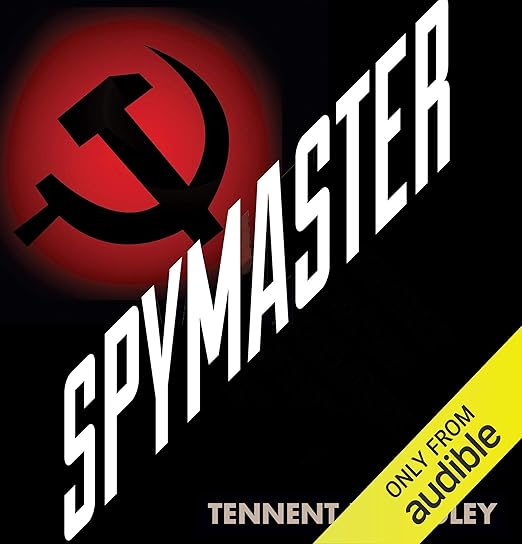
I am always drawn to books that exist because of an unusual set of circumstances, and Spymaster has one of the more remarkable origin stories in nonfiction. Sergey Kondrashev, a senior KGB officer who handled American and British defectors, recruited double agents, and served at the Berlin and Vienna bureaus, met retired CIA officer Pete Bagley during a 1994 television program. They became friends. Kondrashev asked Bagley to help write his memoirs. And when Putin’s regime banned the publication, Bagley promised to have them published in the West. The book you are listening to exists because of that promise, and because two former adversaries spent enough time together to trust each other with the account.
That backstory is worth holding onto throughout the listening experience, because it shapes what the book can and cannot deliver. Kondrashev was a careful man who spent his career in an institution that rewarded discretion. He was present at an extraordinary number of critical moments: surviving Stalin’s purges, plotting to reveal the Berlin Tunnel operation, managing KGB responses to the Hungarian Revolution and Prague Spring, and handling the final disposition of Adolf Hitler’s remains. The problem, as one reviewer notes, is that he tends to describe being present without fully illuminating what happened. The stories are suffused with inconsequential detail that confirms his presence while leaving the substance frustratingly opaque.
Our Take on Spymaster
The value of this book lies less in revelations than in perspective. Reading, or listening to, a senior KGB officer’s account of his own career is simply different from reading Western intelligence historians’ accounts of the same events, even when the Soviet officer in question is being careful about what he reveals. The section on KGB propaganda and disinformation operations that shaped Western public opinion throughout the Cold War is particularly interesting as a structural analysis of how influence campaigns were conceived and executed, even if the specific details are carefully managed. For listeners who have read significant Cold War nonfiction, Spymaster provides a complement rather than a corrective.
Why Listen to Spymaster
Bronson Pinchot is an interesting choice for this material, and largely the right one. He has significant range as a narrator, and Cold War espionage memoir rewards a narrator who can handle both the administrative texture of Soviet bureaucracy and the dramatic episodes that punctuate it. Pinchot’s voice has theatrical quality, which serves the material well in moments of genuine tension and occasionally overplays quieter analytical passages. At just under eight and a half hours, the runtime is appropriate for a book of this scope, substantial enough to develop the historical context, compact enough to maintain momentum.
What to Watch For in Spymaster
Listeners coming from the popular espionage memoir genre, expecting the pacing and revelation density of a defector narrative from the post-Soviet wave of the 1990s, should calibrate expectations carefully. Kondrashev remained a loyal Soviet officer to the end and was not producing a tell-all. The most candid passages involve operational history that is decades old and largely declassified elsewhere; the more sensitive material is present as implication rather than explicit disclosure. One reviewer who has read dozens of nonfiction books about Cold War espionage describes the lack of significant revelations as disappointing. That is a fair characterization if revelations are what you came for.
Who Should Listen to Spymaster
This audiobook belongs in the libraries of serious Cold War history readers who want primary source texture rather than comprehensive analysis. It is most valuable in conversation with other accounts of the same events, where Kondrashev’s insider perspective adds dimension even without full disclosure. Readers who are new to Cold War espionage history might find more narrative satisfaction in works that synthesize the available intelligence history more fully. Existing Cold War enthusiasts will find Spymaster genuinely worthwhile, with the understanding that it is a fragment of a larger picture rather than the picture itself. The unusual provenance alone makes it worth the eight hours.
Frequently Asked Questions
How did this book get published if Putin banned it?
After meeting Kondrashev at a 1994 television program, retired CIA officer Pete Bagley helped him write his memoirs and promised Kondrashev that if Russian publication was blocked, he would ensure Western publication. The book was indeed banned by Putin’s regime and was subsequently published in the West, fulfilling that promise.
Does Spymaster deliver significant new revelations about Cold War espionage history?
Reviewers are divided on this. Some find the insider perspective on events like the Berlin Tunnel, the Hungarian Revolution, and the handling of Hitler’s remains genuinely illuminating. Others, particularly those well-read in Cold War espionage history, note that Kondrashev confirms his presence at key events without fully disclosing what happened. The book is valuable as perspective rather than revelation.
How does Bronson Pinchot’s narration suit the Cold War espionage material?
Pinchot brings theatrical range that serves the dramatic sections of the book well. His voice has considerable presence, which suits the material’s larger-than-life episodes. Some listeners may find the delivery occasionally overplays the quieter analytical passages, but overall the narration enhances rather than distracts from the material.
Is there a conflict of interest in a CIA officer writing a KGB officer’s memoirs?
The relationship between Bagley and Kondrashev was explicitly a former-adversary friendship, and the book is transparent about that dynamic. Bagley’s background in CIA counterintelligence, particularly in European operations, is precisely what made his questions penetrating. The unusual collaboration is one of the book’s most interesting features.