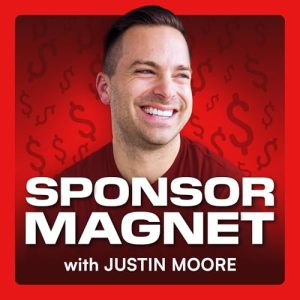
Justin Moore's pitch is blunt enough to state as a verdict before anything else: if you make things online and have never once sent a brand a rate card, this audiobook will change how you price yourself, and if you already run a sponsorship pipeline it will mostly confirm what you know. Six hours and fifteen minutes, narrated by Moore. One oddity needs flagging at the top, because it shapes what a buyer should expect: the description attached to this listing is written as show copy, complete with a welcome to the show, a named host, and a promise of guest interviews, while the product itself is a single continuous audiobook.
Show Copy Promises Interviews This Audiobook Skips
That mismatch deserves a paragraph rather than a footnote. Everything substantive in the description maps cleanly onto a coherent book: real sponsorship negotiations broken down step by step, how to pitch brands that have never heard of you, pricing strategies that detach your rates from follower count, and the psychology behind why brands choose particular creators. Those read as chapter headings, not episode themes. What sits oddly beside them is the framing, the host language and the promise of interviews and success stories, which belongs to a show rather than a book. Assume the four content pillars are what you get, and do not count on interview segments being part of the file.
The strongest idea on that list is the third, and it is the reason the book exists at all. Moore's core claim is that creator rates should be detached from follower count, which cuts against the most entrenched assumption in the influencer economy, where a media kit is essentially a follower number with a price attached to it. Detaching the two means pricing on deliverables, audience quality, and the value of the outcome to the brand instead. That is a genuinely contrarian position, it is the position an agency-side operator would hold, and it is the thing a creator with a modest but engaged audience most needs to hear.
Moore's authority claims are specific, which is more than most books in this category manage. He states that he has personally earned over five million dollars in brand partnerships, that he ran an influencer marketing agency for seven years, and that he has facilitated more than a thousand brand campaigns while paying out millions to creators. He names Nike, Lowe's, and John Deere among the brands he has helped creators land. Those are the author's own figures rather than independently verified ones, and deserve that caveat, but they are concrete in kind, and they place him on the buying side of the table, which is the vantage point the psychology chapters depend on entirely.
Why Negotiation Works Better Spoken Than Written
The negotiation material makes the strongest case for the audio edition, and the case is specific to this format. The description promises those negotiations reconstructed move by move, and negotiation is a spoken discipline: what makes a rate defensible is rarely the number itself but the delivery, the pause after stating it, the refusal to fill a silence. A book that walks through those exchanges in a voice, at speaking pace, teaches something a transcript flattens on the page. Moore reading his own material means a listener hears how a practitioner phrases the ask rather than how a hired reader would render it.
Six hours and fifteen minutes is well calibrated for the subject. Long enough to cover pitching, pricing, psychology, and negotiation with room for worked examples; short enough that a working creator can finish it across a week of editing sessions. Set that against the length business books inflate to when a publisher wants a particular page count and the restraint reads as a decision. Nothing in the content list suggests one idea stretched thin across eight hours.
The audience definition is unusually broad and stated openly: content creators, podcasters, newsletter writers, and event organizers, anywhere from a thousand followers up to a million. Two things follow from that. First, this is not exclusively a book for video creators, which matters, since a newsletter writer with four thousand engaged subscribers is exactly the profile the pricing argument is built to help. Second, a caution below about what one book can realistically do across a range that wide.
Zero Written Reviews Behind a 4.9 Average
The follower range is the real structural risk. A creator with a thousand followers and a creator with a million occupy different economies: one is trying to get any reply at all, the other is fielding inbound offers and arguing over exclusivity clauses. Serving both means the pitching chapters skew toward the first and the negotiation chapters toward the second, and neither listener gets a book written entirely for them. That is a fair trade in a general guide, but anyone at either extreme should expect to skip material rather than absorb all of it.
The evidence picture is the other thing to weigh. This listing carries a 4.9 average across twenty-four ratings and not a single written review, which means no listener has publicly described what the experience is like. Ratings without text tell you people were satisfied and nothing about why, and a small early sample can move sharply in either direction. Treat the score as a promising early signal rather than a settled consensus.
One further caution applies to any book about platform economics: this material has a shelf life. Rate benchmarks, platform behavior, and what brands are willing to pay all move, and they move faster than the psychology of why brands choose particular creators. The durable half is the framework, pitching cold, pricing on value, negotiating from a position of clarity. The perishable half is anything resembling a current market rate. Take the first as strategy and the second as illustration.
Buying Back a Skill Already Outsourced
Creators sitting on an audience they have never monetized are the clearest fit, particularly the ones who assume brand deals begin the moment a brand notices you. The whole book argues against waiting, and the pitching chapters exist to replace the noticing with a process. Newsletter writers and podcasters deserve a specific mention, since the sponsorship conversation is dominated by video-first advice and both formats are named directly in the audience list. Event organizers get an unusual nod as well, which suggests the pricing logic is meant to generalize past personal-brand content.
It suits fewer people than the description implies. Anyone with an agent or management team already handling brand deals is buying back a skill they have deliberately outsourced. Creators earning through products, subscriptions, or services rather than sponsorship will find the entire apparatus beside the point. And listeners after a broad creator-business education covering audience growth, product design, and platform strategy should note how narrow this is by design: one revenue line, examined closely. On that single line, a practitioner who spent seven years on the buying side is a credible teacher, and the complete absence of listener reviews is the main reason to sample before committing six hours.
Before You Press Play
- Narration: Justin Moore reads his own material, which suits a book whose negotiation chapters are essentially scripts meant to be spoken aloud.
- Themes: Cold pitching, pricing detached from follower count, brand-side psychology, negotiating sponsorship deals.
- Mood: Direct, tactical, and impatient with waiting.
- Verdict: A focused guide to one revenue line, strongest on pricing, muddied by a listing that promises podcast segments.