Quick Take
- Narration: Laurel Lefkow delivers a performance that matches the cinematic sweep Aikman aimed for; she handles both the factual reconstruction and the individual women’s voices with clarity and emotional intelligence, adding genuine momentum to the aerial sequences.
- Themes: Women’s ambition against institutional exclusion, war as unexpected liberation, the relationship between risk and identity
- Mood: Propulsive and revelatory, with a documentary exactness that never becomes dry
- Verdict: One of the stronger works of popular military history in recent years, doing justice to genuinely remarkable lives through both rigorous research and a narrative sense that keeps thirteen hours feeling essential rather than exhausting.
I listened to Spitfires during a week when I was thinking a lot about women who did things they were told they could not do, which made it feel like the book had been waiting for me specifically. It had not, of course. Becky Aikman spent years in archives and interviews gathering this story, which is the story of twenty-five American women who, denied the chance to fly for their own country after Pearl Harbor, crossed the Atlantic to fly for Britain instead. By the time I finished the last chapter on a Thursday evening, I had been angry, moved, and occasionally breathless in roughly equal measure, which is about the best thing I can say about thirteen hours of historical narrative.
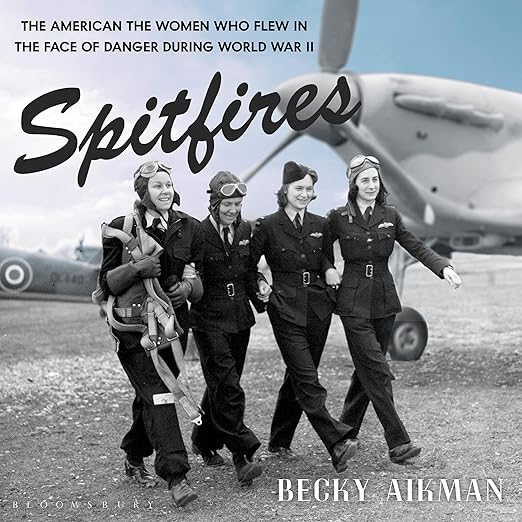
The women at the center of this account served in Britain’s Air Transport Auxiliary, a civilian organization that ferried new warplanes from factories to air bases and returned damaged aircraft for repair, never knowing what mechanical surprises the previous flight might have left behind. It is worth sitting with that for a moment: these women were flying barely tested fighters and bombers, often without radio contact or navigational instruments beyond a map and a compass, in wartime weather over unfamiliar terrain. Several died. Many made emergency landings that would have been unremarkable courage from a male pilot and a sensation from a woman. Aikman follows nine of them specifically, drawing on unpublished diaries, letters, and records alongside her own interviews.
Our Take on Spitfires
Aikman’s real achievement is making you care about nine individuals simultaneously without losing the broader historical argument. The women are not interchangeable. There are crop dusters and debutantes and circus performers, as the synopsis notes, but what Aikman establishes is the specific texture of each woman’s ambition and the specific costs she paid for pursuing it. The personal portraits are built from primary sources with the kind of specificity that distinguishes serious historical research from general impression. One reviewer who works in a World War II aviation museum and has significant background in WASP history specifically noted that Spitfires added detail and depth beyond what they already knew. That is the measure of a book that has done its archival work.
The comparison to the American WASP program, the Women Airforce Service Pilots who served domestically, is handled with care. These twenty-five women flew for Britain before the WASP program existed, making them technically the first American women to command military aircraft. Aikman does not minimize the WASP achievement. She situates both programs accurately in the history of women’s aviation and institutional resistance to it, which is the right approach.
Why Listen to Spitfires
Laurel Lefkow’s narration is excellent. Historical narrative at this length requires a narrator who can sustain momentum across factual reconstruction, personal correspondence, and action sequences, and Lefkow does all three with confidence. The aerial sequences, which require a reader to communicate physical danger and mechanical complexity simultaneously, are particularly well handled. Lefkow does not dramatize them artificially. She reads them with a precise, forward-moving delivery that creates tension without theatrics, which is exactly what the material needs.
Jonathan Eig, the Pulitzer Prize-winning author of King: A Life, called this a bold and soaring work of history that is whip-smart and deeply researched, and I think that endorsement is accurate. Keith O’Brien, who wrote Fly Girls about the female racing pilots of the 1920s, described it as a soaring narrative. The comparison to Fly Girls is apt: Spitfires operates at a similar level of narrative craft applied to recovered women’s history, with the added weight of wartime stakes.
What to Watch For in Spitfires
The book’s structure follows nine women simultaneously, which means the narrative sometimes moves between figures in ways that require the listener to hold multiple timelines. Aikman manages this well on the page, but audio listeners will want to pay close attention to the chapter introductions, which establish whose perspective you are inhabiting. The companion stories are individually compelling enough that the cross-cutting enriches rather than confuses, but passive listening will occasionally leave you uncertain about which pilot you are following.
The book also addresses the lives these women led off duty with the same analytical seriousness as their flying careers. Aikman describes them as living like women decades ahead of their time, shocking their British hosts with thoroughly modern behavior, which turns out to include attitudes toward relationships, independence, and female ambition that were genuinely radical for the early 1940s. These sections are not secondary to the aviation history. They are part of Aikman’s argument about what war temporarily made possible for women that peace subsequently foreclosed.
Who Should Listen to Spitfires
This is for listeners who want military history that centers lives rather than battles, who are interested in the history of women’s aviation specifically, or who respond to popular history written with the research standards of scholarship and the pacing of narrative nonfiction. Fans of Erik Larson’s work or of Sarah Bakewell’s approach to biographical history will find Aikman operating at a comparable level of craft.
It is a less obvious fit for listeners who want tactical military history focused on strategy and operations rather than personal experience, or who find the parallel-biography structure difficult to track in audio. Those are structural limitations rather than failures of the work. For the audience this book was written for, it is genuinely difficult to put down.
Frequently Asked Questions
How does Spitfires relate to books about the WASP program, should I read one before the other?
Spitfires covers American women who flew for Britain’s Air Transport Auxiliary, making them technically the first American women to fly military aircraft, predating the WASP program. Aikman situates both programs in the broader history without requiring prior knowledge of either. Listeners interested in the WASP specifically will find Keith O’Brien’s Fly Girls a complementary read, but neither is a prerequisite for the other.
Laurel Lefkow narrates. How does she handle the technical aviation content alongside the personal stories?
Lefkow is particularly effective in the aerial sequences, maintaining physical tension without over-dramatizing the technical details. She handles the transition between archival correspondence, personal narrative, and flight descriptions smoothly, and her performance across thirteen hours sustains emotional investment without flagging. Several reviewers noted the book as unputdownable, which is partly a function of Lefkow’s pacing.
The book follows nine women simultaneously. Is that difficult to track as an audio listener?
Aikman is skilled at reorienting the reader at each section transition, and Lefkow’s narration honors those structural cues. Occasional attentive listening is required to track which pilot you are following in chapters that move quickly between stories. For commute listening or other contexts where continuous concentration varies, you may want to revisit a paragraph occasionally. The reward for tracking all nine stories is a sense of ensemble that the book uses to powerful effect.
Did these women receive official recognition for their service, and does the book address their postwar lives?
The postwar lives and the long struggle for recognition are addressed, though the book’s primary focus is the wartime period itself. The ATA women received far less official recognition than their male counterparts, and the female pilots’ contributions were marginalized in official postwar historiography for decades. Aikman’s account is partly an act of historical restoration, and she is transparent about that purpose.