Quick Take
- Narration: Ryan Forkel reads with a calm, grounded warmth that suits devotional material, unhurried and reverent without becoming performative, which is exactly the right register for prayer-based content.
- Themes: Spiritual battle and protection, Scripture as active defense, emotional resilience through faith
- Mood: Quiet and fortifying, designed for repeated engagement rather than single-session listening
- Verdict: A compact, well-structured devotional for listeners navigating spiritually or emotionally difficult seasons, the Psalms-rooted prayer format is both accessible and genuinely substantive.
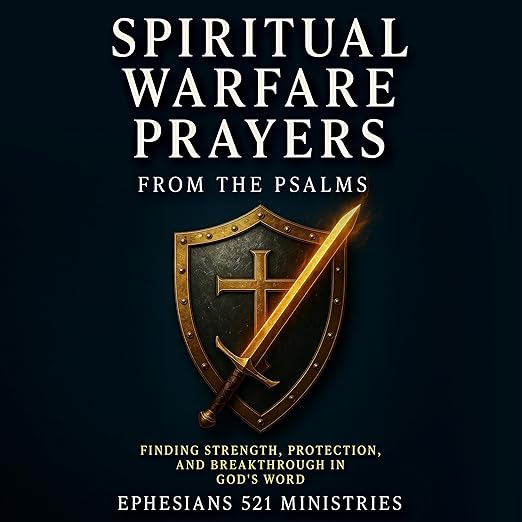
There are audiobooks you listen to once, and there are audiobooks you return to. Spiritual Warfare Prayers from the Psalms belongs firmly in the second category. At 58 minutes, this is not a long listen, it’s closer in format to a guided devotional session than a conventional book, but that brevity is structural rather than thin. This is content designed to be revisited in the morning, during difficult afternoons, or whenever the particular anxiety or spiritual heaviness it addresses resurfaces.
The book comes from Ephesians 521 Ministries, whose name references the Ephesians passage on spiritual armor, and the content is organized around the Psalms, David’s original prayers of protection, lament, and trust, reframed and extended as contemporary spiritual warfare prayers. Each entry pairs a selected Psalm with a heartfelt original prayer and a brief reflection designed to anchor the listener in what the text promises. It’s a format with long roots in Christian devotional tradition, and this version of it is tightly executed.
Our Take on Spiritual Warfare Prayers from the Psalms
What distinguishes this devotional from the broader category of anxiety-and-faith audiobooks is the specificity of its Psalms grounding. The Psalms are already the Bible’s most explicitly emotional text, they’re original cries of fear, abandonment, trust, and relief, addressed directly to God with a directness that later theological writing often softens. Using them as the foundation for spiritual warfare prayers means the content is drawing from material that already does what the prayers intend. One reviewer noted the connection between the “Spiritual Armor” metaphor and its deep roots in Isaiah, Wisdom of Solomon, Maccabees, and Ephesians, with specific Psalms mapped to each element, this is not surface-level devotional content but genuinely researched material.
The categories of need the book addresses, fear, stress, spiritual attack, discouragement, anxiety, relationships, healing, provision, are organized in a way that allows listeners to navigate directly to what they need rather than necessarily listening linearly. That’s a useful structural feature for a devotional intended for repeated use. A listener going through a specific health crisis can find the healing prayers directly. Someone processing relational conflict has a section for that.
Why Listen to Spiritual Warfare Prayers from the Psalms
Ryan Forkel’s narration is well-suited to this content. Prayer-based audio requires a particular quality, too flat and the content becomes clinical, too dramatic and it starts to feel performative rather than participatory. Forkel finds a middle register that is warm without being emotionally manipulative, and his pace gives the listener room to absorb and even silently respond to the prayers as they’re spoken. For a devotional intended as an active prayer companion rather than passive content, this matters considerably.
The reviews collected for this title are consistently personal and specific in a way that generic devotional reviews often aren’t. Multiple listeners describe reaching for this during specific difficult seasons, feeling spiritually overwhelmed, facing fear, navigating extended hardship, and finding the content functional rather than merely inspirational. One reviewer describes it as feeling like “a personal conversation with God,” which is exactly what the format is trying to accomplish. Another notes the comfort of each section reminding them they don’t face battles alone, which is the core theological promise of the Psalms themselves.
What to Watch For in Spiritual Warfare Prayers from the Psalms
At 58 minutes, a single complete listen covers the entire book. This is not a criticism, the format is appropriate for the content, but listeners accustomed to longer devotionals may want to use this as a supplement to deeper study rather than a standalone spiritual resource. The Imprescindibles format analogy isn’t quite right here, but the parallel holds: this delivers its ideas in concentrated form, and depth of engagement comes from the listener’s response to the content, not from extended reading time.
This is also explicitly Christian content rooted in evangelical Protestant devotional tradition. The framing, vocabulary, and theological assumptions are those of a listener who prays, takes Scripture as authoritative, and understands spiritual warfare as a genuine category of experience. Listeners from outside that tradition will find the content meaningful only if they share the underlying framework.
Who Should Listen to Spiritual Warfare Prayers from the Psalms
Christian listeners navigating difficult seasons, fear, anxiety, spiritual heaviness, extended hardship of any kind, will find this a compact and genuinely useful devotional companion. It works as a morning listen, a repeated daily resource, or a targeted tool during specific struggles. Listeners who want intellectually engaged devotional content rooted in the Psalms rather than generic encouragement will find the level of scriptural specificity satisfying. Those looking for secular mental health content or interfaith spirituality should look elsewhere.
Frequently Asked Questions
How is this devotional organized, and can I navigate directly to specific topics?
Yes. The prayers and reflections are organized by category of need, Protection, Provision, Healing, Forgiveness, Strength, Relationships, and Thanksgiving among them. This allows listeners to go directly to what their current situation requires rather than listening linearly every session.
Is Ryan Forkel’s narration appropriate for a listener who wants to pray along with the content?
Yes. Forkel’s pace and tone create space for active engagement rather than passive listening. His delivery is measured and unhurried, which allows a listener to absorb each prayer and respond internally without feeling rushed to the next section.
At 58 minutes, is this audiobook substantial enough to be useful, or does it feel incomplete?
The length is structural, this is a devotional format designed for repeated use, not a single sit-through experience. One complete listen covers the entire book. The value comes from returning to specific sections as circumstances require, which multiple reviewers confirm is how they’ve used it.
Does this audiobook require theological sophistication, or is it accessible to newer believers?
It’s explicitly accessible. The prayers draw directly from the Psalms with clear explanatory framing, and the reflections are written to guide rather than assume prior knowledge. Reviewers from varied backgrounds, including some who describe themselves as overwhelmed or new to structured prayer, report finding it easy to engage with.