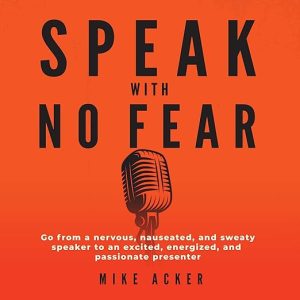
A book about public speaking, read aloud by the person who wrote it, is an audiobook that volunteers to be judged twice. Mike Acker has under three hours to persuade you that seven strategies will move you from nauseated to energized, and the same recording has to demonstrate, in his own voice, that those strategies worked on him. Very few instructional productions put the evidence and the argument in the same room. This one cannot avoid doing it, which is the most interesting thing about the edition.
Seven Strategies Promised, None of Them Named
Nobody needs persuading that the subject matters, and the description leans on it hard. Public speaking is called "the number one fear in America", and millions are said to dread a stage more than they dread dying. One written response opens on the old joke about preferring the casket to the eulogy. Another, from a hypnotherapist, describes the way speaking pulls in rejection, humiliation and ridicule at once. The subject needs no selling, which frees the book to go straight at method.
What the method is, precisely, the description declines to say. Seven strategies are promised twice and none of them is named. The reviewers fill some of the gap: imagining the worst outcome, focusing on a single one-to-one conversation while addressing a whole crowd, and a framing of where speaking anxiety comes from that one four-star response calls a helpful roadmap. Those are real techniques, and they are practical rather than clinical.
My honest read is that this is a short, warm, unembarrassed pep talk with a structure underneath it, and that it knows its own size. A recording this brief is not going to rebuild anybody, and the description does not claim otherwise. The language is about starting today, practicing, and watching the fear begin to fade. Managed expectations are rarer than good advice in this category, and this listing manages them well.
Acker Auditions His Own Advice Live
Self-narration is the first reason to choose audio over print here, and it is not a small one. A page can only assert that its author has overcome a fear of speaking. A recording lets you hear whether the assertion survives a long stretch of continuous talking, which is itself a public speaking task performed under exactly the conditions the book describes. You are not taking the claim on trust. You are auditing it, minute by minute, and print cannot offer that check at any price. Nothing else on this listing can be verified before you pay, and this one thing can, for free.
Timing is the second reason. Two hours and forty-nine minutes means somebody with a presentation next week can finish this before the rehearsal, and the material is built for exactly that use: strategies you can begin today, applied to a business presentation, a school speech or a toast at a friend's wedding. Urgency is the normal condition of this book's reader, and something you can complete in an evening meets it far better than a printed book you will start and abandon.
Five Reviews, but Only One Actual Rating
Something is wrong with the star rating on this page. The counter records a single rating and displays an average of 4.5, when a lone vote has only five possible values and not one of them carries a decimal. Somewhere between the tally and the written responses, the page is counting two different populations: five people have posted full paragraphs here while the counter insists that one person voted. Read the paragraphs. The number is not describing them.
Dates need a small correction of their own. One notice was filed three weeks before the recording appeared, which makes it evidence about the text and not about this edition. The distinction matters less here than it would elsewhere, since advice does not change between formats. Still, it is worth registering that the enthusiasm on this page was earned in print, by readers who chose the words over the man saying them.
This Typo Undercuts a Book About Polish
A typo in the description is worth a moment of your time. It says it can seem like everyone is "a gifted speak" when you watch TED talks, dropping half of the last word. Trivial in itself, and I would let it pass except that this is a book about polish and presentation, and the copy at the top of its own listing is the first place a buyer looks for evidence of either.
Series positioning is unclear as well. This is filed as the opening entry in something called No Fear, while the title itself carries no series marker of any kind, so a listener who finishes and wants the next one has nothing on this page to follow. Seven strategies at this length is a deliberately narrow scope, and a narrow book is usually the beginning of a sequence rather than the whole of one.
Something Scheduled and Already Being Dreaded
The natural buyer has something scheduled and is dreading it. A toast, a quarterly presentation, a class talk: the description names all three, and the book is sized to be finished before any of them arrives. Anybody who has quietly decided that some people are simply not the speaking type will find that assumption addressed head on, since one written response describes arriving with exactly that belief and leaving without it.
A listener who wants encouragement more than technique is equally well served. Two of the five responses praise the author's own experience of the fear ahead of any particular tool, and one calls the positivity itself the helpful part. Taken together they describe a book that works through reassurance and structure rather than through drills, and reassurance is a perfectly legitimate thing to buy when a date is approaching.
Anybody wanting a full curriculum should shop elsewhere, since the promise is seven strategies and a starting point rather than a course. So should anybody who needs drills and feedback, which no recording can supply. And go in knowing that the average on this page is not a real average. One voice, seven ideas and a great deal of goodwill in a single sitting: that is the offer, and for the right frightened listener it is a fair one.
At a Glance
- Read by: Mike Acker reads his own book, which turns the recording into a running sample of the skill it is selling.
- At its heart: Speaking anxiety, preparation routines, reframing an audience
- Vibe: Encouraging, brisk, unfussy
- Short version: A short, generous starting point for somebody with a date already in the diary, let down only by a rating counter that cannot be right.
Before You Listen
Does Mike Acker narrate this audiobook himself?
Yes. The author and reader credits carry the same name, which matters more than usual on a book about delivery. You get to hear whether somebody teaching people to speak can hold attention across a full recording, and that is the clearest single reason to choose this edition over the printed one.
How can the average be 4.5 when only one rating is counted?
It cannot, and no rounding argument rescues it: one person clicking a star produces a whole number and nothing else. So the tally and the average are not counting the same people. Five full written responses sit on the same page. Read those instead, and treat the headline figure as a display fault.
What are the seven strategies?
The description promises seven and names none of them. Reviewers mention a few in passing: imagining the worst outcome, treating a crowd as one conversation rather than many, and a framework for where speaking anxiety originates. Beyond those, the specifics stay behind the purchase, which is worth knowing before you commit.
Is this audiobook long enough to be useful?
It is deliberately short, and the scope matches. Nobody is promising a course, drills or feedback, and the copy is honest about that. The offer is a set of strategies you can start applying before a scheduled event, which is precisely the situation most buyers of a book like this find themselves in when they press play.