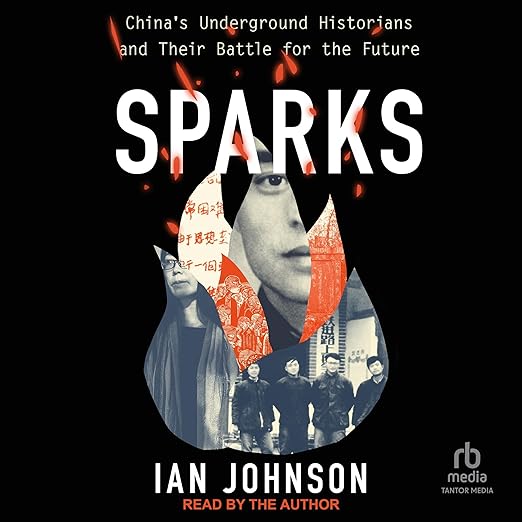
Quick Take
- Narration: Ian Johnson narrates his own work with the measured authority of a longtime Beijing correspondent. The prose lands with weight because he clearly lived alongside these stories.
- Themes: Historical memory and state suppression, digital samizdat resistance, the cost of speaking truth in authoritarian China
- Mood: Urgent and quietly defiant, like dispatches from a country fighting to remember itself
- Verdict: Essential reading for anyone who wants to understand what is actually at stake in Xi Jinping’s China beyond the headlines.
I started listening to Sparks on a Tuesday morning commute and found myself sitting in a parked car for twenty minutes after I arrived, unable to stop. Ian Johnson opens with a deceptively simple premise: that controlling the past is the central project of the Chinese Communist Party, and that a loose, dispersed network of writers, filmmakers, and digital archivists has begun quietly fighting back. By the time he gets to the first specific story – guerrilla footage smuggled out via encrypted apps, memoirs self-published and distributed before they can be scrubbed – it becomes clear this is not a book about abstractions. These are people risking their lives to document famine and purge and outbreak, and Johnson has spent years earning their trust.
The title comes from a 1960 underground journal, itself named after a quote attributed to Mao: a single spark can start a prairie fire. The irony that dissidents borrowed the chairman’s own metaphor to undermine his party’s historiography is exactly the kind of layered detail Johnson excels at. He has been the Beijing bureau chief for the New York Times, won a Pulitzer for his reporting on underground religious movements, and it shows. His analysis never loses sight of the human being at the center of each story.
The Battleground That Isn’t on Any Map
What Johnson does especially well is contextualize the CCP’s obsession with history within a longer Chinese tradition. Dynasties have always rewritten the record of their predecessors to justify their own legitimacy; Marxism gave that impulse an ideological scaffold; Xi Jinping has made it a signature policy. Johnson traces the intellectual and institutional architecture of this control with a precision that never tips into academic dryness. By the time he describes how Xi’s government has moved to systematically erase the Tiananmen generation from the internet and from textbooks, you understand exactly why the underground historians treat their work as existential.
The audio format suits this material particularly well. Johnson reads with a journalist’s economy, never lingering when the facts can speak for themselves. There is something appropriate about hearing his voice deliver accounts of people who circulate their own recordings to stay beneath official notice. The medium and the message briefly collapse into each other in a way that a professional narrator could not replicate.
The Faces Behind the Samizdat
The book’s greatest strength is its characters. Johnson profiles independent filmmakers documenting Xinjiang, elderly survivors who kept diaries through the Cultural Revolution and now scan them onto hard drives, and younger activists who never knew pre-digital censorship but have become expert at routing around it. He is careful to distinguish between reformist intellectuals who still work within party-adjacent institutions and those who have placed themselves entirely outside the system. The gradations matter, and he treats them with the seriousness they deserve.
One sequence that stayed with me involves a journalist who documented an ethnic clash in the mid-2000s. He kept the footage for years, not sure what to do with it, before eventually finding a channel through which to release it. Johnson neither romanticizes nor simplifies the decision. The cost of memory, he shows, is unevenly distributed. It falls heaviest on those with the least protection.
Where the Argument Gets Tested
The book’s final chapters turn to the question of what all this underground documentation is for. Johnson is cautiously optimistic: he argues that the breadth and persistence of this resistance suggests a China far more contested than the image of monolithic state control. He points to the role these archivists played in the early weeks of the COVID-19 outbreak, when citizen journalists posted footage and testimony that briefly broke through before being scrubbed. That episode alone makes the argument vivid in a way that no theoretical framing could.
Skeptics will note that the party has so far contained each of these sparks without serious political consequence. Johnson acknowledges this, though he frames the underground effort less as a movement toward immediate political change and more as an act of long-term preservation – keeping the ember alive until circumstances shift. Whether you find that persuasive will depend on your reading of Chinese political resilience, but it is an honest argument, not a wishful one.
Who Should Listen, Who Should Skip
Listen to this if you follow Chinese politics, have ever wanted to understand the human texture of life under Xi’s information controls, or found yourself frustrated by coverage that treats China as a monolith. Skip it if you are looking for a comprehensive political history of the PRC. This is focused, granular, and operates at the level of individuals rather than systems. That focus is its power and its limit in roughly equal measure.
Frequently Asked Questions
Is this the same Ian Johnson who wrote ‘The Souls of China’?
Yes. Johnson is the same Pulitzer-winning journalist. Sparks builds on his long-term reporting on underground civil society in China, and readers who appreciated The Souls of China will find familiar depth here, though the subject has shifted from religion to historical memory.
Does Johnson have direct access to the underground historians he profiles, or is this largely secondhand reporting?
Johnson is explicit that much of the book is based on years of direct contact with subjects in China. He conducted interviews, attended screenings of underground films, and read samizdat materials firsthand. Some sources remain anonymous for obvious reasons, but the research base is extensive and primary.
Does the audiobook cover the COVID-19 outbreak and the citizen journalists who documented Wuhan?
Yes. Johnson includes the early weeks of the COVID-19 outbreak as a case study of the underground documentation network in real time. He discusses how footage and testimony circulated through encrypted channels before being suppressed, framing it as both a tragedy and a proof of concept.
Is Sparks politically balanced, or does it take a clear position on CCP information control?
Johnson is a journalist rather than an advocate, and his analysis is grounded in documented evidence rather than polemic. The book does not pretend to neutrality on whether suppressing historical memory is harmful. He is critical of CCP information controls but approaches the subject through reporting rather than ideology.