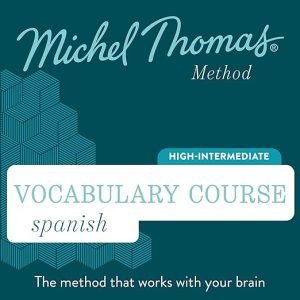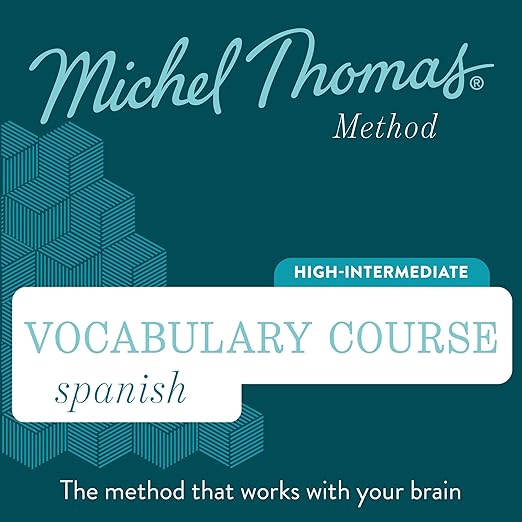
Spanish Vocabulary Course (Michel Thomas Method) is a different kind of audiobook from its predecessor in the Michel Thomas sequence. Where the Foundation course teaches grammar through reconstruction, the Vocabulary Course tackles what is arguably the harder problem for intermediate language learners: expanding word knowledge beyond the grammatical skeleton the earlier courses establish. This six-hour audiobook places Rose Lee Hayden, a certified Michel Thomas Method teacher, in the instructor role rather than Thomas himself, and over roughly twenty to twenty-five hours of active engagement, learners work through more than 1,000 carefully chosen Spanish words and phrases. It is a narrowly specialized tool, but for its intended audience at the fourth position in the recommended sequence, it fills a gap that most language programs handle poorly and inconsistently.
Hayden Unlocks Spanish You Already Half-Know
Thomas's central insight about vocabulary is embedded in his famous dictum: "What you understand, you know; and what you know, you don't forget." The Vocabulary Course implements that principle through what Hayden describes as "unlocking" words you already know. English and Spanish share a significant layer of Latinate vocabulary, and Hayden's approach systematically activates that shared knowledge, demonstrating how understanding a small set of transformational patterns allows a learner to derive hundreds of Spanish words from their existing English vocabulary rather than memorizing them individually. This is vocabulary learning as inference rather than accumulation, which is precisely what makes it feel distinct from any standard word-list approach.
The classroom format, two genuine students learning alongside the listener, continues from the Foundation and earlier intermediate courses. That format has a specific pedagogical function in the vocabulary context: hearing students apply the unlocking patterns incorrectly and then being corrected demonstrates the limits and conditions of each rule in ways that abstract explanation cannot replicate. The inclusion of "power words," verbs and everyday phrases chosen for maximum communicative utility rather than arbitrary alphabetical or frequency ordering, also reflects a deliberate curriculum decision rather than a simple word list padded out with rare vocabulary.
Fourth in Sequence, No Written Vocabulary Lists
The audiobook format is, as with all Michel Thomas Method courses, not just convenient but fundamental to the method's design philosophy. Hayden's course makes no concession to learners who want to consult written lists or pause and write down vocabulary because the method's philosophy explicitly opposes that approach as counterproductive. The accompanying PDF, available with the audiobook purchase, provides a written reference for review purposes, but the primary acquisition is intended to happen through listening and active verbal response. Learners who are uncomfortable with that approach will find the audio-only method more frustrating than helpful, and the design assumes you will be pausing the recording frequently to respond before Hayden provides the answer.
This course occupies the fourth position in the recommended Michel Thomas sequence, following Foundation, Language Builder, and Intermediate. It is not an entry point for beginners and makes no attempt to function as one. Hayden's instruction assumes that learners have already internalized the grammatical structure from the earlier courses and are specifically ready to expand their expressive range beyond the building-block sentences those courses establish. The sequencing is strict, and arriving at the Vocabulary Course without the earlier foundation means encountering Hayden's references to structures previously learned without having the referents in place.
A Narrow Purpose Explains the Low Rating
The very low rating this particular listing has received reflects, in part, a mismatch between the course's narrow purpose and broader listener expectations about what a language-learning audiobook should deliver. The Vocabulary Course is not a complete language learning solution and never claims to be. It is a supplement to a specific sequence, and learners who arrive at it out of order or expecting a comprehensive course will find it frustratingly incomplete and decontextualized. Within its intended position in the curriculum, though, it addresses the vocabulary bottleneck that many intermediate Spanish learners hit after acquiring grammatical structure but struggling to express a full range of ideas in actual conversation.
The production, dating to its original 2007 recording, has the same live-classroom sound as the rest of the Michel Thomas catalog: warm, slightly intimate, with the ambient texture of a real learning environment rather than a polished studio. Listeners accustomed to modern audiobook production standards will notice this. It is a feature as much as a limitation, since the unedited classroom atmosphere is part of what makes the method feel authentic, but the expectation gap between this and a conventional professionally produced audiobook is real and worth anticipating before purchase.
Grammatically Confident Learners Who Lack Vocabulary Range
Learners who have completed the earlier Michel Thomas Spanish courses and feel their grammatical confidence outpacing their vocabulary range are exactly the audience this audiobook addresses. The unlocking approach is particularly effective for English speakers who suspect they already know more Spanish-adjacent vocabulary than they can actively access in conversation, and Hayden's course gives that latent knowledge a systematic activation route that feels fundamentally different from rote memorization.
Complete beginners, and learners who have used other methods to build their Spanish rather than the Michel Thomas sequence, should approach this course with caution. The references to previously established structures and the assumed familiarity with the classroom format mean that arriving without the prior courses is likely to produce a disorienting rather than illuminating experience. The Insider's course, which follows this one in the recommended sequence, is the next step for learners who complete the Vocabulary Course and want to continue toward natural, confident fluency in Spanish.
A Few Questions About Spanish Vocabulary Course
Does Rose Lee Hayden follow the same classroom method as Michel Thomas himself in this audiobook?
Yes. Hayden is a certified Michel Thomas Method teacher and maintains the same live-student classroom format, the same no-memorization, no-writing philosophy, and the same pattern-based unlocking approach. The main difference from the Foundation course is that Thomas himself does not appear; Hayden leads the session throughout.
Is the accompanying PDF necessary to get full value from this audiobook course?
No. Like all Michel Thomas Method courses, the audio is the primary experience. The PDF is available as a reference tool for review but is not required during the active listening sessions. The method specifically discourages concurrent writing or note-taking, so the PDF serves a post-session review function rather than a parallel one.