Quick Take
- Narration: Dalton Lynne delivers the phrasal verb content cleanly, though at sixty-five minutes the session feels more like a focused reference drill than a course.
- Themes: Phrasal verbs, English-to-Spanish translation, conversational vocabulary
- Mood: Brisk and utilitarian, like a focused review session rather than a learning experience
- Verdict: A narrow but honest reference tool covering the 100 most common English phrasal verbs in Spanish, useful as supplementary material, thin as a standalone course.
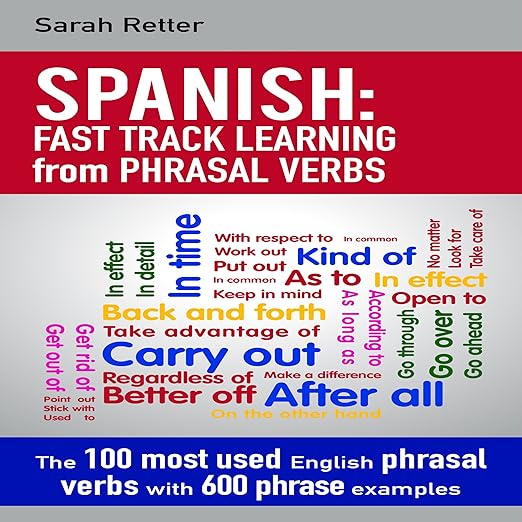
I want to start with what this product actually is, because the category label and runtime tell a more specific story than the title alone. At one hour and five minutes, Spanish: Verbs Fast Track Learning is not a Spanish course. It is not a grammar guide or a conversational method. It is a curated reference list: the 100 most frequently used English phrasal verbs, presented in Spanish translation, organized for efficient review. That is a genuinely narrow scope, and the product’s honesty about it, focus your energy on what matters most, is one of its more defensible qualities.
Phrasal verbs are a genuine pain point for language learners working in both directions. English speakers learning Spanish often struggle with how to express phrasal meanings like turn off, give up, or look after, which do not map cleanly to single Spanish verbs or direct translations. The approach here, ranking phrasal verbs algorithmically by frequency and presenting the Spanish equivalents in a no-complications format, addresses a real gap that standard grammar textbooks often handle poorly.
The Frequency-Ranked Approach
The synopsis is explicit about the methodology: an algorithm provides the ranking of the 100 most frequently used English phrasal verbs. This data-driven framing is interesting and, if the underlying frequency data is solid, genuinely useful. Learning the expressions you will encounter most often is demonstrably more efficient than working through a phrasal verb dictionary in alphabetical order. The question is whether the frequency analysis behind the ranking is rigorous or whether it is a marketing frame applied to a standard compilation.
Given the limited review data, seven ratings averaging 3.9, with the single available review being a strongly positive recommendation, I cannot evaluate the quality of the frequency analysis independently. What I can say is that the premise is sound and the format, stripped down and sequential, is appropriate for the kind of drilling this material requires. The reviewer who called it a must-have for anyone wanting to become more expressive in Spanish conversations was clearly in the target audience and found it delivered on its promise.
What Sixty-Five Minutes Can and Cannot Do
One hour and five minutes of phrasal verb content is a light audio experience, and the absence of review data makes it difficult to assess how the material is paced. At roughly 37 seconds per entry if distributed evenly across 100 verbs, there is not a great deal of room for context, example sentences, or the kind of repetition that aids retention. Either the examples are abbreviated, the pacing is faster than typical language learning content, or the runtime includes only the most essential coverage without extended practice.
Narrator Dalton Lynne reads the English-Spanish pairings cleanly, according to the available evidence, which is the appropriate skill set for this type of reference material. The narration of phrasal verb content requires clear diction and reliable pacing rather than the performance range needed for dialogue or narrative. That is a low bar, but it is the relevant one here.
The Companion Context You Need
This is supplementary material, not a primary resource. If you are working through a Spanish course and finding that phrasal verb expressions keep stopping you, this short audio reference could be a useful targeted supplement. The series designation, Spanish Learning for English Speakers, implies a collection of focused supplements rather than a complete program, which is the right way to position content of this scope. Each volume presumably addresses a specific problem area rather than the whole of Spanish language learning.
The 3.9 average rating, while based on only seven reviews, is the lowest in this batch, and the small sample makes it hard to know whether it reflects genuine quality concerns or simply a mismatch between listener expectations and product scope. There is no structural reason that a well-executed frequency-ranked phrasal verb audio reference should disappoint; the risk is more in whether the execution lives up to the framing.
Who Should Listen, Who Should Skip
This is specifically for intermediate Spanish learners who have a grammar foundation and conversational basics but struggle with English-derived phrasal verb expressions. It is also worth considering for advanced beginners approaching the stage where phrasal constructions start to appear. Skip it if you are a complete beginner, phrasal verbs require context that this level does not yet have, and skip it if you are looking for a comprehensive or immersive learning experience. This is a targeted tool, and it should be used as one.
Frequently Asked Questions
Does this course cover verb conjugation alongside the phrasal verb translations?
The synopsis focuses on phrasal verb translation rather than conjugation instruction. The emphasis is on expressing the meaning of English phrasal verbs in Spanish, not on systematic conjugation practice. For conjugation, you would need a separate resource.
Is this product part of a larger series, and do the volumes build on each other?
The series is titled Spanish Learning for English Speakers, suggesting a collection of focused supplement volumes rather than a sequential program. Each volume appears to address a specific aspect of Spanish rather than requiring the others as prerequisites.
What level of Spanish is this designed for?
Based on the content description, this is best suited for intermediate or advanced beginners who already have basic Spanish grammar and vocabulary. Complete beginners would likely struggle without context for how the phrasal verb equivalents function in sentences.
Why are there only seven ratings for this product?
The low review count likely reflects the narrow and specialized nature of the content. Phrasal verb reference material appeals to a specific niche of learners at a particular stage, rather than the broad beginner or travel-prep audience that drives high review counts for courses like Pimsleur or Spanish in 60 Days.