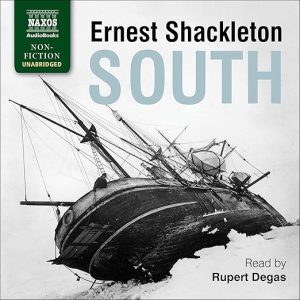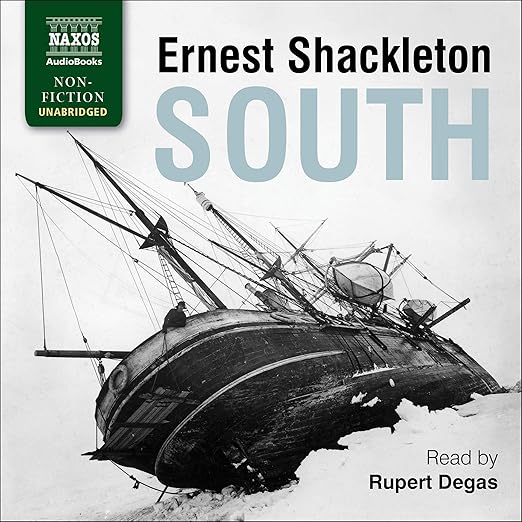
How did Ernest Shackleton's Endurance crew survive nearly two years trapped in Antarctic ice with no radio contact and no realistic hope of rescue? This audiobook is Shackleton's own answer, a firsthand account written by the commander who led all twenty-eight men home alive despite losing the ship itself.
Worsley Navigates Eight Hundred Miles by Sextant
The expedition set out on August 8, 1914, days after the outbreak of the First World War, aiming to complete the first land crossing of Antarctica from the Weddell Sea to Scott's old base at Cape Evans. The Endurance never got the chance; pack ice caught the ship, held it through months of uncontrolled drifting, and eventually crushed it, forcing the crew onto the ice itself and then into small boats bound for the relative safety of Elephant Island.
What separates this from the many later retellings of the same expedition is that it is not a retelling at all: this is Shackleton's own contemporaneous account, published under his own name, of decisions he made in real time with men's lives on the line. That firsthand quality gives the book an authority no secondary history can fully replicate, even when later scholarship adds context Shackleton himself could not have had.
Shackleton was not alone in commanding attention during the ordeal: Frank Worsley's navigation of a small lifeboat across roughly eight hundred miles of open Southern Ocean to reach South Georgia for help stands as its own remarkable feat within the larger story, and the book gives that harrowing boat journey real space rather than rushing past it to get to the rescue itself. That specific navigational achievement, plotting a course by sextant from a pitching, half-swamped boat with almost no margin for error, has since become one of the most studied feats in the entire history of maritime navigation, and Shackleton's own account of watching it unfold carries real tension even though readers already know the outcome. Elephant Island itself, barren and essentially uninhabited, gets its own careful attention too; Shackleton is honest about how thin the margin for survival was even after escaping the ice, since the island offered shelter but no real food security for the twenty-two men who stayed behind while the rescue boat went for help.
Degas Differentiates Two Dozen Men by Emphasis
Rupert Degas narrates with measured gravity, reading Shackleton's own considerable restraint accurately rather than importing a more emotionally demonstrative modern register that would feel false against the source material. Early twentieth-century British explorers tended toward understatement even when describing genuine horror, and Degas trusts that understatement to land on its own across the full fifteen hours and forty-eight minutes rather than pushing the drama for a contemporary audience.
Reviewer G.W. Meador, who says he has read other books on the Endurance expedition, calls this 'the best,' praising 'incredible stories of intestinal fortitude, survival against all odds and death' and adding that the men involved 'had no equal.' Coming from a reader with comparison points across the wider Shackleton literature, that is a meaningful endorsement, and it lines up with what a primary account offers that a secondary history generally cannot: the specific, unfiltered voice of the person who had to make the calls.
Shackleton's own narrative voice has to carry descriptions of roughly two dozen other men without the benefit of a full-cast production, and Degas differentiates the ship's captain, the photographer, the ship's surgeon, and the rest mostly through subtle shifts in emphasis rather than distinct voices, which keeps the focus correctly on Shackleton's own perspective and decision-making rather than turning the book into something it was never meant to be. Listeners who have heard other narrators handle similarly large historical casts will recognize the specific skill involved in keeping that many names straight without resorting to obvious vocal gimmicks to distinguish them.
Edwardian Restraint Only Looks Like Flatness
Reviewer Ed Barton offers a useful, balanced counterpoint worth taking seriously: the book 'sometimes moves briskly and competently while it also bogs down in spots with minutiae and disjointed writing.' That is a fair description of what a firsthand 1919 account actually reads like; Shackleton was an expedition leader writing after the fact, not a professional narrative stylist, and some stretches of navigational and logistical detail move more slowly than the survival drama that surrounds them.
The prose itself carries real Edwardian formality, long sentences, period vocabulary, an occasionally stiff narrative distance from the very real suffering being described. Modern listeners more used to contemporary survival-narrative pacing should expect an adjustment period in the early chapters before the account's cumulative power takes hold.
Readers expecting the kind of raw emotional processing common in contemporary survival memoirs should recalibrate: Shackleton describes genuinely life-threatening moments, capsized boats, collapsing ice, starvation, with the same measured, almost procedural tone he uses to describe routine ship's business. That flatness is not a failure of feeling; it reflects both the era's narrative conventions and Shackleton's own temperament as a leader who could not afford to let his men see him rattled, and the book is more moving, not less, once a listener adjusts to reading the restraint itself as meaningful. Once that adjustment happens, moments Shackleton describes almost in passing, a near-miss with a collapsing ice floe, a supply run gone wrong, land with considerably more weight than their brief, understated treatment on the page would initially suggest.
Business Schools Get the Doubt Case Studies Cut
Readers of adventure and exploration history who want the primary source rather than another popular retelling are the ideal audience, along with anyone drawn to leadership case studies; few real historical episodes offer a cleaner test case for decision-making under sustained, escalating crisis than this one. History teachers looking for a primary source to assign alongside a broader unit on early twentieth-century exploration will find it equally well suited to classroom use.
Corporate leadership and management audiences, a group that has long treated Shackleton's expedition as a case study in crisis leadership, will find the primary source considerably richer than the condensed leadership-book versions of this story that circulate in business contexts, since Shackleton's own account includes the doubt, the improvisation, and the incomplete information business case studies tend to smooth over in hindsight. Business schools and leadership seminars that already assign condensed excerpts would do their students a real service by pointing them toward Shackleton's full, unfiltered account instead.
Listeners new to polar exploration who want a faster-paced, more narratively shaped introduction might be better served starting with a modern secondary account before tackling Shackleton's own denser, more procedural version of events.
Is the South audiobook Ernest Shackleton's own firsthand account, or a modern retelling?
It is Shackleton's own contemporaneous account, published under his own name, not a later historian's secondary retelling of the Endurance expedition.
How long is the South audiobook?
It runs 15 hours and 48 minutes, covering the full expedition from departure through the eventual rescue of all twenty-eight men.
Does Rupert Degas's narration modernize Shackleton's Edwardian prose style?
No. Degas reads with period-accurate restraint rather than importing a more emotionally demonstrative modern register, which keeps the account feeling authentic to its 1919 origins.
Is this audiobook a good starting point for someone completely new to polar exploration history?
It can work, but listeners wanting a faster-paced, more narratively shaped introduction may prefer a modern secondary account first before tackling Shackleton's denser primary source.