Quick Take
- Narration: Michael Prichard delivers a clean authoritative performance appropriate for military history, with steady pacing and clear differentiation between operational overview and individual medal citations.
- Themes: WWII South Pacific operations, Australian military contribution, the politics of American-dominated historical memory
- Mood: Comprehensive and methodical, reference-grade history that rewards careful listening rather than passive absorption
- Verdict: The most complete single-volume treatment of South Pacific WWII operations available in audio, with the specific added value of restoring the Australian contribution to a record where it has been systematically understated.
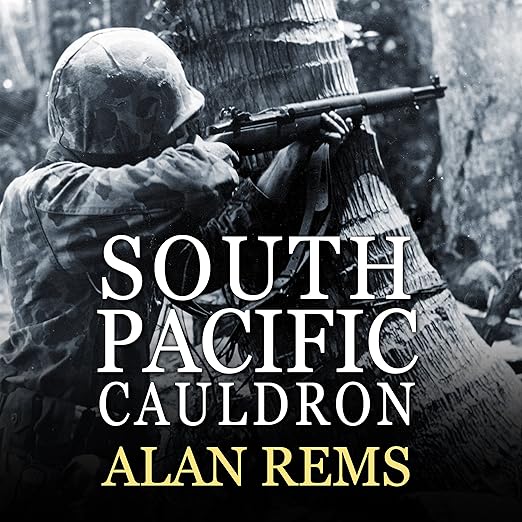
I came to South Pacific Cauldron from a direction that probably mirrors how many listeners find it: I had been working through the standard American accounts of the Pacific War and kept noticing a structural absence. The Australian campaigns, including the fighting in New Guinea, the Kokoda Track, and the broader Southwest Pacific Area under MacArthur’s command, appeared as supporting material, context for the American narrative rather than as equal parts of the same theater. Alan Rems’s book fixes that, and fixes it comprehensively, at just under eleven hours.
The claim to be the first complete history embracing all land, sea, and air operations in the Pacific War is ambitious, and the book’s scope backs it up. Rems covers the operations that most accounts treat as peripheral or omit entirely: the New Guinea campaigns that lasted years rather than the famous island-hopping operations that form the popular image of the war’s last phase; the air war over the Coral Sea and the Solomons; the naval engagements that aren’t Midway or Leyte Gulf but that were equally decisive in keeping supply lines open or closed. The result is a military history that feels genuinely complete in a way that narrower accounts don’t.
Restoring the Australian Record
The book’s most important contribution, and the one most relevant to listeners coming from Australian history rather than Pacific War history, is its treatment of the Australian military contribution. As Rems notes, drawing on the official Australian history of World War II, Australia’s part in the Pacific war is barely mentioned in American histories. This is not accidental. The organizational structure of the Southwest Pacific Area under MacArthur prioritized American operational control and American historical credit in ways that shaped both the conduct of the war and how it was subsequently written about. Rems presents this as a historical fact to be corrected rather than a grievance to be pursued, but the correction is real and thorough. The role of General Thomas Blamey, the Australian commander whose forces bore a disproportionate share of the land fighting, receives the treatment a division-grade history should have given it decades earlier.
The Commanders Rems Assembles
MacArthur and Halsey dominate the command structure of the book as they dominated the actual campaign, and Rems captures both their genuine capabilities and their significant personal flaws without either hagiography or hatchet work. MacArthur’s strategic vision alongside his relentless subordination of the Australian contribution to his own narrative; Halsey’s audacity alongside his periodic lapses of judgment in fleet operations: both figures emerge as fully human in the way that good military biography requires. The individual soldiers and sailors whose medal citations Rems uses to populate the ground-level account serve as an effective counterweight to the command narrative, giving the operational history a human scale without turning into individual biography.
Michael Prichard and the Military History Register
Prichard is a narrator with extensive experience in military and political history, and it shows throughout. He manages the shift between operational overview and individual medal citation smoothly, handles the geography of the Southwest Pacific Area without apparent confusion, and paces the narrative in a way that keeps eleven hours from feeling like a slog. One reviewer specifically noted that the book “brings everything to life and as you read you feel like your in the middle of all the heavy fighting,” which is what good military history narration achieves, and Prichard delivers it consistently here.
The mild criticism that Rems tried to cover too much, that Guadalcanal gets one chapter where other books give it a volume, is not wrong, but it measures this book against the wrong standard. Rems isn’t writing the definitive history of Guadalcanal or the Kokoda Track. He’s writing the definitive overview of the whole theater, and at that level of ambition, some thinning of individual campaigns is the necessary cost of comprehensiveness. For listeners who want to go deeper on specific operations after finishing South Pacific Cauldron, the bibliography points in useful directions. This is the audiobook version of a reference work that should have existed earlier, and for anyone serious about the Pacific War, it’s the place to start.
A practical note for Australian listeners specifically: this book gives context that most American Pacific War histories do not, and it situates Australian military history within the broader strategic picture in a way that national accounts necessarily struggle to do. Reading it alongside a dedicated account of the Kokoda Track or the New Guinea campaign produces a significantly richer understanding than either alone. Rems gives you the theater; the national historians give you the ground. Together they make the scale of what was happening in the South Pacific between 1942 and 1945 genuinely comprehensible, and the Australian listener who has read Kokoda accounts without the strategic frame will find South Pacific Cauldron recontextualizes everything they thought they understood about those campaigns.
Frequently Asked Questions
Does South Pacific Cauldron cover the Kokoda Track campaign specifically?
Yes, though as one operation within a broader theater overview rather than as a dedicated extended treatment. The Kokoda Track receives proportional attention relative to the book’s comprehensive scope, more than most American Pacific histories give it, but less than a book devoted specifically to New Guinea operations would. Listeners wanting a full account of Kokoda specifically should also seek out dedicated works on that campaign.
Is this suitable for listeners who are not familiar with WWII Pacific operations?
The book assumes some basic familiarity with the war’s context, including the attack on Pearl Harbor, the fall of Singapore, and the broad outlines of the Pacific theater. It doesn’t assume specialist operational knowledge, and Rems explains the strategic context for each campaign, but listeners coming in completely fresh to WWII may find the density of operational detail demanding. A brief general overview of the Pacific War first would improve the experience significantly.
How does Rems handle the MacArthur-Australian command relationship?
With historical care and without whitewashing. He documents MacArthur’s organizational control of the Southwest Pacific Area and the ways that control shaped both the conduct of operations and the subsequent historical record. MacArthur’s relationship with Blamey and the Australian command is treated as a genuinely important factor in understanding why the Australian contribution was underrepresented in American histories.
Are the medal citation accounts accurate to the historical record?
Rems uses the Congressional Medal of Honor, Victoria Cross, and other decoration citations as ground-level accounts drawn from the official historical record. At least one reviewer noted the inclusion of extra information from sources not commonly referenced in popular histories, which suggests Rems went beyond the standard sources in at least some cases. The citations themselves represent documented acts recognized at the time of the war.