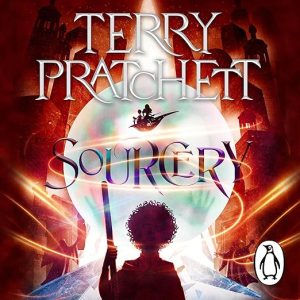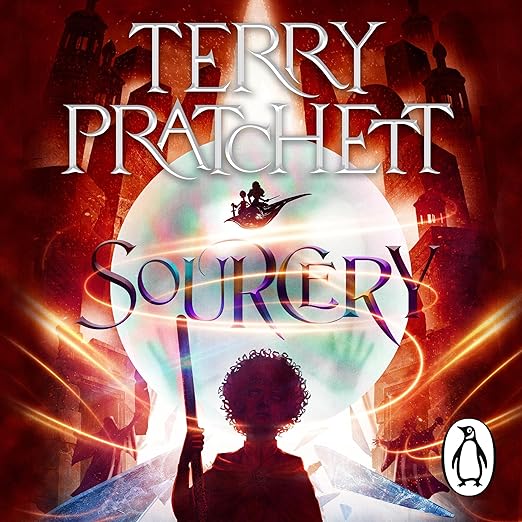
Terry Pratchett's Sourcery is the fifth Discworld novel and the third entry in the Wizards sub-series, and the 2022 Penguin Audio production is one of the more carefully considered audiobooks the Discworld catalogue has received. Colin Morgan narrates; Bill Nighy reads the footnotes; Peter Serafinowicz voices Death. That lineup is not incidental to the experience. Pratchett's footnotes are an essential part of his prose architecture, not decorative asides, and the decision to cast them separately transforms what could be a cumbersome structural feature into one of the production's genuine pleasures. The series has passed one million audiobooks sold, and listening to this production it is easy to understand why the format has caught on so thoroughly.
Context is useful for new listeners. The Discworld premise, an enormous flat world carried on the backs of four elephants standing on the back of a great turtle swimming through space, has by this fifth novel developed enough internal geography and mythology to reward prior familiarity, though Pratchett designed the series so that individual volumes are accessible without previous knowledge. Sourcery functions as a self-contained story. What it requires is a tolerance for comedy that operates on multiple registers simultaneously: slapstick, philosophical, satirical, and occasionally genuinely moving. The three-part cast is the production's way of acknowledging that Pratchett's text is itself operating in multiple registers, and that no single voice was equipped to carry all of them alone.
Our Take on Sourcery
The premise of Sourcery drives to one of the more structurally interesting questions the Discworld series had raised to this point: what happens when magic itself becomes corrupted by unlimited power? The sourcerer Coin, an eighth son of an eighth son, arrives at Unseen University and begins dismantling the careful, institutionalized mediocrity that Pratchett had spent four novels establishing as the Disc's magical establishment. The comedy in those sequences is inseparable from the dread. Pratchett is genuinely funny about apocalyptic scenarios in a way that few writers manage, because his humor comes from precise observation of how people and institutions actually behave when facing dissolution rather than from jokes inserted alongside a serious narrative as relief.
Colin Morgan's narration is excellent throughout. He plays Rincewind, the returning cowardly wizard, with exactly the right quality: not quite a coward, more a pragmatist with an unusually accurate assessment of risk. Morgan does not caricature him. The performance is warm and slightly bewildered in the way the character requires, and he handles the large supporting cast, including Coin himself and the deeply sinister Ipslore the Red, without the character distinctions becoming cartoonish. This is a harder thing to achieve than it looks in a novel with this many named speaking parts.
Why Listen to Sourcery
The full-cast element separates this Penguin production from earlier Discworld audio adaptations in ways that matter structurally. Nighy's footnote readings are the detail that most rewards careful listening. Pratchett's footnotes are often where the most genuinely subversive thinking in the book resides, the places where he steps out of the narrative to make a philosophical observation or deliver a joke at the expense of the genre conventions the story is otherwise inhabiting. Nighy delivers them with a quality of dry, slightly conspiratorial amusement that is exactly right. Serafinowicz as Death is similarly well-cast. Death in the Discworld is not a horror character but a philosophical presence with a particular manner of speaking, and Serafinowicz calibrates the gravity and the gentle absurdity of that voice with evident understanding of what Pratchett intended the character to carry thematically.
The original theme composed by James Hannigan also signals that this production is treating Pratchett's world with genuine respect. The production design communicates that someone has thought seriously about what these books should sound like rather than simply hiring a capable narrator and recording the text in a quiet room. That care is audible throughout the nine hours.
What to Watch For in Sourcery
One reviewer described this as the answer to the question of how Pratchett could top Mort's disc-threatening events, and that framing is accurate. Sourcery goes larger in terms of apocalyptic scope than its predecessors. The middle section, in which Rincewind sets off on an essentially impossible mission while the sourcerer's transformation of Unseen University accelerates, requires listeners to hold competing narrative threads simultaneously. The comedy never disappears, but the stakes are higher here than in the earlier Wizards novels, and the emotional weight of the ending catches some listeners by surprise in the best possible way.
The novel was first published in 1988, and the production notes flag that some elements of the Discworld universe may reflect this. Pratchett's satire is capacious and mostly ages well, but the specific institutional targets of some passages require a slight historical recalibration for contemporary listeners. This is a very minor issue and does not affect the narrative's emotional or comedic force. Listeners coming to Pratchett for the first time through this production may find the satire refreshingly specific in ways that contemporary fantasy comedy rarely attempts.
Who Should Listen to Sourcery
Essential for existing Discworld readers who have not yet encountered this production. The full-cast format is a genuine upgrade over single-narrator versions of the same text, and the Nighy-Serafinowicz additions alone make it worth seeking out even for listeners who have read the book multiple times. For new listeners, Sourcery is a workable entry point, though the Wizards arc benefits from starting with The Colour of Magic and The Light Fantastic for full character context. Anyone who finds that comedy and genuine philosophical seriousness are not natural antagonists will find Pratchett generally, and this audiobook specifically, an unusually satisfying combination of both impulses operating at once.
A Few Questions About Sourcery
How central are Bill Nighy's footnote readings to the Sourcery audiobook experience?
Very central. Pratchett's footnotes carry some of the best philosophical humor in the novel, and Nighy's delivery makes them a production highlight rather than a structural interruption.
Does the Sourcery audiobook work for listeners who don't typically enjoy fantasy?
Yes, provided they are open to comedy as a primary mode. The fantasy setting is largely a vehicle for satire of institutions, human nature, and power. Genre commitment is not required.