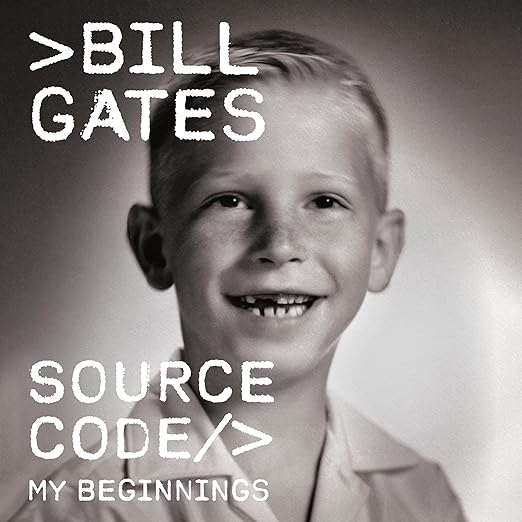
- Narration: Wil Wheaton brings warmth and playfulness to Gates's boyhood sections, capturing the precocious teenager without condescension.
- Themes: Intellectual obsession, the accident of historical timing, childhood as the blueprint for adult ambition
- Mood: Nostalgic and intimate, more personal than the tech-giant story you expect
- Verdict: Gates proves a more candid and emotionally perceptive narrator of his own early years than his public persona would suggest, and Wheaton's performance matches the book's surprising humanity.
I went into Source Code expecting the standard Silicon Valley origin story, the kind of memoir that functions as a brand document dressed up in childhood anecdotes. What I found instead was something disarmingly candid. Gates begins not with computers but with his grandmother, his parents, his first friendships, and the particular texture of a 1950s and 60s Seattle childhood that no longer exists. I was halfway through my morning commute when I realized I had stopped thinking about Microsoft entirely.
The book is explicitly scoped to the years before the founding of what would become Microsoft, ending with the start-up Micro-Soft as a deliberately chosen endpoint. Gates is promising two more volumes, which means this one is freed from the obligation to explain the empire and can simply explore the formation of the person. That is a more interesting project than most tech memoirs allow themselves.
A Closer Look at Source Code
What the reviews from listeners consistently emphasize, and what my own experience confirmed, is Gates's ability to differentiate the voices of his various younger selves. The seven-year-old who gets called a precocious brat by his own mother, the socially insecure and rebellious teenager, the cocky but secretly uncertain college student: each phase is rendered with specific detail rather than retrospective smoothing. One reviewer described it as watching a well-known black-and-white sketch filled in and painted in vivid color, and that captures something true about the effect. Gates is willing to describe failure, social difficulty, and genuine uncertainty in ways that the public narrative about his success has always obscured. The section covering the sudden death of his best friend is handled with more emotional directness than readers expecting a business memoir will be prepared for, and it lands hard precisely because the book has earned its intimacy by that point.
Wil Wheaton is a genuinely interesting casting choice. He brings a register of nerd-adjacent self-awareness that suits a memoir about a child who never quite fit the social expectations of his environment. His performance in the teenage sections has the right level of energy without tipping into caricature, and he modulates between arrogance and vulnerability in a way that single-register narrators rarely manage. At just under twelve hours, the audiobook is the right length for this scope of story. The midnight escapades at university computer labs, when Gates and his friends were teenagers essentially breaking into facilities to get computing time, are told with the kind of sensory detail that suggests genuine memory rather than reconstructed narrative, and Wheaton's delivery of those sections has the right conspiratorial energy.
Things to Know Before Starting Source Code
This is volume one of a planned trilogy, so the book ends with the founding of Micro-Soft rather than the full Microsoft story. Listeners who are listening for the competitive tactics, antitrust battles, or philanthropic pivot will need to wait for subsequent volumes. What is here is the human context for everything that followed, and it is richer than expected. Listeners should also note that Gates writes about the Harvard years with more self-awareness about his own arrogance than is commonly attributed to him, which changes the texture of the narrative in ways that resist the hagiographic reading some listeners will bring in. The book is also one of the more honest accounts of what intellectual loneliness actually feels like in adolescence, which gives it an unexpectedly broad emotional resonance.
Who Bill Gates Is Writing For
Anyone interested in how intellectual identity forms in childhood will find this rewarding regardless of their interest in technology. Listeners who want a conventional business biography of Microsoft's rise should look elsewhere for now. The book is particularly well suited to parents interested in what an exceptionally driven childhood actually looks like from the inside, stripped of retrospective mythology. Listeners who have enjoyed Walter Isaacson's approach to subject biography but wanted something with more of the subject's own voice will respond well here.
Good to Know
Does Source Code cover the founding and rise of Microsoft?
No. The book is scoped to Gates's childhood and early years, ending with the founding of Micro-Soft as a start-up. It is the first volume of a planned trilogy, and the Microsoft growth story will be covered in later volumes.
Why was Wil Wheaton chosen to narrate, and does it work?
Wheaton is an actor with a well-known passion for technology and gaming culture, which makes him a thematically fitting choice. His performance is broadly praised for capturing the different registers of Gates's younger selves without flattening them into a single tone.
How candid is Gates about his personal struggles and failures in the book?
More candid than expected. He addresses social difficulties, grief over a close friend's death, and the gap between his public confidence and private uncertainty during his Harvard years. Multiple reviewers noted this as a surprise.