- Voice: Twenty hours of comic timing in one reader's hands, plus a scene that plays after the credits have run.
- Big ideas: Fantasy economics, undead marketing, second chances for washed-up heroes
- Atmosphere: Boisterous, satirical and darker than the jokes let on
- Worth it?: A middle volume that improves on the first, and a poor place to start the trilogy.
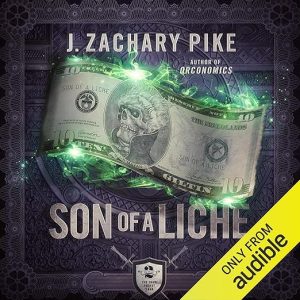
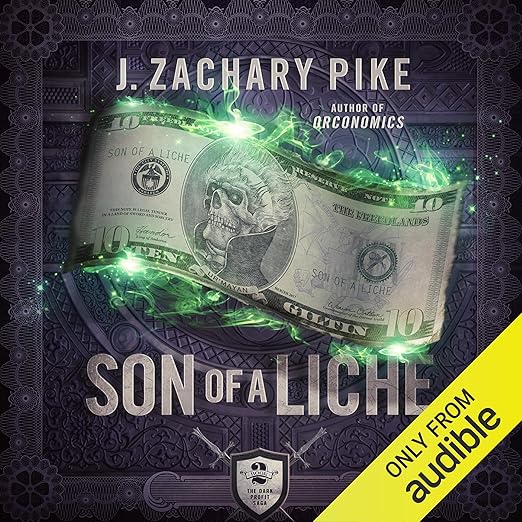
What does a liche want with a marketing department? In J. Zachary Pike's second Dark Profit novel the undead have gone to market, and the villain besieging the city is first encountered pitching frightened citizens on the merits of the undead lifestyle at the head of a corpse army. This audiobook runs twenty hours and ten minutes and it is squarely a sequel: Gorm Ingerson, a doubly disgraced dwarven hero, is still bruised from a quest that ended with his band accidentally betraying the orcs they were supposed to be helping. The joke Pike keeps making is that heroism and business share a vocabulary, so the plot moves by pitch, scheme and hostile takeover rather than by prophecy.
What J. Zachary Pike Delivers
Gorm and his misfit band are trying to make amends when an old enemy arrives at the gates, and the harebrained scheme they hatch to save the city lands them on the king's kill list, which leaves the novel running two pursuits at once. What lifts it above the parody it could easily have been is that the finance material is load-bearing rather than decorative. The description advertises a blend of finance and high fantasy, and one buyer describes the previous novel as a satire in the Pratchett tradition aimed squarely at economics. Another, independently, calls this what Terry Pratchett would write if he played D&D and poked fun at the GFC. Two of five readers reached for the same name without coordinating, which is about as clear a genre signal as a review pool ever produces.
Satire needs a target, and the target here is not the fantasy genre. The liche is run as a sales operation: high-pressure tactics on frightened customers, an army of pushers, a lifestyle marketed to people who never asked for it. Gorm's counter-move uses the identical vocabulary, since he has to craft a pitch of his own to raise troops, which turns the climax into a contest between two campaigns rather than two armies. The description closes by promising imaginative takes on tired tropes, and the trope taken apart here is the dark lord, recast as a firm. Even the tagline is in on it, calling a second attempt at redemption a grave mistake.
What J. Zachary Pike Gets Right
Comic fantasy usually costs you either the joke or the stakes, and the only four-star account explains why this one keeps both. Pike weaves humor into a legitimately dark plot, the character development is strong, and the ending opens the next book without leaving anybody dangling. A corpse army run like a sales organization is funny for about a chapter; keeping it funny across twenty hours while people are genuinely dying takes a writer who means both halves of it. That, more than the worldbuilding, is what I would buy this for.
Middle volumes of trilogies are usually where a series sags, and four of the five accounts here describe the opposite happening. One calls the book better than the first outright. Another lists what returns and expands: worldbuilding, characters, clever writing, and the relationships between people we already know. A third simply reports laughing, crying and losing bladder control, which is a review format rather than an argument but does communicate enthusiasm efficiently. One account describes an epic woven from multiple threads, building on characters introduced in the first book toward a climactic finish, which is a structural compliment rather than an enthusiastic one and carries more weight for it. Another says the setting feels familiar and is presented in a way that is not, which is the whole trick of comic fantasy stated in a single sentence. The pool is small, but every part of it points the same way.
Where J. Zachary Pike Loses Some Ground
Start with the number, because it cannot be correct. The page shows a 4.6 average against a rating count of one. A single vote can only be a whole number of stars, so 4.6 cannot come from one rating, and the count also sits below the five written responses displayed underneath it. Something in the ratings pipeline on this listing is plainly broken, and a buyer scanning quickly would take that 4.6 for a genuine consensus. Ignore the average altogether and read the five accounts, which are the only reliable evidence the page carries.
Stay to the end, and then keep going. One account mentions a hidden scene after the credits. On the page that is simply a leaf you turn; in audio it is a track that plays after you have mentally finished a twenty-hour book, which makes it exactly the sort of thing a listener stops before reaching. If you want the hooks into book three, do not let the player move on when the story appears to have closed.
The pool also has a soft spot. The longest of the five responses spends most of its length praising the previous novel rather than this one, and opens by disclosing that the writer receives review copies. That is honest, and it is also worth factoring in. Of five written accounts, one is largely about the predecessor and one is three sentences of comic hyperbole, which leaves three engaging closely with this book. That is a thin base for a commitment this size, and it makes the four-star account, the most measured of the set, the one to weigh hardest.
Who Should Pick Up Son of a Liche
Read Orconomics first. Every account here treats this as a continuation, one reports the story picking up about a year after the first novel ended, and the description itself frames the book as the second of a trilogy. Given that, the series suits readers who enjoy fantasy that takes its own tropes apart, who like satire aimed at institutions rather than at individuals, and who have the time to give a comic novel that also intends to be an epic. The description's own shorthand is accurate enough: rib-tickling shenanigans and second-rate heroes.
Broad comedy in fantasy irritates plenty of readers, and the tone here starts at snake-oil salesman and grows no more restrained, so that is the first thing to test yourself against. A self-contained story is not on offer either, because the ending is built as a bridge, generously rather than cruelly, but a bridge nonetheless. Twenty hours of comedy puts the timing of every joke in one reader's hands, which is a larger bet than the same length of straight epic fantasy would ever ask you to make.