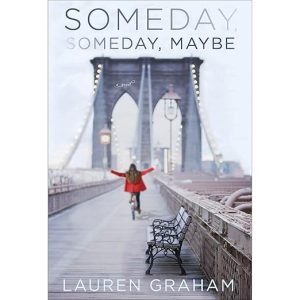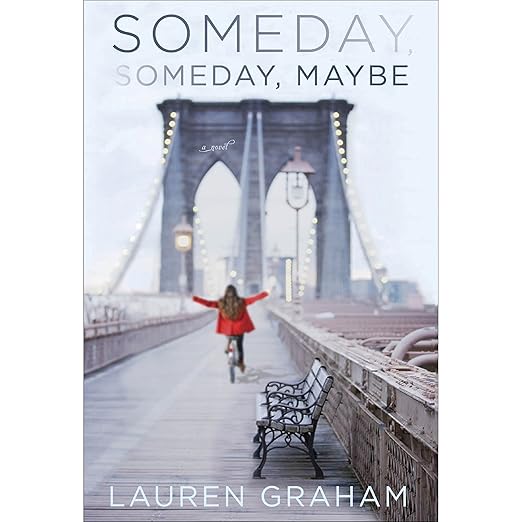
I listened to Someday, Someday, Maybe on a Sunday morning when I was feeling the particular anxiety of someone who has set a deadline for themselves and is watching it approach. That turned out to be exactly the right mood for it. Lauren Graham's Franny Banks has given herself three years to make it as an actress in New York City, and with six months left on that deadline she has an ugly Christmas sweater commercial and a waitressing job to show for her efforts. The specific humiliation of that gap between where Franny thought she would be and where she is might be the most honest thing about the novel.
What surprised me was how good the writing actually is. Graham has a comedian's instinct for timing on the page as much as on stage, and Franny's voice is warm without being saccharine, funny without being performative. The 1995 setting is handled with the restraint of someone who was actually there and does not need to over-explain it. The Filofax entries that punctuate the narrative, the datebook pages with Franny's scheduling anxiety rendered in her own handwriting, are a structural choice that could easily have felt cute and instead feel genuinely revealing. Reviewers have been consistent in noting that Graham can actually write, and they are right to be relieved and right to be surprised, given how rarely the transition from performer to novelist produces work this confident.
How Someday, Someday, Maybe Holds Up
The novel's central anxiety is about timing: when do you know that hope has curdled into denial, and how do you stay in a pursuit that requires you to believe in yourself past the point where belief looks reasonable? Franny does not have a clean answer to this, and Graham does not provide one. The showcase that anchors the final third of the book is presented as a genuine possibility rather than a guaranteed resolution, and the romantic subplot with James Franklin, the most successful actor in her class who has inexplicably started paying attention to her, is handled with the same ambivalence. Things may work out. Things may not. That refusal to pre-resolve is what separates the novel from its lighter genre neighbors.
Lauren Graham narrating her own debut novel is the obvious audio advantage, and it is a real one. Her timing on the funnier passages is calibrated precisely, and her investment in Franny's particular combination of hope and self-doubt is audible throughout. This is not a narrator performing an author's creation; this is an author inside her own work, and the difference is significant. Several reviewers who approached the book with skepticism about whether Graham could actually write found themselves converted, and the narration is part of what makes that conversion possible. Hearing the prose in Graham's voice makes its rhythm undeniable in a way that might be more resistible on the page.
Why Someday, Someday, Maybe Works as an Audiobook
The 1995 setting is not nostalgic decoration but a structural element of the story. There are no smartphones, no social media metrics to validate or dismiss you, no immediate access to the industry's opinion of your work. Franny's anxiety exists in a longer time signature than contemporary ambition anxiety would allow. She has to wait for callbacks that may never come, show up to auditions without knowing what the audition is really for, and maintain her belief in herself with very little external reinforcement. That isolation is specific to a particular era, and Graham uses it to make Franny's persistence feel genuinely hard rather than easily narrativized.
The roommate dynamic, between Franny, her best friend Jane, and the aspiring sci-fi writer Dan, gives the novel its warmth without making it comfortable. These are people who support each other and also know each other well enough to see each other's failures clearly. The supportive-but-honest quality of the friendship, particularly between Franny and Jane, is more accurately observed than most literary treatments of female friendship in fiction about ambition.
Weak Spots in Someday, Someday, Maybe
The novel is slight in the best sense: it does not try to carry more weight than its premise warrants, and it is better for that restraint. But readers looking for the kind of structural complexity that gives literary fiction its depth will find this comfortable rather than demanding. The romantic subplot is warm but not surprising. The industry satire is gentle rather than sharp. These are not failures, but they are limitations that are worth knowing about before you start.
One reviewer described the book as fun and lightish but not fluffy or dumbed down, and that is probably the most accurate description of what it is doing. It sits in a middle register between literary ambition and genre comfort, and it inhabits that register with confidence. Whether that middle register is where you want to spend eight hours is the central question.
Should You Listen to Someday, Someday, Maybe?
Listeners who want a funny, specific, warmly observed novel about ambition and timing in 1990s New York will find this one of the more satisfying examples of the genre. The self-narration makes the audio format strongly preferable to the print version. Gilmore Girls fans will find the sensibility familiar without feeling like a reprise. Skip it if you need literary complexity or structural ambition, or if the comedy-of-aspiration genre is one that generally leaves you cold. At eight hours, it is exactly the right length for what it is trying to do.
Key Details
- Voice: Lauren Graham narrates her own novel and the advantage is significant; her timing, warmth, and obvious investment in Franny Banks gives the character an authenticity no other narrator could match.
- Big ideas: the self-imposed deadline as motivator and tormentor, the cost of ambition in a city that does not particularly care about your goals, the difference between hope and delusion
- Atmosphere: Warm and funny, with genuine melancholy underneath the 1990s nostalgia
- Worth it?: A debut novel that earns its charm through a specific protagonist in a specific time and place, made considerably better by the author's self-narration.
Does Lauren Graham's narration of her own novel significantly improve the listening experience over reading the book?
Yes, in a way that matters. Graham's comic timing is precise, and her investment in Franny Banks is audible throughout. Several reviewers who were skeptical about whether she could write found the narration part of what converted them. The prose rhythm is considerably more apparent when Graham reads it herself.
Is Someday, Someday, Maybe primarily for Gilmore Girls fans, or does it stand independently?
It stands independently. The novel's sensibility, its warmth, timing, and the specific texture of Franny's voice, will be recognizable to Gilmore Girls fans, but the story is its own thing. Graham is not reproducing Lorelai Gilmore; she is creating a different character in a different situation. Fans of the show have an easy entry point, but the novel does not require that context.
How explicitly is the 1995 setting used, and does the period nostalgia become a crutch?
The setting is structural rather than decorative. The absence of smartphones and social media creates a specific kind of ambition anxiety that is different from contemporary equivalents, and Graham uses that difference to give Franny's persistence its particular texture. The nostalgia is present but does not overwhelm the story.