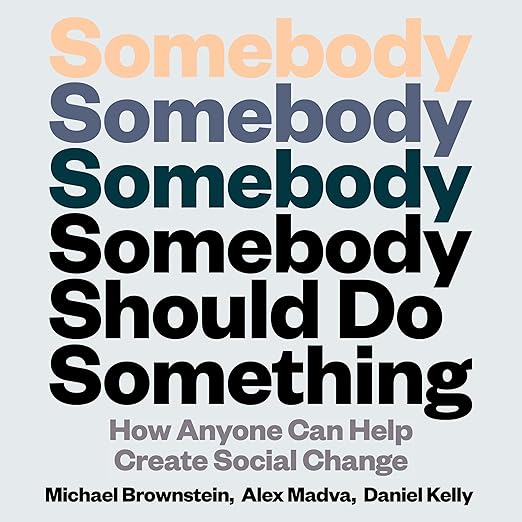
Quick Take
- Narration: John Keating reads with steady authority and just enough warmth to keep the academic material from feeling like a lecture. Well-matched to the book’s conversational yet rigorous tone.
- Themes: Individual agency versus structural change, collective action, social psychology of moral responsibility
- Mood: Thoughtful and galvanizing without being preachy, the rare social science book that ends with more energy than it started
- Verdict: One of the more intellectually satisfying listens in the current wave of social change literature, built on actual science rather than inspirational platitudes.
I picked this one up at a moment when I had been doing a lot of reading about collective action and finding most of it either too theoretical to be useful or too anecdotal to be convincing. Somebody Should Do Something arrived at exactly the right time, which I recognize is something you could say about a lot of books right now, but the claim is more accurate here than it usually is. Brownstein, Madva, and Kelly are philosophers and cognitive scientists, and their book does something uncommon: it uses actual behavioral science to make a case about how social change happens, rather than relying on the usual roster of inspirational stories held together by loose reasoning.
The central argument is specific enough to be worth explaining. The authors reject what they call either/or thinking, the false choice between making better personal choices and changing systemic structures. Their point is that this framing has paralyzed a lot of well-meaning people, and that the most effective individual actions are not the ones that reduce your carbon footprint or donate to the right causes, but the ones that connect you to collective efforts. Chris Smalls organizing Amazon workers is the example they return to most often, and it works because it is concrete: one person’s decision that became a structural intervention.
Our Take on Somebody Should Do Something
The book is organized in three movements, and the structure genuinely supports the argument rather than just packaging it. The first part dissects why the either/or framing developed and why it persists. The second introduces what the authors call a new picture of human nature, drawn from social psychology, cognitive science, and behavioral economics. This section is the intellectual center of the book, and it is dense in the best way, the kind of material that forces you to slow down and think. The third part applies this framework to real cases, with climate change and racial injustice receiving the most sustained attention. Reviewers praised the balance of stories and science, and one specifically noted finishing the book with a better understanding of the moment we are in, which is a precise description of what the authors are trying to achieve.
Why Listen to Somebody Should Do Something
The audiobook format serves this book well because Keating’s narration keeps the pacing from becoming too textbook-like. The authors write with what they describe as some jokes, and Keating handles the lighter passages without over-emphasizing them. The conversational quality of the writing, which draws on philosopher Bill McKibben’s line about how one important thing an individual can do is be somewhat less of an individual, is preserved in audio. That phrase alone captures the book’s spirit: not self-abnegation, but a redirection of individual energy toward collective ends. It is a genuinely different argument from the usual calls for personal virtue, and hearing it delivered at a measured pace helps the logic settle.
What to Watch For in Somebody Should Do Something
The book is not a how-to manual, as the authors explicitly state, and some listeners may find that frustrating. If you come to it expecting a step-by-step guide to becoming an effective activist, the theoretical depth of the middle section may feel like delay. The payoff is real, the final section does apply the framework to concrete situations, but readers who prefer prescriptive nonfiction will need patience. The book also leans heavily on examples from the progressive tradition of social movements, which is probably inseparable from the subject matter but worth knowing in advance. The analysis is academic in origin even when the prose is accessible.
Who Should Listen to Somebody Should Do Something
This is for readers who have found themselves genuinely uncertain about whether individual action matters in the face of structural problems, a very common position right now, and one the authors take seriously rather than dismissing. It is also a strong choice for anyone who works in policy, organizing, or institutional settings and wants a more rigorous vocabulary for thinking about change. Skip it if you are looking for emotional reassurance rather than analytical clarity; this book will challenge your assumptions more than it will soothe you, though the net effect is energizing rather than dispiriting.
Frequently Asked Questions
Is Somebody Should Do Something specifically about US politics, or does it address structural change more broadly?
It addresses structural change broadly, drawing on examples from labor organizing, the history of civil rights, public health campaigns, and climate policy. The US context is prominent because the authors are American academics writing for an American audience, but the framework they develop is designed to apply across democratic societies.
How accessible is the social science content for non-academic listeners?
Quite accessible. The authors are careful to introduce concepts from behavioral economics and social psychology through stories before formalizing them. One reviewer described it as stories and critical thinking blended together, which is accurate, the empirical material is present but never buried under jargon.
The synopsis mentions Chris Smalls and Amazon unionization as a central example. Is the book primarily about labor organizing?
No. The Smalls example is used to illustrate the broader principle about how individual decisions can become collective interventions. The book covers climate change and racial injustice in comparable depth, and the framework is meant to apply across issue areas.
Does John Keating’s narration handle both the theoretical passages and the personal stories well?
Yes. Keating has a composed reading style that works for the academic material without becoming flat during the narrative sections. He is not a dramatic narrator, but the book does not need drama, it needs clarity, which he delivers consistently.