Quick Take
- Narration: Charles Constant keeps a steady, well-paced delivery that suits the investigative tone, clear and unhurried, which is the right call for material this dense with historical reference.
- Themes: Freemasonry and American founding mythology, symbol and conspiracy, history versus legend
- Mood: Curious and methodical, with the pleasure of having myths examined rather than either confirmed or dismissed
- Verdict: Christopher Hodapp does the genuinely useful work of separating documented Masonic influence on the American founding from the conspiracy-inflated version, and the audiobook format makes that tour of Washington surprisingly companionable.
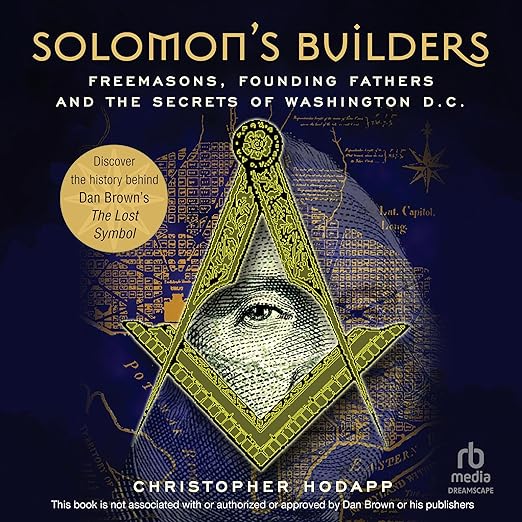
I picked up Solomon’s Builders on a weekend when I was planning a work trip to Washington, D.C., thinking it would be a useful companion for walking the city’s public spaces with fresh eyes. What I got was something more genuinely rigorous than I expected, and something considerably less sensationalist than the subject matter usually produces. It was published partly in anticipation of Dan Brown’s The Lost Symbol, and you can feel that defensive posture throughout, in the best possible way.
Christopher Hodapp is himself a Freemason, which shapes the book’s argument from the first pages. He is not an outside observer evaluating the fraternity with detached skepticism, nor is he a breathless expositor of hidden codes. He is someone who knows the organization from the inside and is frustrated by the mythologized version that conspiracy literature has built around it. That frustration produces a better book, more specific, more willing to say what the evidence actually shows rather than what would make a satisfying story for readers who came looking for secrets.
Separating the Documented from the Decorated
The core project of Solomon’s Builders is a kind of archaeological patience: going through the specific claims that circulate about Masonic influence on Washington D.C.’s design and on the founding of the United States, and sorting them into categories of documented fact, plausible inference, and outright invention. Reviewers praise this approach consistently, with one noting that Hodapp fairly and accurately discusses the history of Freemasonry in America and does a good job breaking down many misconceptions, both pro and anti-Masonic.
The documented connections are genuinely interesting on their own terms. George Washington, Benjamin Franklin, and a substantial number of the founders were active Masons. Lodge ceremonies, principles of fraternal governance, and Masonic symbolism did inform some aspects of how these men thought about civic organization. That is a real historical argument worth making carefully. The problem is that this real history has been inflated into a unified secret-society conspiracy, and Hodapp’s particular contribution is showing, patiently and specifically, where the inflation happens and why the inflated version does not hold up to scrutiny.
The Da Vinci Code Problem
The book was partly timed to anticipate Dan Brown’s The Lost Symbol, which took the Masons and Washington D.C. as its setting and subject. Hodapp was, by his own account, trying to put accurate information into the public sphere before the novel’s fictional version of Masonic history took root in popular understanding. That context matters because it shapes the book’s defensive posture in places, Hodapp is arguing against a version of events that had not yet been published when he wrote the original, which gives the book an interesting preemptive quality.
Charles Constant’s narration navigates the dual purpose well. When Hodapp is being historical, Constant sounds like a reliable guide. When Hodapp is being polemical, and he is occasionally polemical against both the conspiracy theorists and the Masons who overclaim their own importance, Constant maintains a tone that is measured without being bloodless. One reviewer describes the book as very readable, which translates in audio to consistently listenable across nine hours.
Washington D.C. as the Real Subject
The Masonic tour of Washington is where the book is most immediately useful. The sections on the National Mall, the Capitol, the George Washington Masonic Memorial in Alexandria, the layout of the streets, this is material that rewards an active listener walking through the city rather than a passive one commuting past unfamiliar territory. I found myself looking up several specific sites Hodapp mentions, which is the mark of a book that produces curiosity rather than just transmitting information. Another reviewer specifically recommends it for anyone planning to spend time in the D.C. area, and that recommendation holds.
The nine hours and twelve minutes feel appropriately sized for a book that needs to cover both the full history of Masonry in the American context and the architectural tour of D.C. It is not a short listen, but it does not repeat itself, and the organization by topic rather than chronology makes individual sections useful as reference points even after a single full listen.
The sections dealing with specific symbols, the pentagrams in the street layout, the Masonic connections to national monuments, the architecture of the Capitol, are where the book is most likely to frustrate impatient listeners. Hodapp is methodical in a way that requires you to follow each claim through its evidence before moving to the next. That patience is the book’s epistemic virtue, but it is also the reason some listeners will find themselves wishing he would simply state the conclusion and move on rather than walking through the full evidentiary record. For listeners who find that kind of careful reasoning satisfying rather than tedious, those sections are the best parts of the nine hours.
Best Suited For, and Worth Skipping If
Listen if you are curious about the actual historical relationship between Freemasonry and the American founding, if you are planning a visit to Washington D.C. and want a deeper reading of the city’s symbolic landscape, or if you have read The Lost Symbol and want to know where the fiction diverges from the documented record. Skip if you are looking for genuine conspiracy revelation, Hodapp is systematically dismantling that genre, not contributing to it. Also skip if you need narrative momentum rather than historical explication; this is careful, patient nonfiction, not a thriller-paced work.
Frequently Asked Questions
Is Christopher Hodapp himself a Freemason, and does that bias the book?
Yes, Hodapp is a Mason, and he is transparent about that throughout. His insider perspective gives him access to accurate institutional detail that outside observers often get wrong, but it also means his defensive posture against anti-Masonic conspiracy theories is real. Readers wanting a genuinely neutral evaluation should read this alongside a more skeptical account.
How much of the book is a literal tour of Washington D.C., versus historical narrative?
The two are woven together. Hodapp uses specific sites, monuments, buildings, street layouts, as anchors for historical explanation. If you are planning a visit to D.C., the audiobook functions well as advance preparation. If you are not, the architectural sections are still engaging because Hodapp explains why the sites matter rather than simply describing them.
Does the book engage with The Lost Symbol or other Dan Brown Masonic content?
Solomon’s Builders was written partly in anticipation of The Lost Symbol’s release, so it addresses the broader mythologized version of Masonic history that Brown’s novel drew on. It does not engage with the novel directly since the book predates it, but it systematically addresses the historical claims underlying that fictional version.
Is the audiobook appropriate for listeners with no prior knowledge of Freemasonry?
Yes. Hodapp writes for a general audience and explains fraternal terminology and ritual context as he goes. Multiple reviewers describe the writing as easy to follow and accessible without prior knowledge of the organization’s history or practices.